The Translation Industry in 2026: Navigating Uncertainty and Change
The translation industry in 2026 is marked by AI-driven change and market shifts. As traditional services face pricing pressures, human translators remain vital in specialized fields like legal and medical translation.


Where the Translation Industry Stands in 2026
The translation industry has always been dynamic, shaped by technology, economic shifts, and evolving client expectations.
In 2026, two forces dominate: artificial intelligence (AI) and a market that has stopped growing the way it used to.
As a long-time observer and participant in this industry, I have seen firsthand how these forces are redefining the role of translators, the business landscape, and the overall perception of language services.
Uncertainty Grips the Market
A Market Growing Slowly and Cautiously
Research firms spent 2024 and 2025 revising their forecasts downward. CSA Research recorded a 4.5% drop in industry revenue for 2023, and Nimdzi has since cut its growth outlook twice.
Nimdzi's 2026 report puts the market at a standstill compared with the pre-AI years:
"The language industry reached an estimated USD 72.6 billion in 2025 and is projected to grow to USD 73.4 billion in 2026."Source: Nimdzi, The 2026 Nimdzi 100, 2026
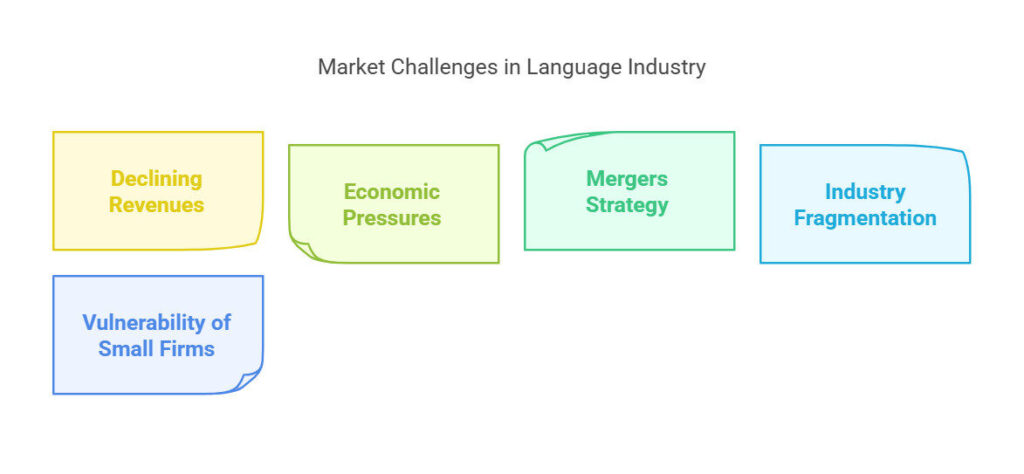
Economic uncertainty, geopolitical tensions, and the rise of AI-powered translation tools have collectively contributed to a market that feels like it is holding its breath.
Independent professionals, in particular, have voiced concerns about pricing pressures, unsustainable wages, and an increasing shift toward post-editing machine translation (MTPE).
The demand for traditional human translation is diminishing, making it difficult for freelancers and small language service providers (LSPs) to maintain profitability.
These pressures are not just anecdotal. A 2024 survey by the UK Society of Authors, later cited by CNN, put numbers on them. It drew 787 responses from authors, translators and illustrators, so the translator subset is small, but the direction is clear. The Bookseller reported the findings under the headline "A third of translators report losing work to generative AI systems."
"A quarter of illustrators (26%) and over a third of translators (36%) have already lost work due to generative AI. Over a third of illustrators (37%) and over 4 in 10 translators (43%) say the income from their work has decreased in value because of generative AI."Source: European Writers' Council, "SoA Survey UK: A third of translators and quarter of illustrators losing work to AI", reporting the Society of Authors survey, 2024
Those figures describe the same shift independent professionals report anecdotally: AI has moved from an occasional tool to a default part of the workflow, and its effect on rates and volume is being felt across the sector.
Mergers and Acquisitions: A Strategy for Survival
Despite the general slowdown, large LSPs are using mergers and acquisitions (M&A) as a growth strategy.
The language industry remains highly fragmented. Nimdzi's 2026 ranking shows how far that goes:
"The industry remains highly fragmented, with the top 100 making up 19.8% of the total industry size in 2025."Source: Nimdzi, The 2026 Nimdzi 100, 2026
Fragmentation has made smaller firms vulnerable, leading to a wave of consolidations as businesses seek to scale operations, reduce costs, and improve competitiveness.
The AI Disruption: Opportunity or Existential Threat?
The Rapid Integration of AI
AI is no longer a future consideration. It is here, actively transforming the translation industry.
Machine translation has been around for decades, but generative AI models have dramatically improved fluency, making them a viable alternative for many businesses. No reliable industry-wide figure exists for the share of professional translations that now involve AI, but few LSPs or freelancers work without it.
For LSPs and translators alike, AI is both a catalyst for innovation and a source of disruption.
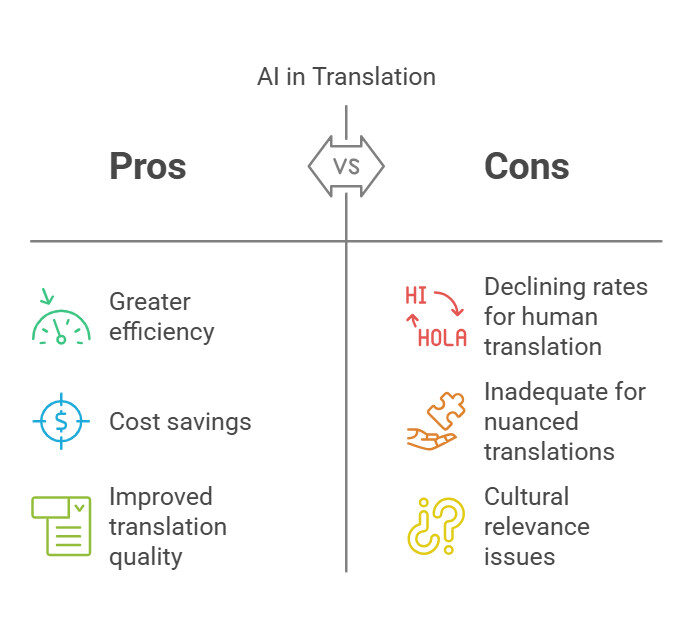
On one hand, it allows for greater efficiency and cost savings.
On the other, it has led to declining rates for human translation, particularly for general content where AI-generated translations are increasingly accepted as "good enough."
The Role of Human Expertise
Despite AI's growing dominance, human translators remain indispensable in areas requiring nuanced language skills, cultural adaptation, and subject-matter expertise.
Legal, medical, and literary translations still demand human oversight to ensure accuracy and compliance. Nimdzi reaches the same conclusion in its 2026 report: the total automation of the linguist has not materialized, and human review remains the safeguard against liability, harm to end users, and reputational damage.
Additionally, many businesses are realizing that while AI can produce passable translations, it often fails to capture the tone, emotion, and cultural relevance necessary for high-quality communication.
That pressure has not yet shown up as an industry-wide collapse in translation jobs. Official figures cited by the New York Times show that employment in translation and interpretation in the EU has kept climbing over the past decade, even as individual freelancers report real anxiety over entry-level work and falling rates.
The headcount numbers and the on-the-ground reports are not contradictory. The mix and pricing of translation work is changing faster than the total number of people doing it.
Market Fragmentation and Specialization
The Shift Toward High-Value Services
With traditional translation services under pricing pressure, many professionals are pivoting toward specialized fields such as legal, medical, and technical translation.
Specialization commands higher rates and provides greater job security in an industry increasingly commoditized by AI. Nimdzi notes that experienced specialists who audit, edit for culture, and manage complex AI workflows are commanding higher premiums, while those left with basic post-editing face downward pricing pressure.
Additionally, language professionals are expanding their services beyond translation.
Many are embracing roles as linguistic consultants, localization strategists, and AI post-editors, providing value that goes beyond simple text conversion.
Regulatory Pressures and Certification Growth
Another notable trend is the growing emphasis on compliance and certification.
ISO 17100 (translation quality) and ISO 27001 (information security) are increasingly requested as clients demand higher levels of accountability and data protection. Nimdzi reports that providers are securing multiple ISO and cybersecurity certifications to win risk-averse buyers in banking, audit, and healthcare.
With AI's growing presence, companies are under increasing pressure to ensure ethical and secure language solutions.
Future Industry Pathways and Next Steps
The translation industry stands at a crossroads.
The industry's future hinges on how well professionals and organizations adapt to rapid change.
Several potential scenarios could unfold:
- The AI-Human Hybrid Model Becomes Standard: AI continues to improve, but human translators remain important for refining output, ensuring quality, and handling complex tasks.
- Hyper-Specialization Becomes the Norm: General translation services become fully automated, forcing professionals to develop niche expertise to stay relevant.
- Regulations Shape the Industry: Governments introduce stricter regulations on AI in translation, requiring human oversight in critical domains.
- A Market Correction Restores Pricing Power: As businesses recognize AI's limitations, the demand for high-quality human translation rebounds, leading to better compensation for professionals.
Through 2026 and beyond, the key to success lies in adaptability, continuous learning, and strategic positioning.
For language professionals, this means embracing technology rather than fearing it, refining expertise in specialized domains, and proactively seeking opportunities in emerging areas of demand.
If you're a translator, LSP owner, or industry stakeholder, the planning you do this year will shape your position for the next five.
As change accelerates, the future belongs to those who innovate. How are you adapting? Which strategies will define your success in this AI-driven era?
Let's discuss and shape the future of our industry together.