


Sworn Translation for Courts and Public Authorities
A sworn translation differs from a standard one in a specific, legally significant way: the translator has taken an oath or formal affirmation before a recognized authority, making them personally accountable for the accuracy of the document. That accountability is what courts, embassies, and government agencies actually require.
Without it, your translation may be rejected at the first point of contact.
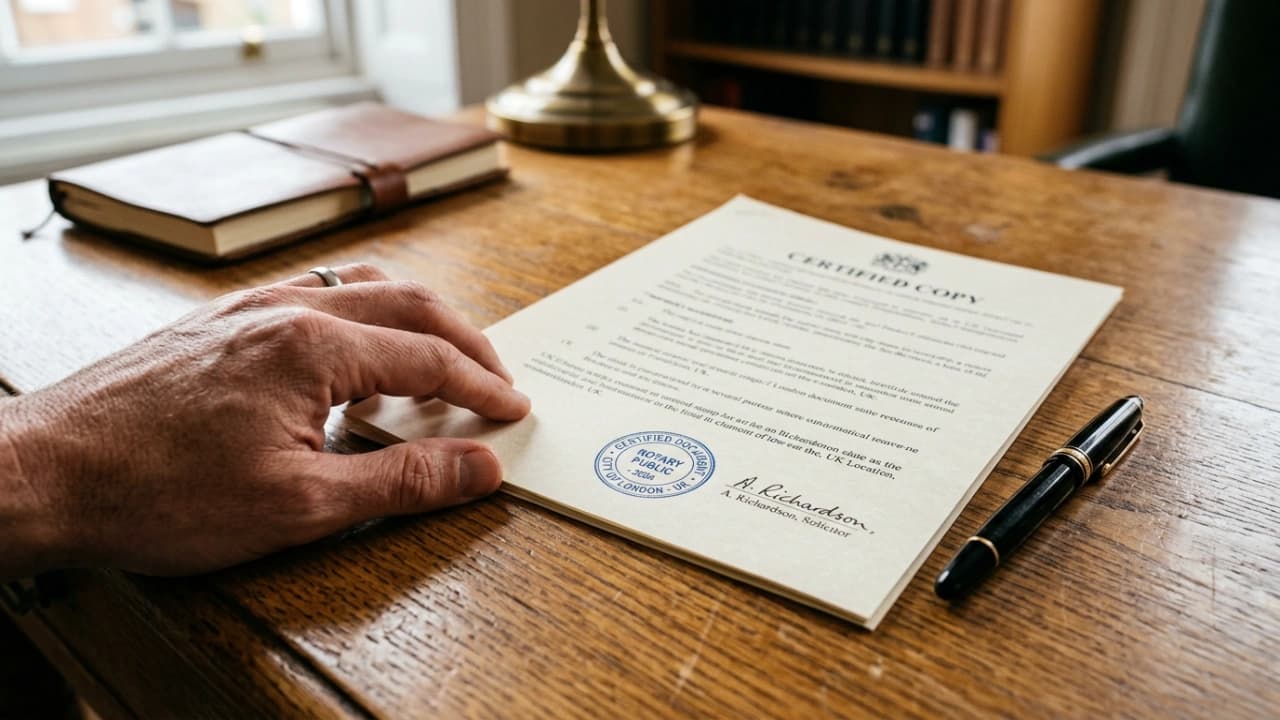
Sworn Translation Services Across European Jurisdictions
Legal Documents
Contracts, court orders, deeds, wills, and powers of attorney for use in foreign legal systems or international proceedings. Certified for submission to courts, legal authorities, and regulatory bodies.
Learn moreOfficial Government Documents
Birth certificates, marriage certificates, divorce decrees, educational transcripts, and diplomas for official use abroad. Required for immigration, visa, residency, and citizenship applications.
Learn morePersonal Identity Documents
Passports, national ID cards, driver's licenses, and medical records requiring certification for official or international purposes such as relocation, insurance, and legal proceedings.
Learn moreAcademic Transcripts and Diplomas
University transcripts, academic diplomas, and professional qualifications certified for foreign university applications, NARIC assessments, and professional licensing bodies.
Learn moreBusiness and Corporate Documents
Articles of incorporation, company statutes, board resolutions, shareholder agreements, and commercial contracts certified for cross-border business operations and legal proceedings.
Learn moreElectronic Certification
Digital certified translations with electronic signatures for jurisdictions that accept them. Delivered securely by email with a signed statement of accuracy and translator credentials.
Learn more
Digital Certified Translations, Delivered by Email
Many jurisdictions now accept certified translations signed electronically. We deliver these as PDF files signed with a qualified electronic signature (eIDAS in the EU, equivalents in the US, UK, and Canada), accompanied by a signed statement of accuracy and the translator's full credentials.
How electronic certification works
Electronic certification removes the wait for a physical seal and a courier. The same PDF can be submitted to courts, embassies, immigration offices, and university registrars in jurisdictions that recognize digital signatures, subject to each authority's rules.
We confirm the format the receiving authority asks for before delivery, and we keep a sealed paper copy on file in case it's needed later.
- Faster delivery can be arranged case by case once translation is complete
- eIDAS-qualified signatures for EU-bound submissions; US-recognized digital signatures for filings to USCIS and federal courts
- Optional notarization stack: digital signature plus a notarized affidavit when the receiving authority requires both
- Signed statement of accuracy and translator credentials embedded in every certified PDF
Not sure if the receiving authority accepts electronic certification? Tell us where the document is going and we will confirm before quoting.

What 'Sworn' Looks Like in Each Jurisdiction
The legal title and the appointing authority differ by country. We work with translators who hold the right credential for the country your document is destined for.
France
TitleTraducteur Assermenté
Appointed by a Cour d'Appel and listed on the Cour de Cassation national register. Required for documents submitted to French courts, prefectures, and most government authorities.
Germany
TitleBeeidigter / Vereidigter Übersetzer
Court interpreting and sworn translation are governed separately. Since 2023 the Gerichtsdolmetschergesetz sets one national oath for court interpreters, renewed every five years, while sworn translators are still appointed by each federal state and listed in the justice database the states run together.
Belgium (Dutch-Speaking)
TitleBeëdigd Vertaler
Entered in Belgium's single federal register of sworn translators and interpreters, held by the FPS Justice. Dutch-language work covers the courts of Flanders and the Dutch-language courts of Brussels.


Spain
TitleTraductor Jurado
Authorized by the Spanish Ministry of Foreign Affairs (MAEC). Required for documents submitted to Spanish courts, the Spanish administration, and consulates abroad. The translator's seal carries unique MAEC registration number.
Italy
TitleTraduttore Giurato / Traduzione Asseverata
Translation sworn before a court tribunal (asseverazione). Translator personally signs the oath in front of a court clerk. Required for legal proceedings, immigration filings, and academic recognition.
Netherlands
TitleBeëdigd Vertaler
Listed in the Rbtv register under the Wet beëdigde tolken en vertalers. The courts, the Public Prosecution Service, the police, the Royal Marechaussee and the IND must use registered linguists in criminal and immigration matters, with written reasons for any exception.


Show 9 moreShow fewer
Belgium (French-Speaking)
TitleTraducteur Juré
The same federal register, worked into and out of French for the courts of Wallonia and the French-language courts of Brussels. Belgium has one national register, not one per language community: what changes is the language of proceedings. Sworn translators hold an official identity card and apply a legal seal to each translation.
Switzerland
TitleTraducteur-Juré / Beglaubigte Übersetzung
There is no federal sworn-translator register. Requirements are set canton by canton: Geneva and Vaud recognize official traducteurs-jurés, while German-speaking cantons more commonly require the translator's declaration to be notarized. The apostille is issued by the cantonal chancellery.
Hong Kong
TitleNo sworn-translator regime
No licensing regime for translators, and a system separate from mainland China. A certified translation is a statutory declaration before a Commissioner for Oaths or a notary, and court documents are certified by the Judiciary’s Court Language Section.
India
TitleNo sworn-translator regime
India has no national register of sworn translators. Notaries and court-approved panels are the usual route, and the requirements differ between High Courts and between receiving authorities.
Check what the receiving court or authority requires before commissioning work.



Brazil
TitleTradutor Público Juramentado
Appointed by Brazilian state Junta Comercial. Required for any document presented to Brazilian public administration, courts, or notary registries (cartórios).
Portugal
TitleTradutor Certificado
Certification via Portuguese notary or Cámara de Comercio. Portugal recognizes both Portuguese-certified translations and translations sworn in other EU member states.
United States
TitleCertified Translation
No sworn translators in the European sense. USCIS (8 CFR 103.2(b)(3)) requires a full English translation certified by the translator as complete and accurate, and courts set their own standards, which vary by jurisdiction.
United Kingdom
TitleCertified Translation
The UK uses a self-certification model. A CIOL (Chartered Institute of Linguists) or ITI (Institute of Translation and Interpreting) member signs a Certificate of Accuracy. Prepared for UK Visas and Immigration, the Home Office, and UK courts.
Canada
TitleCertified Translator (CTTIC member associations)
Province-by-province certification (OTTIAQ in Quebec, ATIO in Ontario, STIBC in BC, etc.). Translator's seal for filings with Canadian courts, IRCC, and provincial bodies.





When You Need an Apostille on Top of the Translation
An Apostille is a separate legalization step required when a public document is being used in another country that signed the 1961 Hague Convention. Under Article 5 of the Convention it certifies the authenticity of the signature, the capacity in which the signatory acted, and where relevant the identity of the seal or stamp.
What an Apostille does and does not cover
What an Apostille does not do is validate the content of the document. It says the signature is genuine, not that the statements inside are true or that a translation attached to it is accurate.
Many translation projects need both: the sworn translation itself, plus an Apostille on the source document, the translation, or both. We coordinate the full chain where your destination requires it.
- Apostille on the original document (issued by the country of origin)
- Sworn or certified translation of the original (issued by a recognized translator in either country)
- Apostille on the translation when the destination authority requires double-Apostille
- Consular legalization chain when the destination is not a Hague Convention signatory. Check current membership before assuming this applies: China joined the Convention with effect from 7 November 2023 and Saudi Arabia from 7 December 2022, so neither now needs the consular route. The United Arab Emirates is not a party.
Tell us your destination country and the receiving authority and we will confirm exactly which steps your document needs and in what order.
A sworn translation is only one step. Once the paperwork is accepted, most clients are dealing with housing, the padron and an NIE appointment at the same time, which is where relocation services in Valencia take over from us.
What Sworn Translation Work Actually Looks Like
A sample of recent requests, anonymized. This is the ordinary shape of the work: a receiving authority with particular wording rules, a legalization step that has to happen in the right order, a language pair that takes sourcing.
Civil Status, Nationality, and Family Files
- A Brussels-born applicant needed his birth certificate sworn-translated from Dutch into English to meet the exact wording HM Passport Office specifies.
- A Belgian family with dual-national children had five birth certificates translated into English to support a British passport application.
- A UK family relocating to the Costa Blanca sent three children's birth certificates and a marriage certificate for sworn translation into Spanish, specifying which pages to include.
- Working with a Belgian humanitarian organization, we handled a Greek civil document for an asylum file with the Commissioner General for Refugees and Stateless Persons.
- A Portuguese-speaking resident of Liège needed her birth certificate in French to support a Belgian nationality application.
Company Registration and Corporate Filings
- A UK company had its Articles of Association sworn-translated into Spanish by a MAEC-authorized translator to obtain a Spanish tax ID through Modelo 036.
- An international compliance firm needed a notarized, apostilled Australian company registration extract translated into Spanish for a client in Malaga.
- A French company needed a Dutch commercial contract translated ahead of a signature deadline, in the official quote format French corporate rules require.
- A due-diligence firm set up a standing arrangement for sworn translations of company-register extracts across several jurisdictions.
- A Belgian small-business owner needed a bilingual Turkish and English lease translated into French because the French landlord required it before signing.
Courts, Notaries, and Legal Proceedings
- An industrial equipment marketplace needed a statement of claim translated from German into Turkish for simultaneous use in German and Turkish proceedings.
- A Brussels-area case required an Arabic to Dutch sworn translation for court use.
- A cross-border property sale needed a Spanish deed of sale for a Venezuelan property, with two Venezuelan birth certificates, translated into French.
Diplomas and Professional Recognition
- A Belgian-trained physiotherapist had her bachelor's and master's diplomas translated into Spanish to have her qualification recognized for practice in Spain.
- A French client had twelve pages of academic transcripts translated into English for admission to an Italian university.
- A Romanian-speaking Belgian resident needed a work-history document translated urgently so an employer would recognize her prior experience.
- A Belgian resident needed her driver's license sworn-translated into Portuguese.
Language Pairs That Take Sourcing
- Two personal documents into Uzbek, ahead of a wedding celebrated in Uzbekistan.
- A Finnish civil document into Dutch, one of the Nordic pairs we source regularly.
- A French document into Spanish for use in the Dominican Republic, needing a translator authorized in that jurisdiction and a mailed hard copy.
Sectors We Serve
- Immigration and residency
- Legal and notarial
- Academic and professional licensing
- Corporate and business
- Banking and insurance
- Civil status and certificates
- International courts and arbitration
Document Types Accepted




















What Our Clients Say
“We contacted Betranslated services in July 2024. My daughter had time sensitive documents that required certified translation from Spanish to English.”
Lyne G.Google review (SL), a year ago “They offer great and reasonable prices for sworn translations. Thank you for your help in translating my documents for my legal process.”
DravenGoogle review (SL), 6 months ago “Wir haben die Dienste von BeTranslated im Juli 2024 in Anspruch genommen. Meine Tochter hatte zeitkritische Dokumente, die eine beglaubigte Übersetzung vom Spanischen ins…”
Lyne G.Google review (SL), vor einem JahrTranslated from English
Sworn Translation: Common Questions
What documents require a sworn translation?
Any document submitted to a public authority, court, embassy, immigration office, or notary typically requires a sworn translation. Common examples include birth certificates, marriage certificates, diplomas, legal contracts, court orders, and immigration documents.
The exact requirement depends on the destination country and the receiving authority.
What is the difference between certified and sworn translation?
The terminology varies by country. In the US, a certified translation includes a statement signed by the translator attesting to accuracy and completeness. In many European countries, a sworn translation is produced by a translator who has taken an official oath before a court or government authority. We provide both formats.
Contact us to confirm which is required for your destination.
Are your sworn translations accepted by embassies and immigration authorities?
We format every certified and sworn translation to meet the requirements of embassies, consulates, USCIS, UK Visas and Immigration, and immigration authorities across the EU and beyond, and we confirm the specific certification format with the receiving authority before delivery. Final acceptance is always the receiving authority's decision. No translation provider can guarantee it, and we would not claim otherwise. If you are unsure which format is needed, we advise based on your destination country.
How long does a sworn translation take?
Standard documents such as birth certificates and diplomas are typically completed within 24 to 48 hours. Longer legal documents take longer depending on volume. Expedited turnaround is available for urgent immigration deadlines and court filings. Contact us for a quote with a confirmed timeline: we reply within a couple of hours during business hours, or as early as possible the next business day.
Do you provide interpretation for immigration appointments?
Yes. In addition to sworn translation, we offer interpretation services for immigration office appointments, notary proceedings, and legal hearings. Both remote and on-site interpretation are available depending on location and notice period.
Show 1 more question
What do you guarantee, and what can no translation provider guarantee?
We guarantee the translation. If the receiving authority raises a query, or the wording needs adjusting to suit a particular office, we work through it with you until the document is right.
What no translation provider can guarantee is the decision on your application. USCIS approves no translation vendor, and no agency can promise an outcome on a file it does not control. What we can do is make sure the translation is never the reason a file stalls: complete, accurate, and carrying the signed certification the receiving body actually asks for.
Certified Translation, Delivered on Time
Get a free quote for your sworn or certified translation. We confirm the certification format your target authority asks for and deliver within your required timeline.
- Legally recognized
- Prepared for courts and embassies
- Electronic certification available