Healthcare Website Translation: Compliance, Accuracy and Patient Trust
Healthcare translation now covers far more than a static web page: patient portals, intake forms, telehealth interfaces, and digital consent all need the same precision and compliance.

Healthcare Website Translation: Compliance, Accuracy and Patient Trust
One of the most important aspects of healthcare is communication. Your patients should leave every interaction confident they fully understood the diagnosis, the treatment, and any impact on their future, and that confidence has to survive translation.
A "healthcare website" today is rarely just a static page of information. It is a patient portal, an intake form, a telehealth booking interface, and a digital consent form the patient has to actually understand before they sign it. Getting the language right across all of it is a patient-safety question as much as a marketing one.
If a healthcare website is only available in English, and English is not a patient's first language, it creates a barrier to understanding at exactly the moment they can least afford one.
67.8 million people in the United States spoke a language other than English at home in 2019, and Spanish accounted for 62% of them, about 42 million speakers, more than twelve times the next four most common languages combined.
Source: U.S. Census Bureau, "Nearly 68 Million People Spoke a Language Other Than English at Home in 2019"
If any of these patients live in your practice's catchment area, translating your site serves them better, and English is only one language among the roughly 7,000 spoken worldwide, a reminder of how much of the global patient population a purely English-language practice never reaches at all.
1. The Critical Role of Precision and Human Medical Experts
Medical content has zero tolerance for the kind of near-enough translation that a marketing page can sometimes get away with. A certified medical translation process exists because the failure modes in this content are patient-safety failure modes, not brand-tone ones.
Common pitfalls:
- "False friends," words that look similar across languages but mean different things: Spanish "embarazada" means pregnant, not embarrassed, and the Spanish word "actual" means "current" or "present-day," not "actual" or "real," so a form field translated word for word can silently ask the wrong question.
- Dosage and unit errors. A decimal point, or a metric-to-imperial slip on a weight or volume, changes a safe dose into a dangerous one.
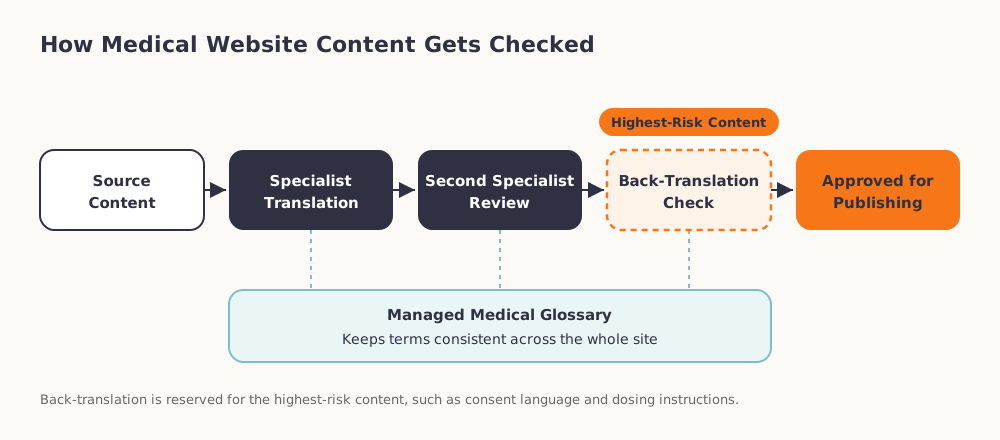
Both are exactly why medical content gets translated by a specialist, then checked by a second one.
Our internal QA process for translating healthcare websites and clinical content is aligned to ISO 17100 and ISO 13485 principles: a second medical-specialist reviewer on every project, consistent terminology management across the full site, and back-translation for the highest-risk content, such as consent language and dosing instructions.
| General Web Translation | Certified Medical Localization | |
|---|---|---|
| Terminology | General bilingual accuracy | Managed medical glossary and termbase, consistent across the whole site |
| Reviewer | One linguist | A second medical-specialist reviewer on every project |
| High-risk content | Translated once | Back-translated and compared against the source for consent forms, dosing, and diagnostic content |
| Regulatory sign-off | Not typically required | Built into the workflow for content that has to meet HIPAA, Section 1557, or GDPR requirements |
2. Navigating Regulatory Compliance and Privacy (HIPAA / GDPR)
Healthcare translation sits inside a stack of overlapping legal requirements, not just one. The main ones to plan around:
- Title VI of the Civil Rights Act. Any US healthcare business that receives federal funding, including Medicare, Medicaid, and SCHIP, is required to provide language access for patients. Failing to do so can be treated as a form of discrimination.
- Section 1557 of the Affordable Care Act. A July 2024 final rule requires covered entities to offer free, timely language assistance from qualified interpreters and translators, requires any AI-assisted translation of vital documents to be reviewed by a qualified human translator rather than published raw, and requires notices of available language assistance in the 15 languages most commonly spoken by limited-English-proficiency patients in the entity's state.
- HIPAA. Any content that touches Protected Health Information has to respect HIPAA's confidentiality requirements, a real consideration for translation workflows and not just clinical ones. Whoever handles the source document, translates it, and reviews it needs to be bound by the same confidentiality standard the practice itself operates under.
- GDPR. For practices serving patients in the EU, health data is "special category" data, which means stricter consent and processing rules apply to it than to ordinary personal data, on top of whatever US-specific requirements already govern the same content.
- State-level rules. Requirements also exist at the state level in the US, so it is worth confirming compliance at that layer too, not just the federal one.
Worth flagging on Section 1557 specifically: parts of the 2024 rule are currently stayed or under litigation, so the exact compliance picture is still moving. This is not legal advice, just useful context for planning ahead.
Need certified translation for your healthcare website or patient portal?
Accuracy and regulatory compliance are essential in healthcare. Our network of specialized medical translators ensures your clinical content, portals, and web pages are precise, accessible, and compliant across all target markets.
3. Localizing Interactive Patient Portals and Telehealth Tools
Everyone, particularly a patient anxious about a medical issue, wants to reach the information they need quickly and in a language they are fully comfortable in, not just well enough to muddle through.
That goes well beyond the marketing pages of a site. Multilingual patient portal localization touches every one of these:
- Appointment booking, intake forms, and lab results, all reading naturally in the patient's own language, not just the homepage.
- Secure messaging with a provider, where tone and clarity matter as much as accuracy.
- Telehealth video visits, where the booking flow, the consent screen, and any on-screen prompts need to be in the patient's language before the clinical conversation even starts.
- Digital consent forms, which carry real legal weight and need the same specialist review as a printed form, not a lighter pass just because they live in an app.
- Directions, parking, and entry instructions, easy to deprioritize next to clinical copy, but they decide whether a patient makes it through the door on time in the first place.
76% of consumers prefer to buy products with information in their native language, and 40% will never buy from websites in other languages, according to a 2020 survey of 8,709 consumers across 29 countries.
A translated portal also means your site can rank for searches made in a patient's first language, reaching people who never would have found an English-only practice in the first place. For more on SEO strategy specifically for medical, healthcare, and dental businesses, see this resource.
Ready to Localize Your Healthcare Website?
If your site, portal, or intake forms are not translated, your patients will have questions that go unanswered, and many will simply call your practice instead, time your staff spends that a properly localized experience would have saved.
That gap matters most for the patients who do not speak good English, since even a phone call may not get them the help they need unless a staff member happens to speak their language too.
Investing in certified medical translation services closes that gap before it costs you a patient, and it is exactly the kind of investment that pays for itself the first time it prevents a miscommunication that would otherwise have real consequences.