How to Achieve Accurate Technical Translations
Technical translation is not word replacement. What the work actually involves, and the glossary, subject-expert and QA steps that keep a manual accurate.

Businesses catering to customers worldwide rely heavily on accurate technical translations to communicate across languages, expand their reach and maintain consistency across international markets.
Whether you are converting instruction manuals, startup guides, software documentation or research papers, a general-purpose machine translator will not get you there on its own.
Professional technical translations require a solid understanding of the source and target languages, as well as the technical concepts being explained.
Ensuring that this type of technical content is translated with all the necessary cultural and linguistic nuances of its target language(s) can make or break success in foreign markets.
There is a commercial case for doing it properly.
Businesses that invested in translation were 1.5 times more likely to observe an increase in revenue. Source: Redokun's translation statistics round-up, citing Localize
This short guide will explore the practical strategies for achieving accurate technical content translations to maintain brand identity and cultural relevance.
Appreciate the Complexity of Technical Translation
It is a common misconception that technical translations are just about changing words from one language to another.
It is a good deal more than that. It takes a working grasp of both languages, of the conventions each field follows in each of them, and of the cultural context the finished document lands in.
Even minor linguistic or cultural inaccuracies can cause confusion and risk among your global audience.
Types of Technical Translations
This is specialized translation in the strict sense: it needs subject knowledge as well as language, because the terminology and the writing conventions differ by field and by market.
- Installation and troubleshooting guides for software, hardware, and electronics
- Industrial equipment maintenance manuals
- E-learning courses and training programs
- Complex IT and cybersecurity service processes like vulnerability assessments, penetration testing exercises, and risk assessments
- Technical and structural drawings with detailed measurements
- API documentation and instructions
- Scientific or medical research paper translation
- Economic and financial forecasts, including Chinese financial translation
- Corporate policy documents such as privacy policies and terms of business
- Legal or regulatory documentation
Each technical field has its own set of industry-specific jargon and terminology that may not have a direct equivalent translation in another language.
The same instruction can also be read differently in another market, so the adaptation has to account for more than the words.
Formatting is part of the job too. Tables, callouts, numbered procedures and figure references all have to survive intact, and a text expansion of twenty percent will break a layout that nobody budgeted for.
How to Ensure Technical Translation Accuracy
Collaborate with Subject Matter Experts
A reliable method to achieve translation accuracy is to include subject matter experts from the relevant technical field(s).
These experts possess a greater in-depth knowledge of the subject and can provide additional insights and context into specific industry terminology and concepts.
Consult with these experts early in the translation process to clarify any misconceptions and miscommunications that could make their way into new translations.
They may even have native speakers on hand who may be able to advise and proofread for technical accuracy and clarity.
Develop a Glossary
Build an expansive glossary of approved, valid technical terms to guarantee that your content stays consistent and relevant across all translated materials in various languages.
This resource, significantly improved by translation memory technology, can store previously translated text segments and terminology for future reuse in the same native language.
Collaborate with your technical team and any external subject experts to identify the most appropriate key terms and approved translations that would make the most sense to native speakers.
Update and maintain your glossary as industry regulations, best practices, and definitions evolve.
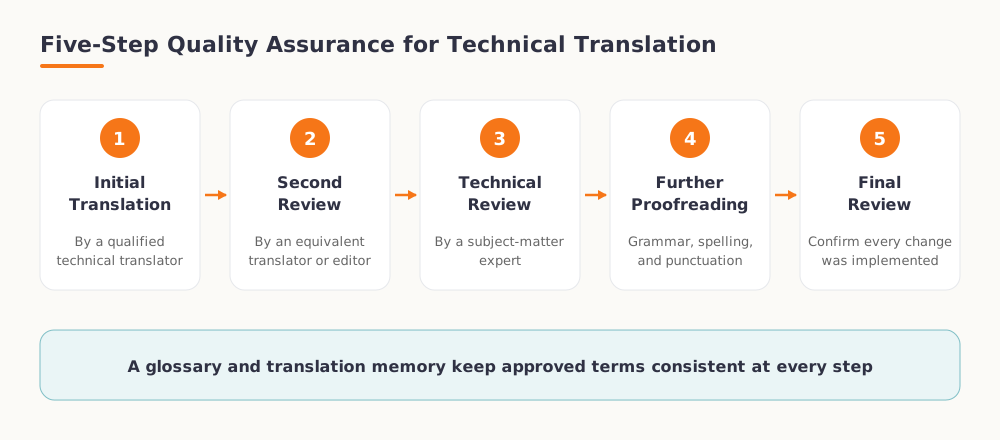
Establish a Solid Quality Assurance Process
Quality assurance is a key step in securing technical translation accuracy.
This multistep approach helps you identify any errors and inconsistencies before that content reaches its intended audience.
A translation management system does a lot of this mechanically. Most have QA checks built in that flag terminology drift, missing segments and broken number formats before a human reviewer sees the file.
The translation management systems market was worth $2 billion in 2023. Source: Global Market Insights, Translation Management Systems Market
Consider a process which resembles:
- An initial translation by a qualified technical translator
- A second review by another equivalent translator or editor
- A technical review by a subject-matter expert
- Further proofreading for grammar, spelling, punctuation, and more, pertinent to its native tongue
- A final review to confirm that all changes have been implemented correctly
The market around all of this is substantial and growing slowly rather than explosively.
The global language services market reached USD 30.85 billion in 2025 and is projected to reach USD 36.10 billion by 2031, a 2.65% CAGR. Source: Slator 2026 Market Report: Language Solutions and AI
That is a mature industry rather than a boom, which is worth knowing when you are choosing a translation services partner: the ones worth hiring compete on accuracy and subject knowledge, not on being new.
Partner With a Reputable Translation Agency
Achieving accurate and helpful technical translations involves a multipronged approach combining linguistic familiarity, technical understanding, and cultural knowledge.
Balancing all of these will maintain your brand’s reputation while effectively communicating complex and specific information to a broader range of global audiences, ultimately supporting your key business goals of expansion and entering new markets.
Investing in high-quality translations is not a cost; it’s a concerted effort to position your business for global success.
Choosing an agency with real experience in your technical field is what makes the difference between a document that is accurate and one that merely reads as though it is.
BeTranslated is a globally recognized translation agency that emphasizes quality and accuracy in all content, no matter how technical.
Using advanced technology and extensive technical expertise, our translators are uniquely equipped to support your globalization objectives and ensure your technical content resonates effectively with your audience.
Get in touch for a free, no-obligation quote and we will talk through what your documents actually need.