Multilingual Social Media Strategy: How to Build a Global Presence
How to plan a multilingual social media strategy: account architecture, short-form video localization, transcreation for social copy, and AI-assisted community management across languages.
Social media gives you direct access to audiences in every market you want to enter, but that access means little if you are speaking to them in the wrong language. Most brands still approach international social media by running home-market posts through a translation tool and calling it done.
Native speakers spot that approach immediately, and it tells them something no brand wants to signal: that you did not bother to understand them. A multilingual social media strategy is not just about posting in several languages. It is about building a presence that feels local to each audience, on the platforms they actually use, in a voice that sounds like a person rather than a machine.
In this guide:
- Centralized vs. Regional Accounts
- Localizing Short-Form Video
- Transcreation for Social Copy
- Multilingual Community Management
- Social Media Localization Support
- Frequently Asked Questions
Quick summary
- Choose an account architecture per platform: one multi-language account is cheaper to run, while dedicated regional handles earn deeper local engagement.
- Plan subtitles, translated captions, AI dubbing with human review, and visual transcreation into every short-form video from the start.
- Transcreate copy, hashtags and memes instead of translating them, and pair central brand posts with local creators, user-generated content and native-speaking community managers.
1. Choosing Your Architecture: Centralized vs. Regional Accounts
Before you write a single post in a new language, you need a clear picture of who you are trying to reach and where they spend their attention. That research decides your account architecture, the first structural choice in any multilingual social media strategy.
Start With Your Audience, Not Your Content
Platform usage varies significantly by country and demographic. LinkedIn is widely used for professional networking across Europe and North America, while LINE and X carry more everyday commercial weight in Japan.
WeChat and Weibo dominate in China while being largely irrelevant in Latin America, where WhatsApp and Instagram drive both personal and brand communication. Facebook remains a leading platform in many Southeast Asian and African markets.
Every major social platform provides native analytics showing where your audience is located, which languages they use, and when they are most active. Use that data to shape your multilingual social media strategy from the start rather than retrofitting it after you have committed to an approach. Opening accounts on every platform in every market without that research is a common and expensive mistake.
Language preference also cuts across fluency levels, so do not assume a bilingual audience is happy with content in your home language. Meta's own research on US Hispanic audiences made the point clearly.
79% of Spanish-dominant, 82% of bilingual and 60% of English-dominant US Hispanic research participants surveyed think brands should advertise in both Spanish and English. Source: Facebook IQ, "Gains in Translation: What Your Language Choices Say to US Hispanics", Latinum Network survey of 519 US Hispanic adults, July 2016
Single Multi-Language Account vs. Dedicated Regional Handles
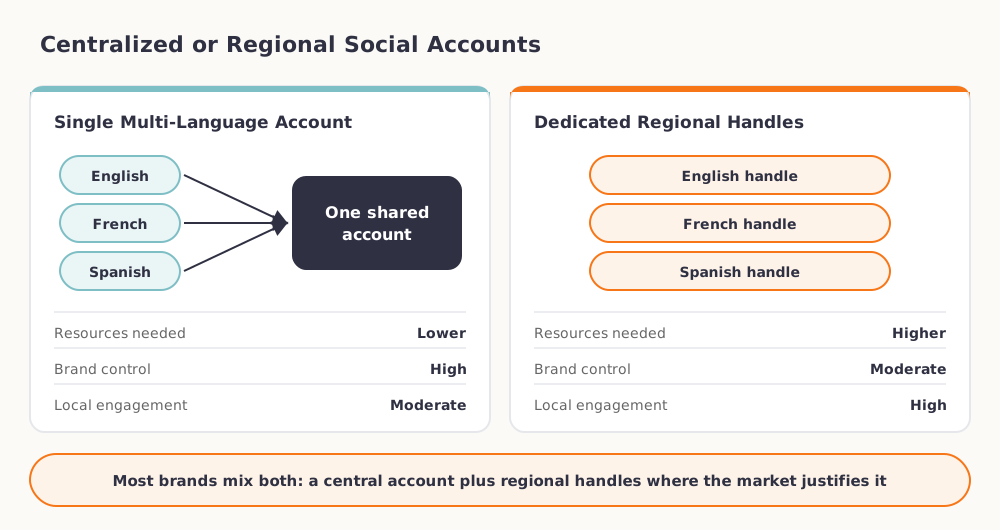
Once you know where your audiences are, decide for each platform whether one global account serves every language or each market gets its own handle. Most brands end up with a hybrid: a central account for brand-level announcements and regional handles only in markets that justify the investment.
| Factor | Single Multi-Language Account | Dedicated Regional Handles |
|---|---|---|
| Resource Requirements | Lower: one content calendar, one team and one set of analytics, with language versions produced from a shared plan | Higher: a separate calendar, native-speaking community manager and approval flow for each market |
| Brand Control | High: every post passes through one central team, so visual identity and messaging stay consistent | Moderate: local teams adapt tone, timing and topics, which requires clear brand guidelines and review rules |
| Engagement Potential | Moderate: followers see posts in languages they may not read, and replies in several languages mix in one thread | High: posts, humor and replies all happen in the audience's language, building a community around shared context |
Separate accounts let you tailor posting schedules, content formats and campaign timing to each market independently. A dedicated French-language account for Belgium and France, supported by native French translators, a separate Spanish-language account for Latin America, and a distinct English account can each feel local in a way a single account rarely achieves.
Separate accounts also build language-specific communities where followers engage with each other, not just with your brand. Building a global brand means balancing that local relevance against a consistent identity, and your account architecture is where that balance is first set.
What the Platforms Now Handle for You
Platform language tools have moved on, and they change the calculation for paid campaigns. Meta lets you advertise in multiple languages from a single campaign. With Meta's multi-language ads, set up in the Languages section of Ads Manager (now moving into a new Translations step), you add a headline and primary text for each language while Meta delivers the right version to each person.
Meta has also added generative AI translations in Ads Manager, which translate an ad's primary text and headline, dub a video's voiceover, and translate text in image overlays. Meta recommends using either AI text translations or its manual multi-language setup, not both, since the two overlap. Businesses with product catalogs can add country and language feeds so Advantage+ catalog ads show items in the right language and currency.
X has taken a viewer-side approach. In April 2026 it began rolling out automatic post translation powered by Grok worldwide, translating posts in people's timelines, and users can switch it off for a given language.
X Ads still offers language targeting for campaigns, but organic posts in other languages now reach readers through machine translation of your original wording. A region-specific handle remains the only way to control exactly what each market reads.
None of these tools replaces a native voice. Meta's help page notes that you cannot edit AI-translated ad text, so a brand-critical campaign still needs professionally adapted ad copy that you control line by line.
2. Localizing Video and Short-Form Content (TikTok, Reels, Shorts)
Short-form video sits at the center of TikTok, Instagram Reels and YouTube Shorts, and it is also the hardest content type to localize well. Every clip carries spoken audio, on-screen text, captions and cultural cues, and each one needs its own decision.
Video producer 90 Seconds was already rounding up content localization statistics in 2016, arguing that a locally focused video will not automatically appeal to a global audience. The platforms have since built the tooling to act on that.
Multilingual Subtitling and Auto-Caption Translation
Many people watch social video with the sound off, so captions are often the first thing a viewer reads. TikTok has offered auto-generated captions and caption translations for viewers since 2022, and most platforms now caption automatically.
Those machine captions are a useful baseline, but they mistranscribe brand names, product terms and slang, and their translations inherit every error. For reels and short videos that carry your brand message, professional subtitling and captioning services give you timed subtitles in each language, checked by native speakers.
Keep subtitle lines short and time them to the rhythm of the edit. Adapt jokes and wordplay rather than translating them literally.
AI Voice Dubbing
AI dubbing has moved from experiment to built-in feature. Meta AI translation for Reels translates, dubs and lip syncs reels on Facebook and Instagram for eligible creators, while YouTube's automatic dubbing generates translated audio tracks that creators can preview, publish or remove in YouTube Studio.
These tools make a first multilingual version of a video fast and cheap. They still need a human check: a mistranslated claim in a dubbed product video is heard by every viewer, and a synthetic voice can sound wrong for a brand that sells on warmth or humor.
Use AI dubbing for high-volume, lower-risk content. Reserve human voice talent and carefully reviewed scripts for hero campaigns.
Visual Transcreation
On-screen text, product shots, gestures, colors and even the setting of a video carry meaning that subtitles cannot fix. Visual transcreation means adapting those elements for each market: re-recording text overlays, swapping imagery that does not travel, and sometimes reshooting a scene with local talent.
Meta's overlay translation can translate the text in single image ads, but it only handles words, not the picture around them. Deciding whether a visual works in Seoul, São Paulo and Stuttgart is still an editorial judgment.
Local Creators, KOLs and User-Generated Content
The most effective short-form content in a new market is often not made by the brand at all. Local creators and key opinion leaders (KOLs) already speak their audience's language, slang and humor, and their endorsement carries trust that a centrally translated brand post cannot.
Build your plan around partnerships with creators in each priority market, and give them a clear brief rather than a script to read out. Encourage and reshare user-generated content in each language, with permission, so your regional feeds show real customers rather than only head-office posts.
Brief creators in their own language. Have briefs, disclosure wording and usage terms reviewed by a native speaker so nothing is lost between your team and theirs.
3. Transcreation for Social Copy, Hashtags and Memes
There is a meaningful difference between translating content and creating native content, and your audience will feel it even if they cannot say why. Translated content, even when accurate, tends to carry the structure and rhythm of the source language, so it sounds like a document rather than a conversation.
Native content is written by someone who thinks in the target language and knows how people in that community actually talk to each other online. A machine-translated post lacks cohesion in ways that native speakers detect instantly, particularly on platforms like X or TikTok where tone and timing are everything.
Brand Voice and Campaign Copy
Transcreation rebuilds a message in the target language so it keeps its intent, tone and emotional effect rather than its exact words. For brand voice guidelines, campaign slogans and social captions, marketing translation and transcreation gives you a copywriter who adapts the idea, not just the sentence.
Localization goes further still: it means adapting your marketing strategy and messaging for a specific audience. Some content travels reasonably well with careful adaptation, provided you adjust the tone, localize references and have a native speaker review it before it goes live.
For campaigns built around cultural moments, humor or community identity, creating multilingual content from scratch in each language will usually outperform anything derived from a source-language original.
Hashtags
Hashtags are a particularly sharp illustration of why this matters. A hashtag that works in English may be meaningless, bizarre or offensive when carried directly into another language and cultural context.
Getting hashtags right requires an understanding of what is trending, what carries cultural weight and what to avoid in each market at a given moment. Research local hashtags natively instead of translating your English ones, and keep a campaign hashtag untranslated only when it is a brand name people will search for as written.
Memes and Humor
Memes are the hardest social content to move between languages, because they depend on shared references that change from week to week. A format that is fresh in one market may be dated or unknown in another, and a pun rarely survives translation.
Treat memes as local-only content, created by native-speaking social teams or creators who live in that market's online culture. If a joke needs explaining, it is not ready to post.
Why Free Tools Fall Short
Free translation tools have improved considerably, and they are useful for quick reference and internal communication. For public-facing social media content, they are not enough.
The gap between a Google Translate output and a professional translation is most visible in conversational content, which is exactly what social media requires. Idiomatic expressions, platform-specific language, cultural humor and community in-jokes all fall outside what automated tools handle reliably.
A professional translation agency with native-speaking translators who understand your industry and target market brings both linguistic precision and cultural judgment to your content. For brands trying to build trust with a multilingual audience, that judgment is what the investment actually buys.
4. Multilingual Community Management and AI Workflows
Publishing is only half of social media. The replies, comments and direct messages that follow are where people decide whether your brand really speaks their language, and a reply in the wrong language, or a week late, undoes the work of a well-localized post.
The ideal person managing a language-specific community uses that social media ecosystem daily, understands the cultural subtext of the market, and engages with followers in a way that feels natural rather than corporate. Whether that is an in-house native speaker, a local market specialist, or native-speaker community management from an agency, that local fluency separates a credible multilingual account from one that reads like a translation project.
LLM-Assisted Comment and DM Handling
Large language models have changed how teams cover many languages at once. Social inbox tools can now use LLMs to detect the language of incoming comments and DMs, translate them for the team, tag sentiment and urgency, and draft replies in the follower's language in close to real time.
Used well, that lets a small central team triage conversations in languages it does not speak and route anything sensitive to the right native speaker. Used carelessly, it creates new risks: an AI-drafted reply can misread sarcasm, miss a complaint that is really a legal or safety issue, or answer confidently in a register that sounds wrong to locals.
A Human-in-the-Loop Workflow
- Triage automatically. Let the model detect the language, translate each message, and tag it by topic, sentiment and urgency.
- Draft, do not auto-send. Generate suggested replies in the follower's language from approved answers and a glossary of brand and product terms.
- Review by language. Have a native speaker approve or edit drafts, and escalate anything involving complaints, health, legal questions, pricing or a crisis to a person immediately.
- Feed corrections back. Update the glossary, tone notes and saved replies regularly so the drafts improve in every language.
Keep one native speaker accountable for each active language, even when AI handles the first pass. The goal is faster, more consistent replies, not a community that can tell it is talking to a machine.
Measuring What Works in Each Market
The return on multilingual social media compounds over time in ways that are easy to underestimate at the start. Brands that build a credible presence in a new language market earn trust that converts into engagement, word-of-mouth referral within language communities, and brand advocacy that paid campaigns struggle to manufacture.
Track engagement, response time and sentiment separately for each language and platform, not as one global average, so a struggling market does not hide behind a strong one. The brands that treat language as a core part of their global B2B and B2C marketing strategy are the ones gaining ground in new markets.
A professional translation and localization partner should be part of your multilingual social media setup from the start. Bringing one in after your first campaign fails to land costs more and fixes less.
Build a Social Media Presence That Speaks Every Market’s Language
BeTranslated helps brands create native-quality multilingual content for social media, from platform-specific copy and subtitles to full localization strategies across European and global markets. For channel strategy, short-form video and paid social, see our multilingual social media services.
📞 +34 962 02 22 22
Frequently Asked Questions
What is multilingual social media marketing?
Multilingual social media marketing means creating and managing social media content in more than one language, adapted to the cultural context and platform preferences of each target market. It goes beyond translation to include localized tone, culturally relevant references, market-specific hashtags, and community management in each language. The goal is to build genuine engagement with audiences who feel the content was made for them rather than converted from another market’s version.
Should I create separate social media accounts for each language?
It depends on the market's value and your resources, and many brands run a hybrid of one global account plus regional handles in priority markets. Meta's multi-language ad tools, X's automatic post translation and YouTube's automatic dubbing all extend the reach of a single account. Separate regional handles still give you far more control over what each language audience reads, hears and replies to.
Why is machine translation not enough for social media content?
Social media content depends on conversational tone, cultural timing, idiomatic expression, and platform-specific language conventions that automated translation tools handle poorly. Native speakers consistently recognize machine-translated text, and the lack of naturalness damages brand credibility rather than building it. Hashtags, humor, and community-specific references require cultural judgment that goes well beyond linguistic accuracy.
Which social media platforms should I prioritize for international markets?
Platform choice depends entirely on the specific market. WeChat and Weibo are dominant in China; LINE and X carry more weight in Japan; WhatsApp and Instagram drive commercial communication across Latin America; Facebook remains a leading platform in many Southeast Asian and African markets. Researching actual platform usage data in each target country before committing to an account structure will save significant time and budget.
How does multilingual social media marketing support SEO?
Multilingual social media content supports international SEO by building brand signals, backlinks, and audience engagement across language markets. Localized content in each target language reinforces the topical relevance of corresponding website pages, and social sharing in native languages increases the reach of your multilingual web content to audiences who are more likely to link to, cite, or search for your brand in their own language. Combined with a properly structured multilingual website, it strengthens your visibility across multiple regional search landscapes simultaneously.