How to Localize Black Friday and Holiday Campaigns for Europe
Black Friday is November 27, and Europe is not one market. A market-by-market guide to local sale rules, discount wording, VAT and currency, email timing, and a checklist that works back from the date.

Black Friday falls on November 27 this year, with Cyber Monday on November 30. From today, October 10, that leaves about six weeks. It is enough time to fix the parts that do real damage, such as price claims, local wording, and delivery promises, and too little to rebuild a campaign from scratch.
Europe is not one market, and a shopper in Lyon, Leipzig, Valencia, or Utrecht does not meet Black Friday the same way. This guide goes market by market, covers the legal rule that catches most discount campaigns, and ends with a timeline you can work back from. It is general information, not legal advice, so have counsel check your price wording in each market.
Black Friday Is Not the Same Event Everywhere
Intent to shop varies by country. In a September 2025 survey of more than 10,000 consumers, BCG singled out Italy as a leader and Denmark and the Czech Republic as markets with room to grow:
"Italy and the US lead the way, with 90% and 83% of consumers intending to shop, respectively." "... countries like Denmark, at 60%, and the Czech Republic, at 64%, show upside potential." Source: BCG, "Consumers Are Rewriting the Rules of Year-End Sales Events", 2025 survey of more than 10,000 consumers aged 18 to 75 in 10 markets
BCG does not say whether those shares are of all respondents or only of those aware of the sales, so use them to rank markets, not to forecast turnout. The study covers seven European markets (the Czech Republic, Denmark, France, Germany, Italy, Poland, and the UK), plus Australia, Canada, and the US. Spain, the Netherlands, and Belgium are not in it, and we found no comparable figure we could verify, so use your own analytics there.
Awareness tells a different story from intent:
"consumer awareness of Black Friday at 96% (up 1pp over 2024)" and "roughly 33% for Singles' Day (up 6pp)" Source: BCG, "Consumers Are Rewriting the Rules of Year-End Sales Events", 2025 survey of more than 10,000 consumers aged 18 to 75 in 10 markets
Both figures cover the whole 10-market sample, so read them as a global pattern. Almost everyone has heard of Black Friday, while Singles' Day is known to about a third. Unless your own data says otherwise, treat November 11 as a warm-up date, not a second peak.
Two decisions follow before any copy is written. Keep the English name "Black Friday" wherever shoppers already use it, and test a local name only with a native marketer. And segment by market, not by language: Belgium alone needs Dutch and French, and Spanish for Madrid is not Spanish for Mexico City.
Local Dates and Sale Rules by Market
Map what else is happening in each market before you plan sends. This table covers the dates that compete with or extend the season, and whether the law sets a sales calendar.
| Market | Dates to plan around | Legal sales season? |
|---|---|---|
| France | November 11 is a public holiday, a Wednesday this year | Yes. Two periods of four weeks, set nationally. By the legal rule, winter sales open January 6, 2027 |
| Germany | No competing date | No. Abolished in 2004 |
| Spain | December 8 and January 6 are national holidays | No set dates. Each retailer chooses timing and length |
| Italy | December 8 and January 6 are public holidays | Yes. Regions set the dates |
| Netherlands | Sinterklaas on December 5, a Saturday this year | No |
| Belgium | November 11 is a public holiday | January 3 to 31 and July 1 to 31, but see below |
| UK | Boxing Day is December 26; the bank holiday moves to Monday, December 28 | No |
| Poland | December 24 is a public holiday and three Sundays before it are shopping Sundays | Check locally |
| Sweden, Norway, Finland | Sweden's post-Christmas sale, mellandagsrea, starts December 25 | No regulated periods |
Three points hide inside that table. First, France restricts a word, not only a calendar:
Outside the official sale periods, using the word "soldes" or its derivatives is prohibited, with fines of €15,000 for sole traders and €75,000 for companies. Source: Service-Public.fr, "Soldes : règles à respecter"
So do not translate "sale" as "soldes" in a November email. Second, Belgian practice is in flux. Law firm Altius lists the English word "Sales" among terms Belgian case law has treated as equivalent to "solden" outside the legal periods, while LexGO reports that three rulings of May 20, 2026 held the statutory restriction incompatible with EU law and to be disregarded. Ask a Belgian lawyer where that stands before you use any of those words in a Black Friday banner.
Third, Poland changes your delivery promise: with Christmas Eve now a day off, a December cut-off that works in Spain can be a day late in Warsaw.
The Price Claim Rule That Catches Most Discount Campaigns
This is the rule that matters most, and it applies in every EU market. Directive 98/6/EC now says:
"Any announcement of a price reduction shall indicate the prior price applied by the trader for a determined period of time prior to the application of the price reduction." "The prior price means the lowest price applied by the trader during a period of time not shorter than 30 days prior to the application of the price reduction." Source: Directive (EU) 2019/2161, Article 2, inserting Article 6a into Directive 98/6/EC, EUR-Lex
Member states had to apply it from May 28, 2022, and national versions exist. Germany's Price Indication Ordinance, section 11 requires the lowest total price of the last 30 days, and France's official guidance describes the same reference price.
What this means for a November 27 start:
- The lowest price counts, not the usual one. A "pre-Black Friday" offer on November 10 becomes your reference price if it is the lowest in the window. For a November 27 start, the window runs from about October 28, so decide your reference prices before then.
- Stepped discounts can keep the original reference. Where national law allows it, as Germany and France do, a Black Week that moves from 20% to 30% off may compare against the price before the first reduction.
- The label is a legal phrase. Translate "prior price" as the local legal wording, not as a marketing line, and have a local reviewer sign it off.
- No fake urgency. The EU's unfair practices blacklist bans falsely stating that an offer ends soon, and the UK's CMA guidance gives a countdown clock that restarts as its example.
The UK sits outside the EU rule, but the CMA applies its own misleading-pricing tests, so the same discipline pays off there.
Currency, VAT, and Cross-Border Details
Consumer prices must show the tax. The Price Indication Directive defines the selling price as the final price including VAT, and the Consumer Rights Directive asks for the total price inclusive of taxes plus delivery charges. Under the EU scheme for cross-border online sales, known as OSS, VAT on distance sales to consumers is declared for the country where the customer is, so the same product can carry different gross prices by market.
Poland, Sweden, Norway, Denmark, and the UK do not use the euro. Set prices in the local currency instead of converting live, so the discount math and your prior-price record stay clean per currency.
Three smaller rules catch localization teams:
- Do not auto-redirect by country. The Geo-blocking Regulation bars redirecting a customer to another version of your site for reasons of residence unless they explicitly consent, and the version they asked for must stay easy to reach. Use a suggestion banner.
- Disclose your support language. If you promote in German and later offer after-sales service only in English, the unfair practices blacklist requires saying so clearly before purchase.
- Word returns carefully. The EU withdrawal period is 14 days, and any longer holiday window is your promise, so state it in plain local language.
Email Subject Lines and Send Times by Market
Consent comes first. Marketing email generally needs prior consent under Article 13 of the ePrivacy Directive, with a narrow exception for a seller's own similar products to existing customers, and national rules differ in detail. Merge lists by market only after checking the consent record behind each one.
For subject lines, a few habits transfer well:
- Decide formality once per market. German du or Sie, French tu or vous, Spanish tú or usted, Italian tu or Lei, Dutch je or u: choose per brand and write it in the style guide, so every translator and every campaign agrees.
- Lead with the offer. German and Romance-language lines usually run longer than English, and preview panes cut them off.
- Test emoji, do not assume them. Treat them as a per-market decision.
- Transcreate, do not translate. Humor, puns, and countdown phrases rarely survive a word-for-word pass, as our guide to translation versus transcreation explains.
Send in each recipient's local time. Clocks in the UK and the EU change on October 25, so on November 27 the UK is on UTC+0, most of continental Europe on UTC+1, and Finland on UTC+2. Black Friday and Cyber Monday are working days, so test a lunchtime send against an evening one per market, and write dates day-first, as in "27 November". More tactics are in our post on ecommerce email marketing.
A Timeline Back From November 27
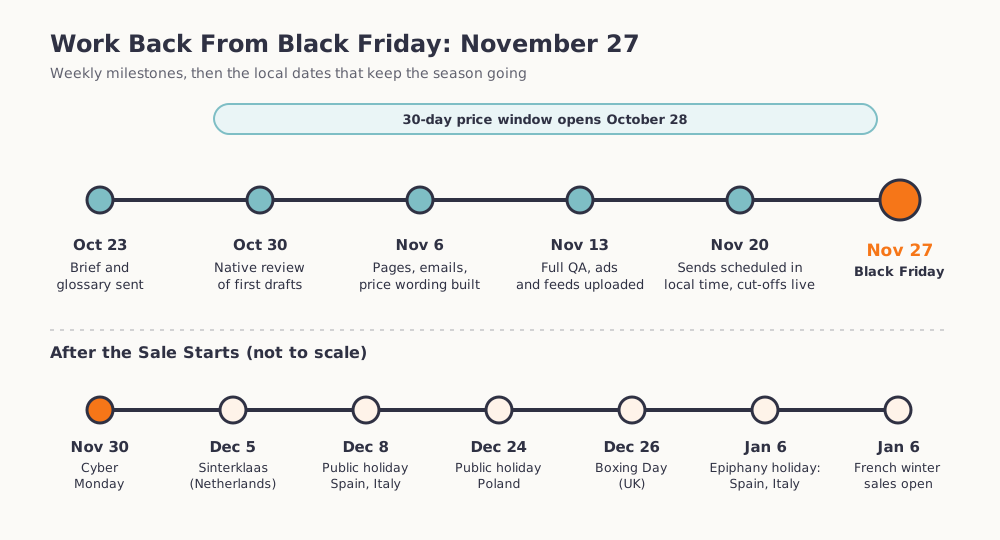
Work back one week at a time:
- Now to October 23: pick markets and offers, set reference prices, and send translators the brief and a glossary of offer terms.
- October 30: native review of first drafts, with price wording checked by a local reviewer.
- November 6: landing pages, emails, and price wording built in every language. Use a permanent landing page per market, with hreflang tags, so multilingual SEO value carries into next year.
- November 13: full QA of the rendered pages for text expansion, accents, and currency, then ads and feeds uploaded.
- November 20: sends scheduled in local time, delivery cut-offs and support language live.
- November 27 and 30: Black Friday and Cyber Monday.
- December 5 and after: log what each market did, from Sinterklaas on December 5 to Boxing Day on December 26, then debrief.
If you are starting late, pick two markets and put native review where it counts most: subject lines, the hero banner, and every price line.
Planning the Next Season Earlier
Smooth campaigns settle terminology, pricing rules, and approvals months ahead. Our multilingual marketing calendar lists the other dates worth planning for in each market. For that groundwork, our marketing translation and e-commerce translation teams work from your offer terms and glossary, and our multilingual email marketing service covers the send side.
FAQ
Is Black Friday celebrated in every European country?
Awareness is high across the markets BCG surveyed, but intent to shop differs from country to country, as the survey figures above show.
Do EU discount rules apply to Black Friday offers?
Yes. Any announcement of a price reduction must show the prior price, defined as the lowest price you charged in at least the previous 30 days. Member states apply it through national law, so check the local wording.
Can I use the word "sale" in France or Belgium in November?
In France, "soldes" and its derivatives are restricted outside the official periods, with fines for misuse. Belgium has a similar restriction in law, but its status is disputed after the May 2026 rulings, so ask a Belgian lawyer first.
Which VAT rate should a Black Friday price show for a customer in another EU country?
Consumer prices must include VAT. Under the EU OSS scheme, VAT on distance sales is declared for the customer's country, so confirm the rate with your tax adviser for each market you sell into.