5 Ways to Teach Your Child a Foreign Language
Knowing a new language offers unique opportunities for cross-cultural communication as well as boosts brainpower and other essential soft skills.

Five Approaches to Teaching Your Child a Foreign Language
Learning a foreign language is often considered obligatory, since it can be beneficial in several ways. Knowing a new language offers unique opportunities for cross-cultural communication, as well as boosts brainpower and other key soft skills. It is becoming increasingly apparent that one should begin learning a new language in childhood.
According to the evidence, children of primary school age show a tendency to learn a language quickly and effectively. So, as a parent, you ought to teach your kid a foreign language, and here are some ways you can manage this.
Show Your Kid Foreign-Language Cartoons
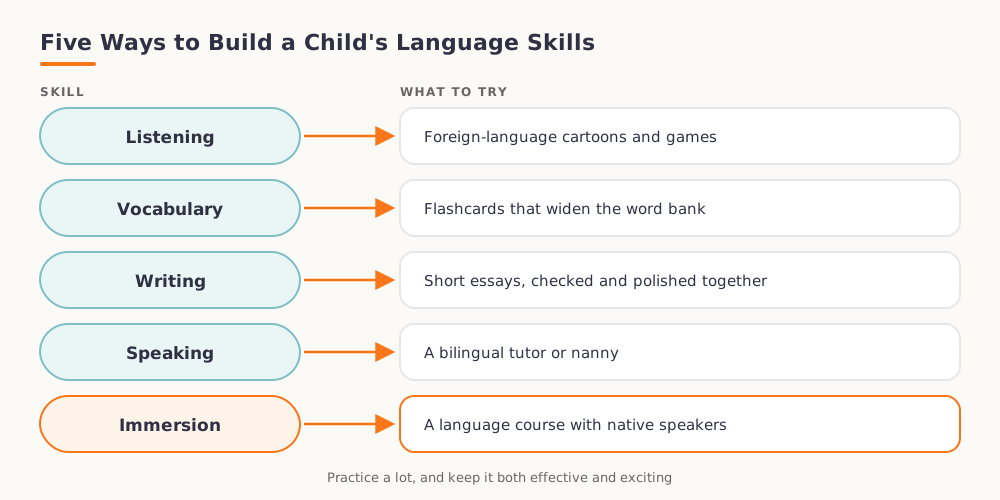
Those who watch foreign-language movies from time to time will agree that such a practice helps to become more fluent in a new language. The same can be applied to young kids. Considering the amount of attention that children give to cartoons, it can be great to let a kid watch them in a foreign language.
With some basic knowledge of the language, the kid will gradually learn new phrases and will be able to use them further. Similarly, you may offer your kid to play a game in a foreign language. There is no need to worry - your child will immediately figure out how to play it once you explain the rules clearly.
Build Your Kid’s Vocabulary
Having a good diction is essential for improving language speaking and writing skills. A great vocabulary lays grounds for quick learning and allows a kid to practice a new language.
So, as a parent, you ought to put efforts into building your kid’s vocabulary. As an example, you can manage this by creating a lot of flashcards to widen a child’s vocabulary and improve the learning process in general.
Help Your Child to Write in a Foreign Language
Writing serves as a powerful tool for reinforcing grammatical structures, which in turn enhances overall language speaking skills. Parents can support this process by encouraging children to practice new vocabulary and complex sentence structures through regular writing exercises.
This practice allows learners to organize their thoughts and construct logical arguments in a foreign language. For constructive feedback, families can turn to professional language tutors or editors to review the work. Afterward, parents and children can collaborate on polishing the text, turning the revision process into a valuable shared learning experience.
Hire a Bilingual Tutor/Nanny
There are a multitude of arguments for hiring a bilingual nanny or a tutor. First and foremost, communicating with a native speaker who can easily switch between two languages is like having a personal translator.
Once a kid does not understand the meaning of some phrase, the person can immediately translate it. This will lead to your child being able to communicate with a nanny or tutor on a regular basis. It means he or she will gradually become accustomed to speaking both languages.
Foreign Language Courses
In case your kid goes to school already, it will be indeed effective and beneficial for him or her if you send them on a language course abroad.
Doing so will give your child an opportunity to communicate with native speakers and get a unique insight into a foreign culture. This option is effective in terms of improving language speaking skills.
Considering the fact that such courses engage many young kids who share similar interests due to the same age.
The best way to teach your kid a foreign language is to communicate with native speakers and practice a lot.
So, use the tips outlined above to make the learning process both effective and exciting.