Multi-Language Website: Why It Matters for SEO and Multilingual Marketing
Why a multi-language website is the base of multilingual marketing: multi-language SEO basics, examples of multilingual websites, content strategy and social media tips for reaching customers in their own language.


Why a Multi-Language Website Helps SEO and Marketing
A multi-language website is the base of any multilingual marketing plan. Your ads, emails and social posts can speak a customer's language, but if the page they land on does not, the visit usually ends there.
The guide below covers why a multi-language website matters, the multi-language SEO basics that get each version found, real examples of multilingual websites and how to promote them. The internet has opened up a whole range of possibilities for businesses looking to reach their customers.
When people think of making a purchase, many go online first. They search for a company, or they visit its website directly.
Businesses must therefore have a website, even when their target customers are based locally. It serves as an online showcase of their products or services, and is the perfect port of call for their target audience.
It is a good practice, but many companies make the same mistake: they publish their website in one language only, usually English.
Why Every Business Needs a Multi-Language Website
A multi-language website opens many doors. English is the most widely understood language, but its comprehension around the world is often overestimated by businesses.
Not every one of your international clients may be able to understand your website if it is only available in English. The likely result is fewer sales, fewer customers, and lower profit.
You will lose site traffic and leads, the last thing you want when reaching out to new customers. A professional website translator is one reliable way to win that traffic back.
Your content does not have to be available in every possible language. Translated versions in the languages spoken by most of your clients are enough to let them learn about your brand without unnecessary hurdles.
A multilingual website matters as much as effective email management when you deal with international clients. Email automation conveys your message to your audience and sends traffic to your website.
Even with a well-tuned emailing system, a site in a single language can still lose a large number of potential customers. If visitors cannot understand your services, they are unlikely to use your company, and most will look for a competitor they can relate to.
In a competitive market, you need a way to stop visitors from leaving for the alternatives.
Your customers are waiting to read your website in their language, so don’t miss out on improving their user experience with the following strategies and pointers:
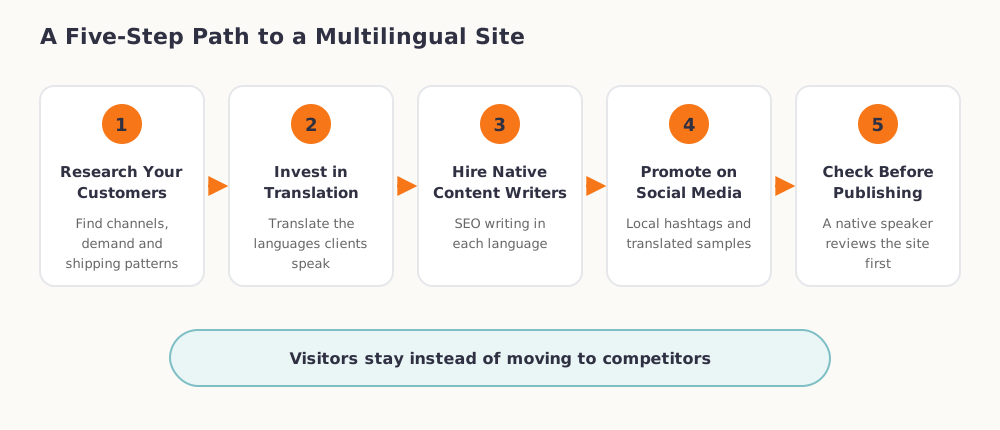
Carry Out Customer Research
If you are thinking about expanding, a little prep work now will pay off later. The internet has opened your storefront to the entire world.
Customers feel most comfortable, and are most likely to buy, when you speak their language. Localizing your website is a strong move for exactly that reason.
With the "why" settled, turn to the "where." Who are you trying to reach? Before you bring in a professional translator, find out what your future customers want.
You need to learn which channels they use, so you can connect with them. There is a world out there waiting for your professionally translated multilingual website, but first, you must learn more about sales opportunities abroad and the market that is open to you.
Read up on budgeting and annual planning, and look for growing customer demand and product shipping patterns. Entering a new market can be hard for some companies, but analytics tools help you fine-tune your strategy.
Whatever the case, research comes first when you plan to enter a new market.
Invest in Your Website
Many companies are unwilling to invest in website translation, yet the cost is often modest next to what they already spend on ads and campaigns that send visitors to the site.
Translating your key pages makes every other marketing channel work harder. If you decide not to translate your website, you may alienate potential customers who never learn about your brand.
Multi-Language SEO: The Basics
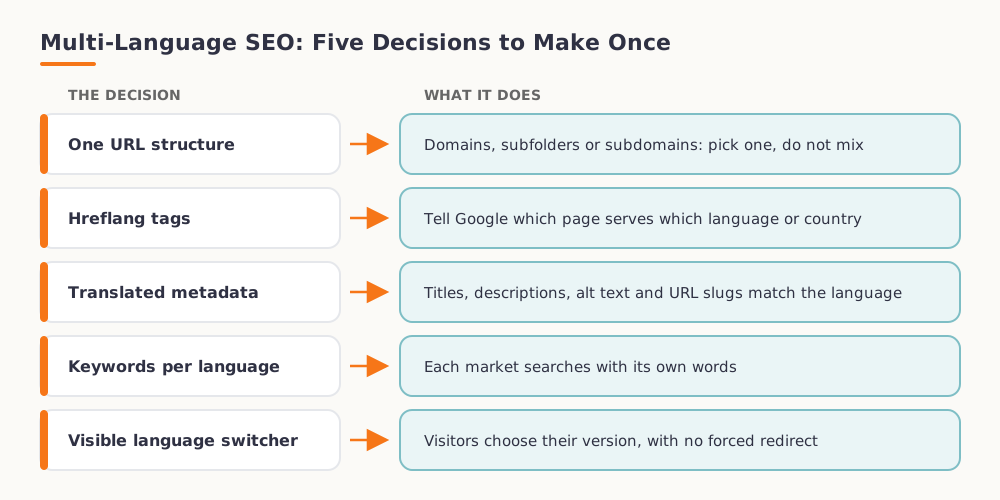
A translated page only brings visitors if search engines can find it and show it to the right people. Multi-language SEO comes down to a few decisions you make once and then apply to every language.
- Pick one URL structure. Country domains (example.de), subfolders (example.com/de/) or subdomains (de.example.com) all work, but mixing them makes a site harder to manage and harder for search engines to read.
- Add hreflang tags. They tell Google which version of a page serves which language or country, so a reader in Montreal sees the French page and a reader in Toronto sees the English one. Verify them afterward with the multilingual SEO audit steps.
- Translate the metadata. Titles, meta descriptions, image alt text and URL slugs need the same care as the body copy, because they are what appears in search results.
- Research keywords per language. People in each market search with their own words, which is why multilingual keyword research comes before translation rather than after it.
- Let visitors choose. Offer a visible language switcher and avoid forcing a redirect based on location, since a traveler or an expat may want a different version.
Getting these right is the core of multilingual SEO services, and it is what turns a translated site into a multi-language site that ranks.
Examples of Multilingual Websites
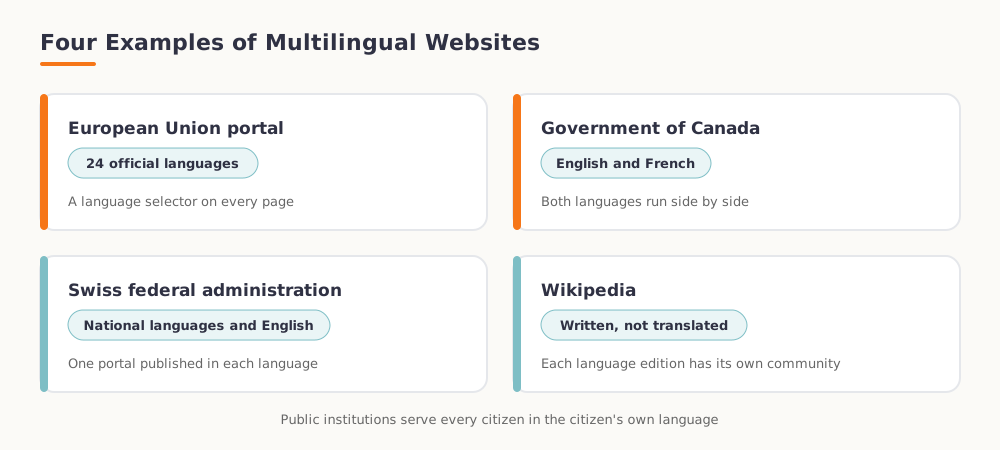
Public institutions are some of the clearest examples of multilingual sites, because they have to serve every citizen in the citizen's own language.
"EU nationals have the right to use any of the 24 official languages to communicate with the EU institutions, and the institutions must reply in the same language."Source: European Union, Languages, 2026
The European Union's portal publishes in those official languages, with a language selector on every page. The Government of Canada's site runs in English and French side by side, and the Swiss federal administration publishes its portal in the national languages and in English.
Wikipedia takes a different route. Each language edition is written by its own community rather than translated from English, so the same topic can have a longer article in German or Spanish than in English. That is a useful lesson for any multilingual content strategy.
Find a Content Writer in Other Languages
If you are ready to enter a new market, it’s time to translate your content. You can contact a translation company for custom SEO writing or original content in your language of choice.
Original content is a strong strategy, since it is written the way your customers actually speak. We work with native linguists, including professional copywriters, in many languages.
Multilingual Marketing Beyond the Website
Once the site exists in several languages, multilingual marketing carries the same message into the channels that bring people to it. Search ads, email campaigns and social posts each need their own localized copy, not a word-for-word copy of the English.
A good multilingual content strategy decides which pages and campaigns every market gets, and which ones only matter in one country. Our multilingual digital marketing team plans that mix, and our multilingual social media management service runs the local channels day to day.
How to Make a Website Multilingual
Making a website multilingual is a sequence of decisions more than a single task. Working through them in order keeps the cost down and the result consistent across languages.
- Choose the first languages. Start with the markets where your visitors, orders and support requests already come from, then add languages as results justify them.
- Set up the structure. Pick one URL structure and a multilingual setup in your content management system. WordPress sites often use a plugin such as WPML, and our WordPress translation team works with it.
- Translate the whole journey. Pages, menus, forms, checkout steps, error messages and metadata all need a native-language version, ideally reviewed by a native speaker through website translation services rather than machine output alone.
- Connect the versions. Add hreflang tags and a visible language switcher, then test every version on mobile and desktop.
- Handle the paperwork separately. If a registry, court or consulate asks for an official version of a document you publish, such as company papers, order a certified translation with a signed certificate of accuracy. Webinars and live events can add interpreting services in the languages of your audience.
Multilingual Email Marketing Starts with the Landing Page
Multilingual email marketing only converts when the page behind the click is in the same language as the email. A subscriber who reads a French subject line and lands on an English page usually leaves.
Localize the subject line, the preview text, the call to action and the legal footer for each list. For subscribers in the EU, consent and unsubscribe wording also has to meet GDPR. Our multilingual email marketing team builds those campaigns, and a professional translation review keeps each version accurate.
5 Tips to Promote Your Multilingual Website on Social Media
Social media has pushed more and more businesses to launch multilingual websites. Given how widely it is used, social media is also a practical way to promote a translation company's website.
Global businesses haven't truly given in to globalization if they do not offer their website content in multiple languages. A translation company can help a business with global plans reach that point.
Other clients are on social media with more specific translation needs, like translating a brochure into multiple languages for non-English-speaking clients. All it takes to reach them is a little promotion.
Here are our key suggestions for promoting on social media.
Use Appropriate Hashtags as in the Local Language
As one of the most useful ways of connecting with others on social media, hashtags are invaluable for business promotion.
Hashtags work on X (formerly Twitter) and Instagram, are easy to click on, and make related content simple to find. When promoting your multilingual website, use hashtags in the local language to reach your target audience.
For instance, #language and #translation are basic, catch-all hashtags that identify your purpose. Looking for clients in a particular sphere? Add hashtags like #French or #MiddleEast.
Showcase Your Translated Content
Your clients will want to know what content your company has translated before. They do not need a full project brief, but they will want to see an example of your quality and the type of work you do.
Client testimonials and samples of your work help promote your translation website on social media in a professional, credible way.
Stay Connected with Your Audience
Social media is called social media for a reason. Businesses that do not use it to bring people together miss one of its biggest advantages.
Client or not, multilingual websites on social media need to respond to mentions and say hello to new followers.
Promote Blog Content
A business blog, like this one, should be informative and professional. It should contain information that is helpful to an audience, and it should be more than promotional material.
Sharing posts on social media gives potential clients a way to connect with your translation service website without a sales pitch. The relationship is not wholly based on marketing, and it shows your business in a more useful, credible light.
Use Language in Your Favor
Finally, what better way to connect with global clients than to post in multiple languages?
A translation company that posts strictly in one language does not show its range of abilities. Just as a multilingual website does, social media outreach should reflect diverse linguistic and cultural backgrounds.
The client base for translation is not confined to one linguistic group. There could be Korean customers seeking translation into French, or Spanish-speaking clients targeting the Japanese technology market.
When translation company websites promote their language skills and content on social media, they connect with potential clients sooner.
If you want to reach a wider market by translating your website and social media content, we could be the perfect match for you. Get in touch for more information or a free, no-obligation quote today.
Be Careful About What Content You Are Publishing
It’s a great idea to translate your website, but make sure you are careful about what you publicize and share in other languages. Unless you speak the language yourself, you cannot tell whether a post or a page is offensive.
The best way to avoid that is to source your content from professionals and have a native speaker check your website before it goes live.
Effective website translation can raise traffic to your site, like any other marketing strategy, and it improves the user experience. We hope these tips help you prepare your business for the global online market.
Ready to widen your customer reach? We specialize in website localization and SEO writing for businesses, and we work with native writers and translators.
Get in touch for a free, no-obligation quote today!