German Localization Tips: How to Adapt Your Brand for the DACH Market
Planning to expand into Germany, Austria, or Switzerland? See the linguistic, legal, and payment nuances that decide whether German-speaking customers trust your brand.

German Localization Tips: How to Adapt Your Brand for the DACH Market
There is a real difference between companies that sell in Germany and companies that actually succeed there.
That difference usually comes down to localization: whether the brand speaks German the way a German-speaking customer expects, not just in the words on the page, but in the tone, the legal notices, and the checkout.
Germany, Austria, and Switzerland get grouped together as "DACH" so often that it is easy to treat them as one market. They share a language, but not a currency, a legal framework, or even a spelling convention, and getting that wrong is one of the fastest ways to look untrustworthy to a local buyer.
Linguistic and Cultural Adaptations
Choosing Between "Sie" and "Du"
German has two forms of "you," and picking the wrong one sets the tone for the entire relationship before a customer reads a second sentence.
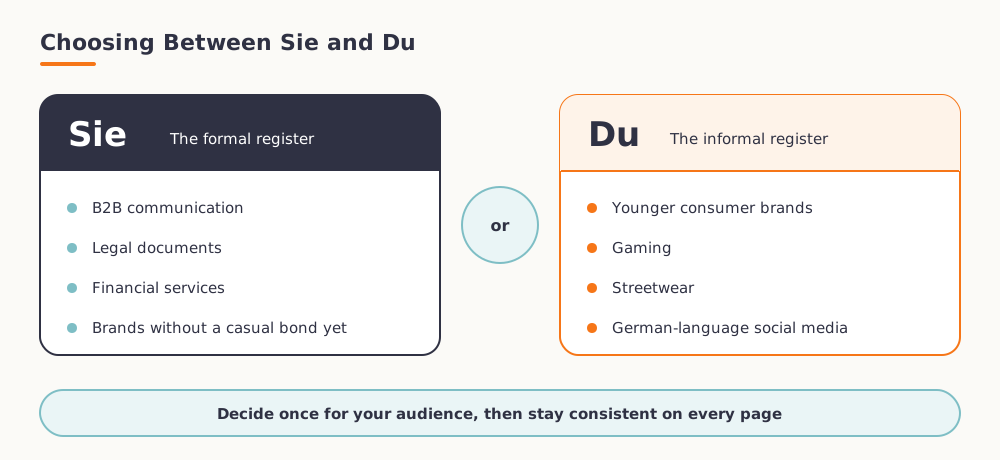
Sie is the formal register: the safe default for B2B communication, legal documents, financial services, and any brand that has not earned a casual relationship with its audience yet.
Du is informal, and it has become the norm for younger consumer brands, gaming, streetwear, and much of German-language social media, where "Sie" can read as stiff or distant.
Neither is universally correct. A law firm that switches to "Du" looks unprofessional, and a youth streetwear brand that insists on "Sie" looks out of touch.
The right call depends on the audience, and it needs deciding once, deliberately, rather than drifting between the two across different pages of the same site.
Common pitfall: Vicks had to rebrand as Wick across German-speaking markets. In German, "v" is pronounced like an English "f," so "Vicks" was heard as the German expletive for intercourse, and an intermediate "Wicks" spelling ran into a second problem as a near-homophone for "wichsen," German slang for masturbation. Neither issue exists in English, and neither would surface in a text-only translation, which is exactly why brand names and taglines need a native speaker to say them out loud before launch, not just professional German translators working from the page.
Managing German Text Expansion in UI/UX
German words and compound nouns run noticeably longer than their English equivalents once a full sentence is translated.
That expansion is not a copy problem. It is a layout problem. A button, a navigation label, or a form field sized for English text will often clip, wrap awkwardly, or force the layout to break once the same string ships in German.
Design for the German website localization pass from the start: build UI components with generous width tolerance, test navigation labels in German early, and avoid locking button widths to the English character count.
Regional Variations Across the DACH Market
Germany, Austria, and Switzerland share a language but differ enough in spelling, currency, and law that a single "German" version of a site can misfire in two of the three markets.
The ß (eszett) is the clearest everyday example. Germany and Austria use it in standard spelling ("Straße"). Switzerland officially dropped it decades ago and writes "ss" in every case instead ("Strasse"), which is also reflected on the Swiss QWERTZ keyboard layout, where ß behaves differently than on a German one.
| Germany (DE) | Austria (AT) | Switzerland (CH) | |
|---|---|---|---|
| Currency | Euro (EUR) | Euro (EUR) | Swiss franc (CHF), not EUR |
| ß usage | Standard ("Straße") | Standard ("Straße") | Not used; always "ss" ("Strasse") |
| Data protection law | GDPR + TDDDG (formerly TTDSG) | GDPR (EU member) | Revised FADP (its own law; Switzerland is not in the EU or EEA) |
| Legal notice requirement | Impressum mandatory (§ 5 DDG) | Impressum mandatory (Austrian E-Commerce Act) | Similar disclosure duties under Swiss law, distinct legal basis |
Switzerland is the one that catches teams out most often: it is not an EU or EEA member, so GDPR does not apply directly, and the country runs its own data protection law (the revised FADP, in force since September 2023) instead. Pricing a Swiss storefront in euros, or assuming GDPR compliance covers a Swiss customer, are both common and avoidable mistakes.
Building Trust and Legal Compliance
Mandatory Impressum and GDPR/TDDDG Rules
A German-facing website without a proper Impressum (legal notice) is not a stylistic choice. It is a compliance gap. The requirement itself has not changed, but its legal basis has: since May 2024, it sits under Section 5 of the Digitale-Dienste-Gesetz (DDG) rather than the older Telemediengesetz (TMG), so a site still citing "§ 5 TMG" is citing a law that no longer exists.
Cookie consent runs on a second, related track. Germany layers its own Telecommunications Telemedia Data Protection Act, renamed TDDDG in 2024 (still widely referred to by its old name, TTDSG), on top of the EU-wide GDPR. Consent for anything beyond strictly necessary cookies has to be freely given, specific, and just as easy to refuse as to accept, which rules out the "accept-only" cookie banners that are still common on English-language sites.
Localized Payment Gateways and Trust Badges
German shoppers are unusually payment-method sensitive, and offering only a credit card field is one of the fastest ways to lose a sale at checkout.
PayPal holds the largest share of German online payment revenue at 28.7 percent, followed by invoice payment (Rechnungskauf) at 26.1 percent and direct debit at 14.4 percent, with credit and debit cards well behind at 13.7 percent.
EHI data via E-Commerce Germany News, Top Payment Providers in the DACH Region, 2026
In practice, a competitive German checkout usually needs PayPal, SEPA Direct Debit, a buy-now-pay-later option like Klarna, and invoice payment alongside standard cards, not instead of them. Invoice payment in particular reflects a real cultural preference: many German shoppers want to receive and inspect goods before paying for them.
Trust signals matter as much as payment choice. A recognizable certification badge, such as Trusted Shops, alongside a visible, correctly cited Impressum and a clear returns policy, does real work toward conversion in a market that is more trust-cautious at checkout than many others.
Building a Localization Strategy That Works
- Hire native-speaking translators, or review every translation with one, rather than relying on a bilingual employee reading it once. Professional German translators catch the errors a fluent non-native speaker misses.
- Avoid word-for-word translation. Read and understand a full passage before translating it, since German and English share roots but diverge often enough in word order and idiom that literal translation regularly produces text that is technically correct and still reads wrong.
- Match the tone of the source document. A playful, informal English original should not turn stiff and formal in German, and a formal legal document should not turn casual.
- Get technical and legal content translated by someone who knows the domain. Translating technical documents into German safely needs a translator fluent in the subject matter, not only the language, since a mistranslated spec or warning label carries real consequences.
- Review the translation more than once. A single pass, even by a skilled translator, misses things that a second read, ideally by a different linguist, tends to catch.
- Show up in the local community, not just in the local language. Sponsorships, local events, and responsive local support build the kind of trust a translated page alone cannot.
Expanding into Germany, Austria, or Switzerland?
Cultural accuracy, tone of address (Sie vs. Du), and legal compliance are essential for earning trust in the DACH region. Our native German linguists ensure your brand speaks directly to local buyers.
The Bottom Line
Localization for the German-speaking market is not one job, it is at least three: get the language and tone right, get the legal and payment layer right, and do not assume Germany, Austria, and Switzerland are the same market wearing the same language.
Brands that treat all three carefully tend to earn the kind of trust that keeps German-speaking customers coming back, rather than bouncing at checkout over a missing payment method or a missing Impressum.
Further German-language learning resources, such as the German language courses offered in Chennai and Trivandrum, can also be useful background for teams building in-house German-language capability alongside professional translation support.