Globalizing Financial Intelligence: Bridging Language Gaps in Data From Various Sources
Filings, analyst notes and market feeds arrive in whatever language the issuer uses. Here is what makes multilingual financial analysis workable in practice.

Financial intelligence decides what a company does with its money, and most companies now draw it from sources that were never written in their working language.
Filings, analyst notes, regulatory bulletins and market feeds arrive in whatever language the issuer uses. Reading them late, or reading them wrong, costs money in a way that is hard to trace back to its cause afterwards.
What follows is the practical side of that problem: the tooling, the cultural context sitting behind the numbers, and the process changes that make multilingual analysis workable. It closes on where AI is being applied in practice and what that is likely to mean for the field.
The Growing Need for Global Financial Intelligence
The Interconnected Global Economy
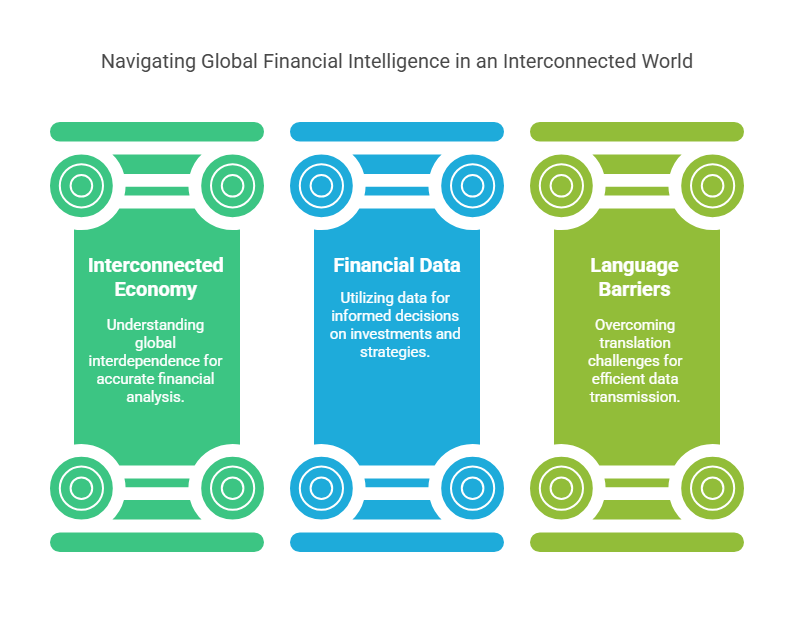
A rate decision in one country moves currencies, equities and input costs in a dozen others. Analysis at international scale is really the tracking of second-order effects, not the reading of separate national markets side by side.
That makes it a research problem before it is a translation problem. It is also a reminder that culture shapes market behavior and not only advertising copy.
What Financial Data Is Actually For
Financial data underpins the decisions that matter: where to invest, what to price at, which risks to carry and which to hedge.
Accuracy counts for more than volume here. A confident decision made on a mistranslated figure is worse than no decision at all, because nobody goes back to check a number that already produced an answer.
Where Language Gets in the Way
Language slows the transmission of financial information and occasionally corrupts it.
A misread term in a disclosure, a number written to a different decimal convention, a footnote nobody translated: each of these has produced real losses, and none of them looks like an error until someone returns to the source document.
Speed compounds it. Working in international financial markets means acting on information that stays useful for a short window, which is why teams pair translation workflows with real-time market data feeds instead of waiting for a quarterly digest.
Using Technology to Translate Financial Data
Translation Tools and AI
Machine translation changed what is realistic. Large volumes of financial content in many languages can be processed in minutes rather than days, which is what makes monitoring dozens of markets possible at all.
The output is not publication quality, and for this job it does not need to be. Deciding which of four hundred filings deserves a human reading is triage, and triage rewards speed over polish.
What the Technology Buys, and What It Costs
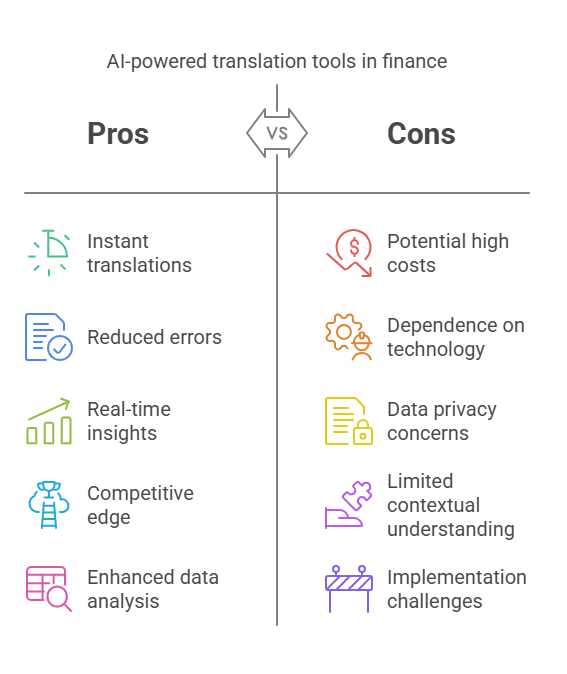
Translation technology inside a finance stack mostly buys time: analysis starts while the information is still current.
It also removes a class of transcription error, though not the interpretive ones. Anything that will be acted on, or published, still needs professional human translation over the top.
The costs are real too, and worth naming before a procurement conversation rather than after. Enterprise translation tooling is not cheap, it creates a dependency on a vendor's uptime, and feeding confidential financial documents through a third-party engine raises data protection questions that a legal team will ask about sooner or later.
What This Looks Like in Practice
Financial institutions have been building this into their workflows for several years, usually alongside the wider shift toward treating data and analytics as a marketing and strategy asset rather than a back-office function.
Investment banks run machine translation across multilingual market data to widen the pool of opportunities their analysts can actually see. Retention rules make long-term data archiving part of the same conversation, since a translated document that will be needed for a future audit has to survive as long as the original.
The Cultural Dimension in Financial Data
Culture Shapes Financial Reporting
Reporting conventions differ by more than language. What gets disclosed, how conservatively it is stated, and how much is left to the reader all vary between markets.
Treating a foreign filing as a translated version of a domestic one is where misjudgments start. The words can be rendered correctly and the meaning still be wrong.
Building Cultural Context Into the Analysis
Analysts need enough context to read a document the way its intended audience would. That means knowing the local reporting requirements and the conventions around them, not only the vocabulary.
It is the same skill that makes cultural media useful for learning a language: exposure to how something is normally said tells you when a particular phrasing is doing unusual work.
Avoiding Cultural Bias in Assessments
Reading a market against your own norms produces a predictable set of errors, usually in the direction of assuming that an unfamiliar disclosure style signals a problem.
Context does not remove that risk, but it makes it visible. An analyst who knows what a standard filing looks like in that market can tell when one is not standard.
Practical Steps for Improved Financial Analysis
Fix the Collection and Translation Process First
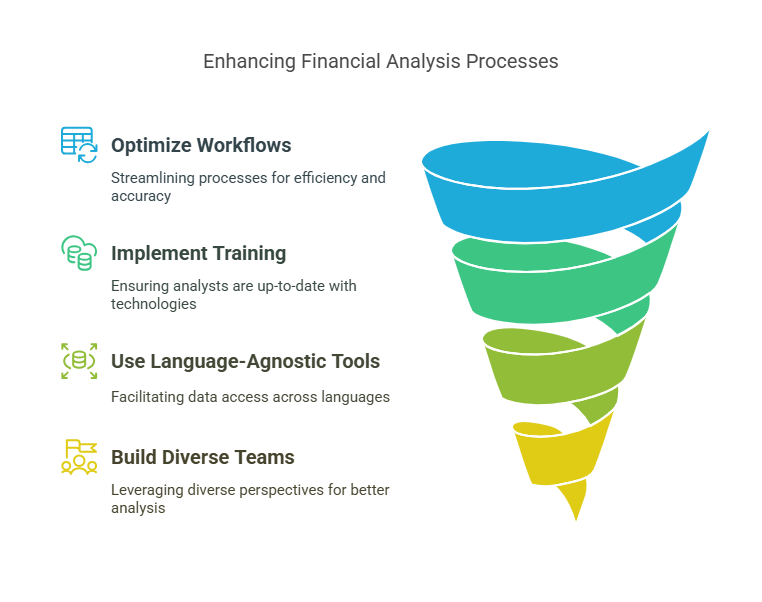
Most of the available improvement is in the process, not the tooling. Work out which sources genuinely need translating, in what order, and to what quality, before buying anything.
Financial translation then sits inside a defined workflow rather than being requested ad hoc, and the recurring items (quarterly reports, French-language filings, regulator bulletins) can be scheduled instead of chased.
Budget for ongoing training as well. Analysts who do not know what the tooling can and cannot do will either distrust it or over-trust it, and both are expensive.
Use Language-Agnostic Analysis Tools
Tools that work across languages let a team query the same dataset regardless of the source language, which removes a whole category of manual reconciliation.
They are not a substitute for translation. They make it obvious which documents need one.
Build Culturally Diverse Financial Teams
A team drawn from several markets reads foreign filings with fewer blind spots, because somebody in the room has seen that reporting style before.
This tends to be the cheapest of the three interventions and the slowest to arrange. It is also the one that keeps paying after the tooling has been replaced.
Future Prospects in Financial Intelligence
Where Language-Agnostic Analysis Is Heading
Expect the gap between source language and analysis to keep narrowing. The direction of travel is toward tooling where the language of a document stops being something the analyst has to think about.
AI and Machine Learning
The near-term gains are in machine translation and natural language processing applied to document triage and entity extraction, rather than in automated decision-making.
Predictive work will follow, and it will be judged on whether anyone can explain its outputs to a regulator. That constraint shapes finance more than it shapes most other fields.
The Evolving Field
Analysis is becoming continuous rather than periodic, which puts pressure on every step that used to happen in batches, translation included.
Infrastructure is moving the same way. Embedded finance platforms are one example of financial capability being built into products that were not financial to begin with, which multiplies the number of places multilingual financial content has to work correctly.
Final Thoughts
Multilingual financial intelligence is a process problem with a technology component, not the other way round.
The organizations that handle it well do three unglamorous things: they decide what needs translating and when, they give analysts enough cultural context to read a document as its author intended, and they hire people who have already worked in the markets they are analyzing.
The tooling makes all three cheaper. It does not do any of them for you.
For more on the wider problem, see our guide to overcoming language differences in international markets.