How to Overcome Language Barriers in International Markets - Practically
Language barriers in international markets are rarely dramatic - they show up as stalled negotiations, misunderstood contracts, and product launches that underperform without a clear reason. 🌐 See the practical options for closing them across written, live, and digital communication.
Language differences in international markets come in shapes that are easy to underestimate until they cause a problem.
A negotiation that stalls because a term did not translate cleanly.
A product launch that underperforms because the positioning was lost in translation.
A contract dispute that runs for months because the parties signed documents they each understood differently.
None of these are abstract risks - they are recurring scenarios for companies that treat language as a logistics problem rather than a communication one.
The European Commission has studied this directly. Its ELAN report on foreign language skills in European enterprise found that a measurable share of SMEs had lost export contracts outright because nobody could operate in the customer's language, and that the aggregate cost to the EU economy runs into the tens of billions of euros.
Identify Where Language Breaks Down in Your Operation
Language differences show up differently depending on the type of international activity involved.
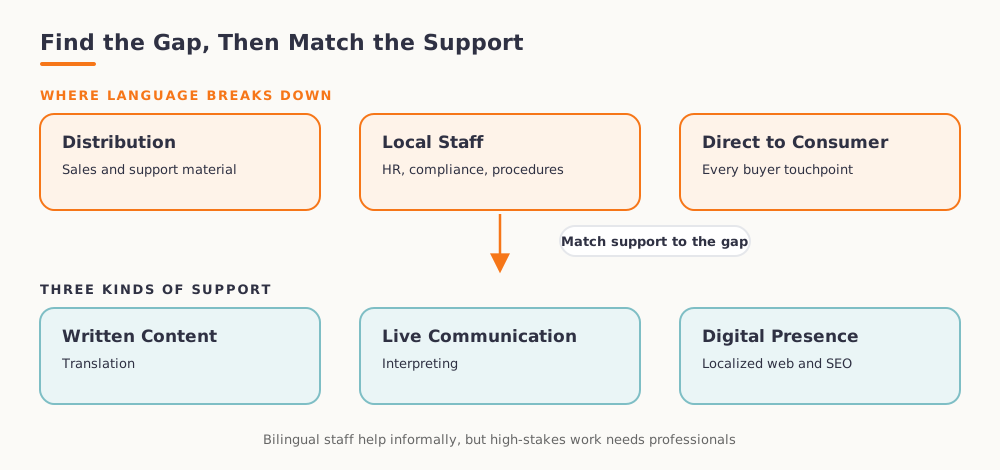
For a company entering a new market through distribution, the barrier is typically in the sales and support material - product descriptions, training documents, and customer-facing content that distributors cannot use effectively in their own language.
For a company operating through local staff in multiple countries, the barrier is often internal - HR documentation, compliance policies, and operational procedures that exist only in the headquarters language.
For a company selling direct-to-consumer across borders, the barrier is the buyer journey - every touchpoint from discovery to post-purchase.
Written Content: Get the Foundation Right First
For most international operations, the highest-volume language need is written - contracts, product content, legal documentation, marketing materials, and customer communications.
Our translation services cover this full spectrum, from contract translation and legal translation through to marketing translation and e-commerce content.
Live Communication: When Real-Time Language Support Matters
Written translation handles the document layer.
Negotiations, sales meetings, technical briefings, board presentations, and client events require real-time language support - and that means professional interpreting rather than bilingual staff trying to handle two roles at once.
Our interpreting services cover both on-site interpreting for in-person events and video remote interpreting for meetings where participants are in different locations.
For companies running regular multilingual meetings or international conferences, our remote interpretation services provide a scalable alternative to the logistics and cost of traditional booth-based conference interpreting.
Digital Presence: Visibility in Every Target Market
A company that operates in Germany but cannot be found by German buyers searching in German faces a language gap even if nobody in the company perceives it as one.
Overcoming digital language differences requires more than a translated website - it requires a fully localized web presence with market-specific keyword targeting so that buyers can find you through organic search in their own language.
See our German SEO services, French SEO services, and Spanish SEO services for how we approach each market specifically.
To map the language gaps in your international operation and scope the work involved in closing them, request a quote - we work across the full range from one-off documents to ongoing multilingual programs.
Frequently Asked Questions
What Is the Most Common Language Gap in International Business?
Legal and contractual documentation is consistently where language differences create the most expensive problems - misunderstood terms, differing interpretations, and compliance failures that surface months after the original documents were signed.
Can Bilingual Staff Handle International Language Needs?
For informal communication, yes - bilingual colleagues are an asset. For legal documents, regulated content, technical specifications, or high-stakes negotiations, professional translation and interpreting removes the liability of asking someone to handle two professional roles simultaneously.
How Quickly Can You Provide Interpreting for an Upcoming Meeting?
We can typically arrange remote interpreting with 24 to 48 hours notice for most language pairs. Contact us via the quote form with your date and language pair and we will confirm availability.
What Languages Do You Cover for International Business?
We cover 50+ languages for written translation and the major European, Asian, and Middle Eastern languages for interpreting services. See our language translation directory for the full list.
Do You Offer Ongoing Language Support or Just Project-Based Work?
Both - we work on project-based briefs for defined scopes and on retainer arrangements for companies with regular ongoing translation and interpreting needs across multiple markets.