What Does a German Elephant Say? Translating Onomatopoeia
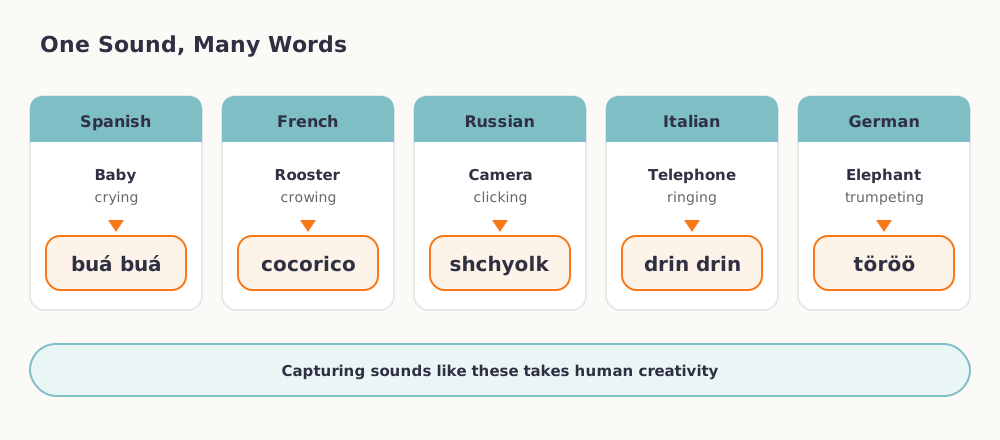
What Does a German Elephant Say? Translating Onomatopoeia The proper term is “cross-linguistic onomatopoeia,” but James Chapman just calls them “sounds in other languages”: from the crying of a baby in Spanish (buá buá), the crowing of a rooster in French (cocorico), the clicking of a camera in Russian (shchyolk) to the ringing of a telephone in Italian (drin […]

How Animal Sounds Change From One Language to Another
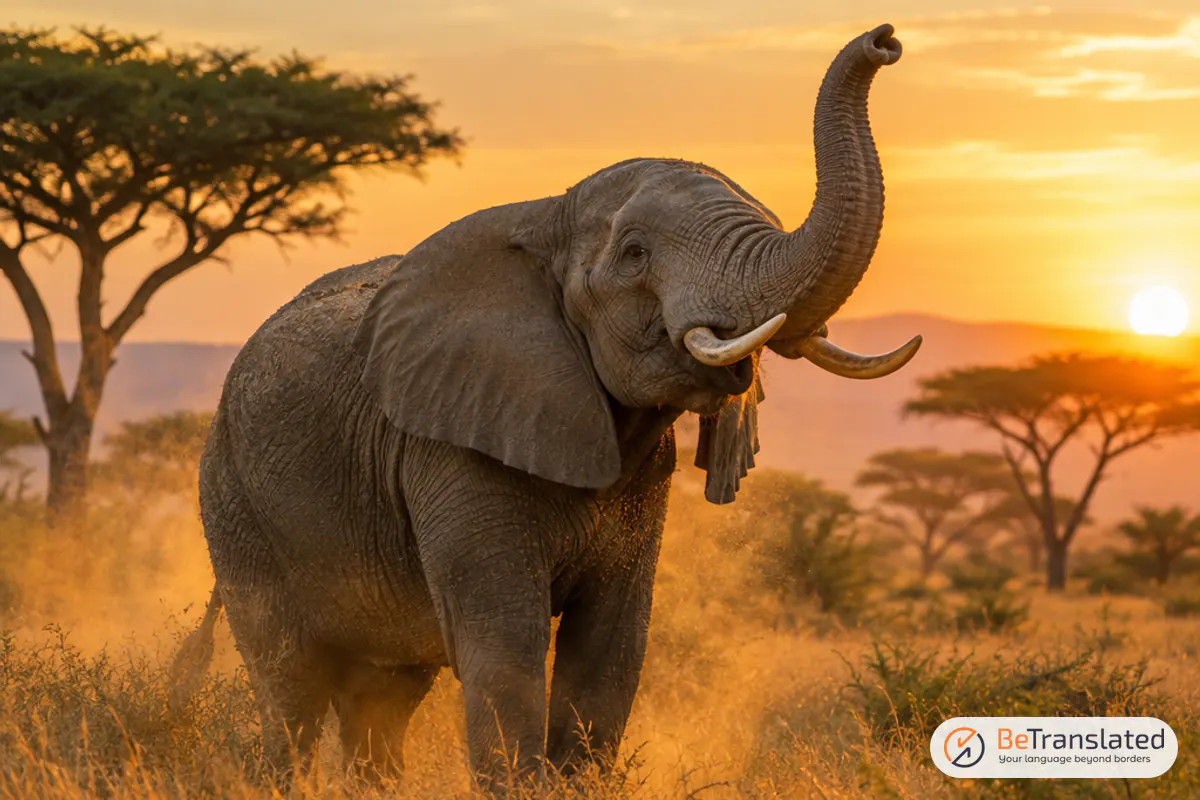
The short answer to the title question: in German, an elephant trumpets töröö. The proper term for words like that is "cross-linguistic onomatopoeia," and the idea is simple.
"Onomatopoeia is a type of word, or the process of creating a word, that phonetically imitates, resembles, or suggests a sound that it refers to."Source: Wikipedia, Onomatopoeia, accessed November 2026
The illustrator James Chapman draws these words on his Tumblr blog. Examples from the Wikipedia list include a baby crying in Spanish (buá buá), a rooster crowing in French (cocorico), a camera clicking in Russian (shchyolk) and a telephone ringing in Italian (drin drin). The same Wikipedia page is a long list of words for noises from around the world.
If a list is not what you want, the drawings on James Chapman's blog make the point more lightly. Our favorite is the International Guide to Shutting People Up.
Do We Hear Differently Depending on Our Language?
Could these differences mean that we hear differently in different languages? An article in Science Daily on a 2016 study of Italian, Persian and Turkish speakers gives a partial answer. The researchers found that the rhythm of a person's native language influenced how they perceived the sounds of other languages.
The same study found no transfer to non-linguistic sounds such as musical tones:
"However, we found no transfer of the effect to the other domains of non-linguistic auditory and visual stimuli."Source: ScienceDaily, Do speakers of different languages hear music differently?, 2016
So the study does not show that speakers of different languages hear a bang, woof or splat differently. Why animal sounds vary so much is a separate question, and an article from The Guardian looks at how the noises we assign to animals differ from language to language, and where they match.
Onomatopoeia in Translation
Translating onomatopoeia is one of the many challenges translators face. Machine translation keeps improving, but it takes creativity to capture subtleties such as onomatopoeia, metaphor and humor, which is one reason every translation we deliver gets a human review.
This matters for anyone who needs translation services. Advertising and marketing text, for example, depends on the reader feeling the same connotations as in the original, whether the target is French translation services, Spanish translation services or Korean translation services.
At BeTranslated we are translators and also lovers of language. If you need a translation that preserves and adapts the cultural references, idioms and style of your text, request a free quote today. We cover 50+ languages, including German translation services for the elephant in the title.