What Is Translation Plagiarism and How to Detect It
Translation plagiarism is undoubtedly a modern-day concern that might also cause trouble for you if you don’t act fast. Read about it in this article.

Recognizing and Detecting Translation Plagiarism
Translation plagiarism is a modern concern that can cause trouble for your site if you do not act quickly. This article explains what it is and how to check for it.
When we talk about translation plagiarism, we mean copying content that another writer published, translating it, and publishing the result as original work. Researchers call this cross-language plagiarism, and it is hard to catch because many standard checkers match wording within a single language, so a translated copy can pass.
Understanding Translation Plagiarism
Translation plagiarism involves copying another person’s work and publishing it on your website or blog after translating it into another language.
Because the wording changes, a translated copy is less likely to trigger an ordinary plagiarism check. That is why some publishers translate content that already exists instead of writing their own.
It can still cost them. Google does not list "translation" as a violation on its own, but its spam policies name translating among the techniques used to republish scraped content at scale.
"Scraping feeds, search results, or other content to generate many pages (including through automated transformations like synonymizing, translating, or other obfuscation techniques), where little value is provided to users"Source: Google Search Central, Spam policies for Google web search, 2026
Pages that add no value can rank lower or drop out of results, which hurts SEO scores and the site’s credibility. Copyright is a second risk, because international law gives authors control over translations of their work.
"Authors of literary and artistic works protected by this Convention shall enjoy the exclusive right of making and of authorizing the translation of their works throughout the term of protection of their rights in the original works."Source: WIPO Lex, Berne Convention for the Protection of Literary and Artistic Works, Article 8, 1979
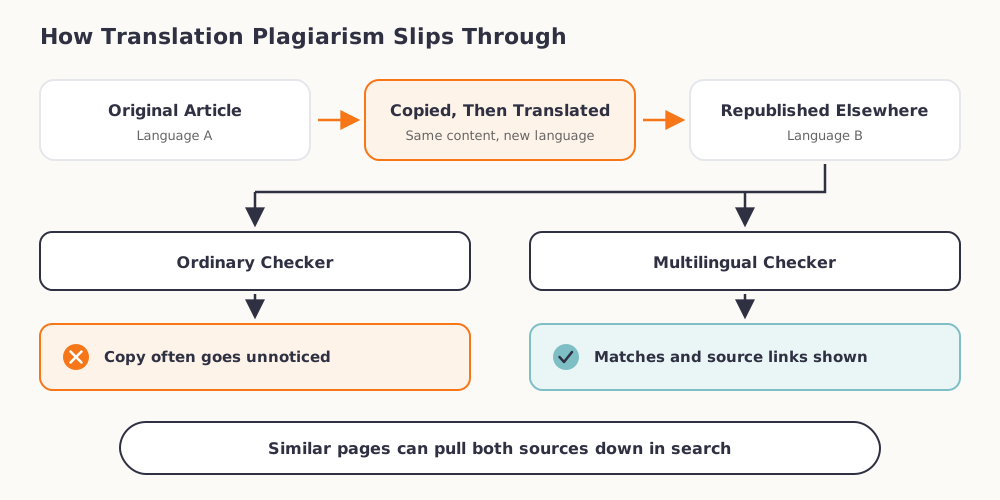
Now, let’s say you think that someone is using your content by simply translating it. In that case, run it through a checker that supports more than one language.
Few tools say they can match text across languages, so read each vendor’s own claims with care. Below are six tools worth knowing, with what each one says it does.
How to Detect Translation Plagiarism
Here are some of the top options to consider when checking translated content on the internet.
Plagiarismchecker.co
The plagiarism checker by PlagiarismChecker.co is a web-based service that checks pasted text and uploaded files such as PDF and Word documents. The free version is limited to 800 words per check, and paid plans raise the limit.
The site lists support for 20+ languages and says it uses AI algorithms to find matches. It does not state that it detects text translated from another language, so treat it as a general-purpose checker.
Grammarly
Grammarly includes a plagiarism checker in its paid plans. It describes the feature as scanning your writing against databases, academic papers, websites and published works.
Grammarly’s documentation does not say that the checker detects translated text, so it is best for catching copying within the same language. Matches show as bars beside your text, and you can compare the sources manually, add a citation or rephrase the passage.
Plagramme
Plagramme is an online checker that gives free originality scores with each upload, up to three checks on its home page. It accepts formats such as DOC, DOCX, RTF, TXT and PPTX, and lists support for 100+ languages.
Plagramme also says it covers the translated case directly.
"Catches plagiarism even when content is translated across languages"Source: Plagramme, Multilingual Plagiarism Checker, 2026
The vendor calls this an exclusive feature, so test it on a sample before you rely on it.
Duplichecker
Duplichecker is a free online tool that runs in any browser on any device. The free version limits how much text you can check at once, and paid plans lift those limits.
You can use this duplication checker as a first pass for copying within the same language. We could not confirm that it detects translated text.
Plagiarism Hunt
Plagiarism Hunt is an online service that bundles several plagiarism checking tools, so you can compare results from more than one engine. Check its site for current free and paid options before you rely on it.
WhiteSmoke
WhiteSmoke is a writing tool whose Premium plan is described as a spelling, grammar, punctuation, style and plagiarism checker. Its translator covers more than 50 languages.
We could not confirm that its plagiarism checker finds text copied across languages, so use it as a general checker and verify any translated match by hand.
Stop Translation Plagiarism Before It Hurts You
Shortcuts like translation plagiarism may look tempting, but the risks outweigh the rewards. The tactic can damage your brand’s reputation, hurt your SEO rankings and expose you to copyright claims.
By understanding what translation plagiarism is and testing the right tools, you can protect your content and keep it original in every language.