Enhancing Academic Cultures: International Study Experiences
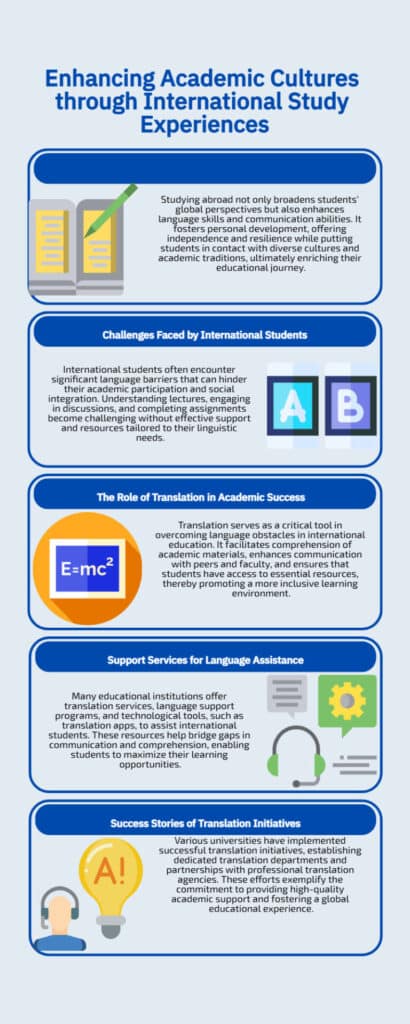
Studying abroad works better when the language stops getting in the way. What the barriers actually are, and what translation and language support can do about them.

Enhancing Academic Cultures: International Study Experiences
More students are studying abroad than a decade ago, and the reasons have not changed much: a different academic culture, a different country, and a degree that travels.
What does get underestimated is the language. A student can meet every entry requirement and still spend the first semester at a disadvantage in lectures, seminars and written work, simply because everything is happening in their second language.
That gap is where translation and language support earn their place. They are not a luxury bolted onto studying abroad, they are what lets a student take part in it on equal terms.
Studying Abroad: Expand Horizons, Experience Diverse Academic Cultures
Going overseas to study puts a student somewhere unfamiliar and keeps them there long enough to learn how the place works. That is the part a semester of reading about a country does not deliver.
The usual gains are well documented and fairly consistent.
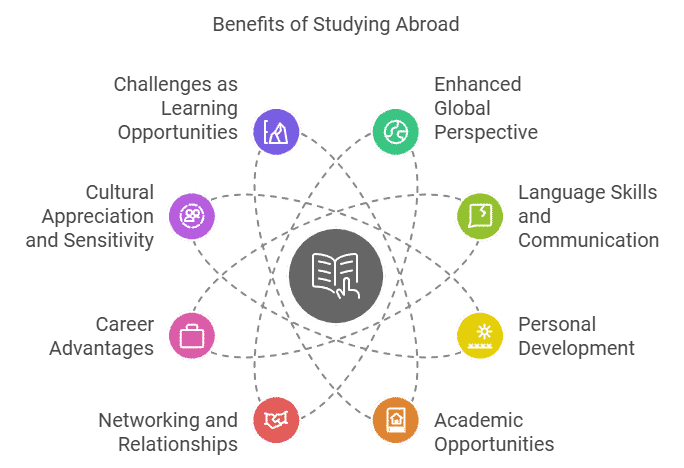
- A wider view of the world. Seeing another education system from the inside changes how a student reads international news, and it shows in careers that touch global markets or international relations.
- Language and communication. The language is a barrier at first and an asset later. Full-time exposure moves a student further in a year than classroom study does in several.
- Independence and resilience. Running your own life in a country you do not know builds a specific kind of confidence, and most students come home with more of it than they left with.
- Academic range. Study abroad courses and research groups often cover specialties that are not available at home.
- Networks that last. The friendships and professional contacts made abroad tend to outlive the degree.
- Something employers recognize. Adaptability, problem-solving and cross-cultural communication are hard to demonstrate on a CV, and a year abroad demonstrates all three at once.
- Cultural fluency. Living inside a different set of norms produces a more useful understanding of them than any amount of reading.
- Useful difficulty. Homesickness, culture shock and the language itself are real, and getting through them is a large part of what the experience teaches.
Challenges of Studying Abroad: Language Differences and Translation Needs
The language problem is not one problem. It shows up differently in each part of academic life, which is why a single fix rarely covers it.
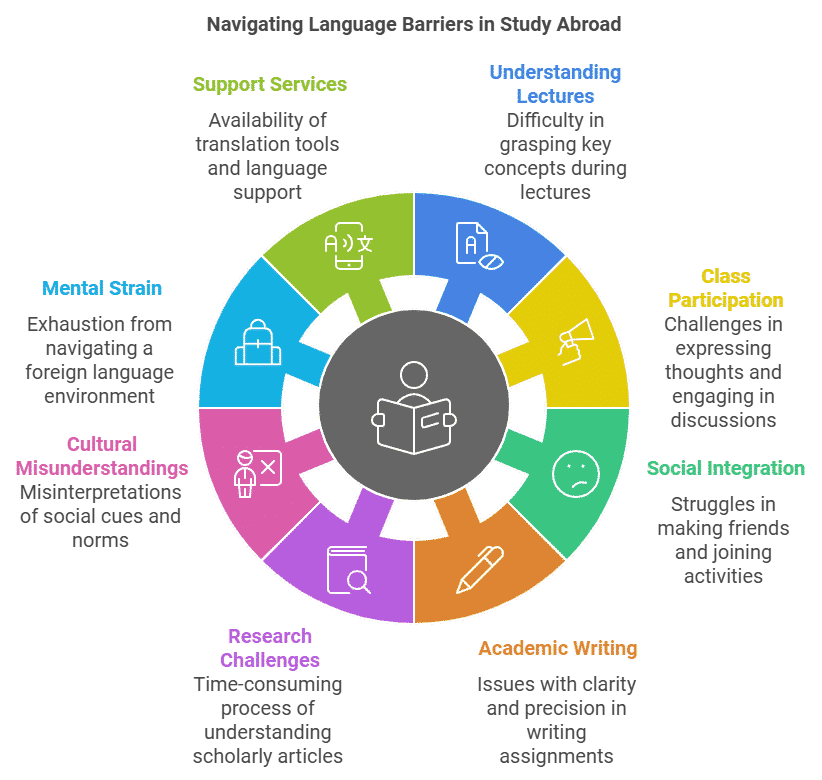
In lectures, a student who is translating in their head is always a sentence behind, and the sentence they miss is often the one that mattered. Bilingual lecture notes or textbooks help, and support aimed at specific communities, such as resources for Hispanic students, is built on exactly that principle.
In discussion, the cost is participation. A student with a good point and not quite the vocabulary to make it quickly will often not make it at all, and seminar grades notice.
In writing, precision is the whole game. Academic writing punishes approximate phrasing, and a non-native writer can lose marks for expression on an argument that was sound.
In research, everything takes longer. Reading a scholarly article in a second language is slower than reading one in a first, and a literature review multiplies that by fifty.
Socially, the effect compounds. Students who find it hard to join conversations find it hard to join anything, and isolation feeds back into the academic side.
Culturally, misreadings go both ways. Language carries norms with it, and a phrasing that is neutral in one culture can land badly in another without anyone intending it.
And it is tiring. Operating in a second language all day is genuine cognitive load, and the resulting fatigue is one of the most underrated parts of the experience.
Most of these have practical answers: university language classes, tutoring, writing centers, translation tools, voice-to-text, and course materials offered in more than one language.
Translation's Role in International Study Experiences
Translation is what turns a course delivered in one language into a course a student can actually take in another.
At the practical level it means access: to the reading list, to the handbook, to the assessment criteria that everyone else understood the first time. Translation services cover the documents, and language support covers the live parts.
The distinction matters when budgeting. Translating a syllabus is a one-off cost; helping a student follow a seminar is an ongoing one.
Resources and Support for Language Assistance
Universities differ enormously in what they provide, and the differences are worth checking before choosing one.
At the document end, institutions commonly translate syllabi, course materials and assignment instructions, which is the same category of work as the translation services businesses commission for their own documentation.
Many also license translation software or platform access for enrolled students, which is cheaper than individual subscriptions and usually better than the free tier.
The live support varies more. Some institutions run writing centers and conversation groups; others point students toward private tutoring, such as an A-level English tutor, and leave the arrangement to them.
The Role of Translation in Academics
Translation does several distinct jobs in an academic setting, and they are worth separating.
It makes comprehension possible, so that lectures, textbooks and course materials are available to everyone in the room rather than to the subset who share the language of instruction.
It opens up global knowledge. Getting research papers and scholarly articles across languages is how findings circulate, and a field that only publishes in one language is a smaller field than it thinks.
It supports multilingual teaching, which is the practical form of inclusion in a department with students from twenty countries.
It enables collaboration between researchers who do not share a working language, which is now most large collaborations.
Accuracy carries more weight here than in almost any other kind of translation. An approximate rendering of a methodology section is not a stylistic problem, it is a reproducibility problem, which is why academic work belongs with specialized translation rather than a general service.
What Institutional Translation Support Looks Like
There is no single model. Four broad patterns cover most of what universities actually do.
In-House Translation Units
Larger institutions sometimes staff their own translation teams, handling course outlines, lecture notes and research output internally.
The advantage is subject familiarity. A translator who has worked on the same department's material for three years knows its terminology better than any newcomer will.
Partnerships With Translation Agencies
Covering a wide range of languages in-house is impractical, so institutions contract it out, often for website content, course material and live interpreting at events.
This is the model behind most international translation services arrangements: a core in-house capability for the main languages and an agency relationship for the rest.
Broader Language Support Programs
Some institutions treat translation as one piece of a wider program that also includes tutoring, writing workshops and cultural orientation.
Where this exists it is usually documented on the university's own site rather than in the prospectus, so it is worth looking. MIT's main site, for instance, keeps its campus life and student resources sections in the top-level navigation, which is the normal place to start.
Digital Tools
Most institutions now provide translation software or platform access as standard, which handles the day-to-day reading load even where it is not good enough for submitted work.
Student-led schemes sit alongside this: bilingual students translating materials or running peer language learning groups. These cost the institution very little and tend to build the community that formal support does not.
Whichever combination a university uses, the languages it can genuinely cover come down to the language pairs available to it.
Tips for Students Studying Abroad
A few habits make translation work harder for you.
- Use translation software for unfamiliar words as you go, rather than saving them up. The lecture does not wait.
- Find out what your university already provides before paying for anything. Workshops and conversation groups are often free and underused.
- Work through difficult material with classmates who share your first language. Two people translating a dense chapter is faster and more accurate than one.
- Ask lecturers directly when something is unclear. Most will happily rephrase, and many will point you at a better source.
- Treat the fatigue as real and plan around it. Scheduling your hardest reading for the end of a long day in a second language is a false economy.
The Impact of Translation in International Education
When the language stops being the obstacle, the experience becomes what the student came for.
Institutions carry most of the responsibility here, because they control the documents, the tooling and the support programs. Students carry the rest, mainly by finding out what is available and using it.
The wider gain is not confined to the students who travel. A department that can operate in several languages is a department more people can contribute to, which is the whole argument for doing any of this.