Does Google Penalize AI-Translated Pages? What the Spam Policy Actually Says
Google does not penalize a page for being machine translated. It acts on scaled, unoriginal pages that do not help users. Here is what Google's own documentation says, and how to review AI-translated pages before they go live.

Short answer: no. Google does not penalize a page because a machine translated it. It acts on pages that exist mainly to game search results, and unreviewed machine output published in bulk is the usual way a translated site ends up there.
That is more precise than most vendor advice, and it is not the rule those posts quote. Older SEO advice still says Google wants a human to review every translation, and in June 2025 a related passage disappeared from Google's documentation. This article walks through what Google's current pages say, what the June 2025 change was and was not, and a review workflow to run before translated pages go live.
Every Google quotation below comes from Google's own pages, read on October 10, 2026. Google rewrites these documents, so check the current wording before you rely on a detail.
What Google's Spam Policy Actually Says
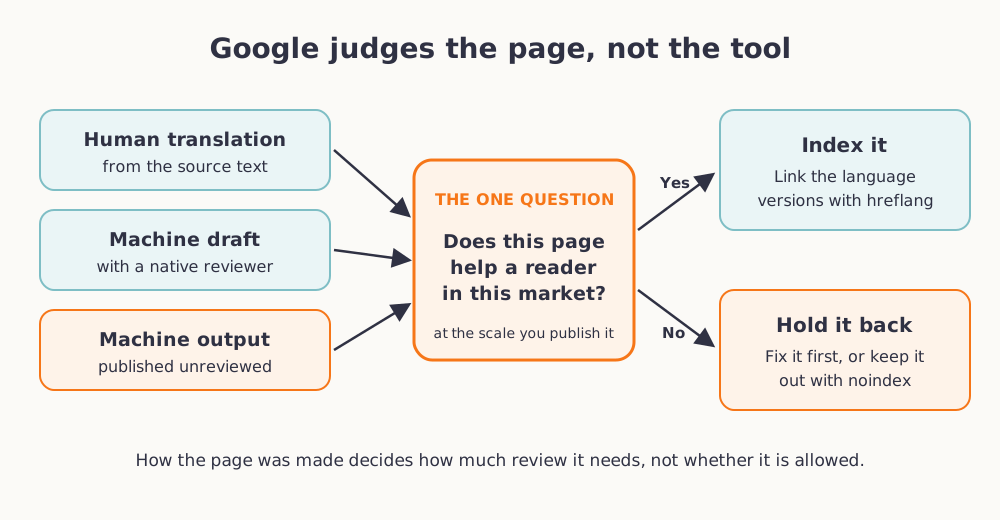
The relevant section is called scaled content abuse. It does not treat machine translation as a category of its own. It describes a purpose and an outcome.
Scaled content abuse is when many pages are generated for the primary purpose of manipulating search rankings and not helping users. This abusive practice is typically focused on creating large amounts of unoriginal content that provides little to no value to users, no matter how it's created. Source: Google Search Central, "Spam policies for Google web search"
Translation appears once, in the list of examples under that heading:
Scraping feeds, search results, or other content to generate many pages (including through automated transformations like synonymizing, translating, or other obfuscation techniques), where little value is provided to users Source: Google Search Central, "Spam policies for Google web search"
Read the sentence in full. It describes taking other people's content, producing many pages, and providing little value. A company translating its own pages for its own customers is not what the example describes. That is our reading; Google does not spell it out.
The consequences are also spelled out on the same page. Google says it detects violations "through automated systems and, as needed, human review that can result in a manual action," and that sites in violation "may rank lower in results or not appear in results at all." Neither sentence mentions translation.
What Changed in June 2025, and What Did Not
Google's Search Central changelog has an entry dated June 11, 2025, titled "Spring cleaning in our multilingual documentation."
What: Removed a section from our multilingual documentation about using robots.txt to block all automatically translated pages. Why: To align with our spam policy update in March 2024. This is a docs-only change, no change in behavior. Source: Google Search Central, "Documentation updates," June 11, 2025 entry
Three details matter here. First, the removed section was about blocking automatically translated pages with robots.txt. It was not a rule that machine translation is spam, and its removal is not a statement that machine translation is always fine. Second, Google calls the edit docs-only with no change in behavior. Third, the stated reason points at March 2024, when Google introduced scaled content abuse as a successor to its older spam policy on automatically generated content.
Google's own announcement of that policy explains the shift:
This new policy builds on our previous spam policy about automatically-generated content, ensuring that we can take action on scaled content abuse as needed, no matter whether content is produced through automation, human efforts, or some combination of human and automated processes. Source: Google Search Central Blog, "What web creators should know about our March 2024 core update and new spam policies," March 5, 2024
The removed section is no longer on Google's site, so the changelog entry is the primary record of what it covered. Search Engine Journal reported the change as a clean-up that brings the documentation in line with the newer spam policy.
So "Google dropped its auto-translation guidance" is accurate only if you add "about blocking it with robots.txt." Posts that still say Google requires human review of every translated page are quoting the framing that the March 2024 policy moved past. In our reading, the test now concerns what a page does for the reader and how many such pages exist, not which tool produced the words.
What Google Says About AI-Generated Content
Google has a separate page for generative AI content. It is about creating content rather than translating it, so applying it to translation is our reading, but it is the closest primary guidance there is.
Using generative AI tools or other similar tools to generate many pages without adding value for users may violate Google's spam policy on scaled content abuse. Source: Google Search Central, "Google Search's guidance on using generative AI content on your website"
The same page asks for review, and it names what to review:
It is critical to manually factcheck and review all AI-generated content for accuracy and trustworthiness before publishing. This review also applies to metadata like
<title>elements, meta description elements, structured data, and alternate texts for images, which can appear in Search results. Source: Google Search Central, "Google Search's guidance on using generative AI content on your website"
The metadata line is the one translation teams skip. A body can be polished while its title tag, description, and image alt text stay in the source language or come straight from a machine, and those are the strings searchers see first.
Google also suggests, rather than requires, telling readers how automation was used. The page says to "consider adding information on how your content was created in a way that makes sense for your audience." A short note about machine-assisted translation with native review costs little.
What Actually Causes Trouble on Translated Pages
Google publishes no list of translation penalties, so this combines Google's text with where we see multilingual sites go wrong.
Bulk, unreviewed machine output. Hundreds of pages published after nobody read them is the closest match to "many pages ... without adding value." Wrong terminology and broken product names fail the value test.
Pages that add nothing for the local reader. Google's multi-regional guidance covers similar content on different URLs in the same language. If both example.de and example.com/de show similar German content, it says to pick a preferred version and use the canonical element and hreflang. Near-identical pages for regions that share a language, produced by swapping a few words, invite the same problem.
Translating only the shell. Google warns about this pattern directly:
Translating only the boilerplate text of your pages while keeping the bulk of your content in a single language (as often happens on pages featuring user-generated content) can create a bad user experience if the same content appears multiple times in search results with various boilerplate languages. Source: Google Search Central, "Managing multi-regional and multilingual sites"
Source-language metadata on translated pages. This is the review gap described above, and it is common when a plugin translates body text but leaves titles and descriptions alone.
Broken hreflang. Google's hreflang documentation lists missing return links as a common mistake: if page X links to page Y, page Y must link back, or the annotations "may be ignored or not interpreted correctly." Each language version must also list itself and every other version. The full list is in Google's hreflang documentation.
Redirecting visitors by language. Google advises against automatically redirecting users from one language version to another based on what you think their language is, because it can stop users and search engines from reaching every version.
What Is Fine
A machine draft that a native linguist then edits is a normal production method. A fully translated page is not a duplicate, and Google says so plainly:
Localized versions of a page are only considered duplicates if the main content of the page remains untranslated. Source: Google Search Central, "Tell Google about localized versions of your page"
Google also recommends a separate URL for each language version rather than cookies or browser settings that swap the language, connected by hreflang annotations. Our international SEO guide covers URL structure and hreflang setup in detail.
A Review Workflow for Machine-Assisted Translation
Google does not publish a checklist for translated pages. This workflow is our judgment, built from the documentation above, and it is the process we would want in place before any machine-assisted page goes live.
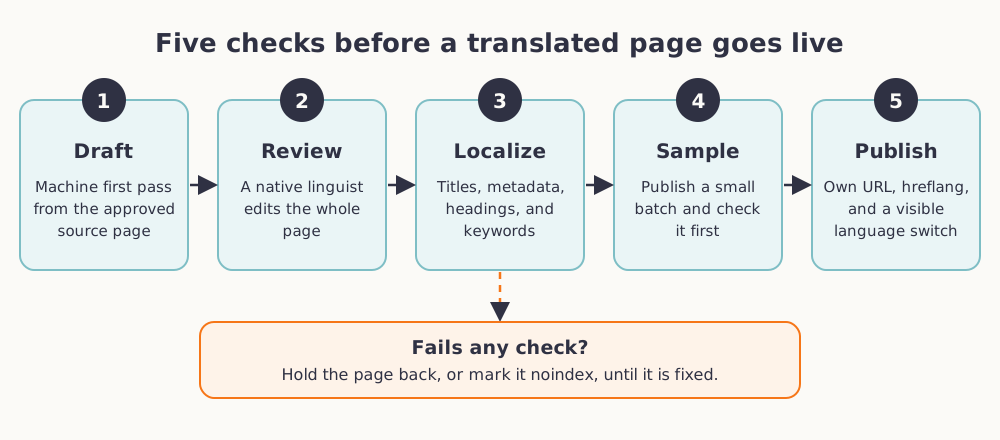
- Draft. Run the machine first pass from the approved source page, not from an earlier translation.
- Review. A native linguist edits the whole page, not a skim of the first paragraph. They check terminology, tone, numbers, units, and any legal or regulated claims.
- Localize. Review titles, meta descriptions, headings, image alt text, and structured data. Pick keywords by checking what people in that market search for, not by translating your source keyword word for word. Our post on multilingual keyword research shows why the literal term is often wrong.
- Sample. Publish a small batch first. Check that the pages are indexed in Search Console, read them on a phone, and compare each to its source for dropped sections or untranslated fragments.
- Publish. Give each language its own URL, add self-referencing and return hreflang annotations, and include a visible language switcher.
Any page that fails a step stays unpublished or carries a noindex tag until it is fixed. Use noindex on the page rather than a robots.txt block. Google's documentation notes that for noindex to work, "the page or resource must not be blocked by a robots.txt file," because a crawler that cannot fetch the page never sees the tag. Details are in Google's noindex documentation.
Where to Spend Human Translation First
You rarely need the same level of review on every page. Put full human translation, or a heavy human edit, on the pages that earn and convert: pages that already rank, product and service pages, pricing, and anything legal, medical, or financial where an error carries real cost. For a closer look at the trade-offs between the two approaches, see our comparison of machine versus human translation.
Lower-stakes material, such as long-tail help articles or archive posts, can get machine translation with a lighter review, or wait until demand justifies the work.
If you want help applying this to a live site, BeTranslated's multilingual SEO services and website translation services cover native review, localized metadata, and hreflang. A free multilingual SEO audit can flag which translated pages need attention first.
FAQ
Is translated content duplicate content?
No, not when the main content is actually translated. Google's hreflang documentation says localized versions are only considered duplicates if the main content remains untranslated. Similar content in the same language on different regional URLs is a different case, and Google's guidance there is to pick a preferred version and use canonical and hreflang.
Do I have to label machine-translated pages?
Google does not require it. Its guidance suggests adding context about how content was created when readers would reasonably wonder, and frames it as a consideration, not a rule.
Does hreflang change the answer?
No. Hreflang tells Google which pages are localized versions of one another so it can serve the right one to each searcher. It does not make a low-value page valuable, and nothing in Google's documentation treats using it as a risk.
Should I block machine-translated pages with robots.txt?
Google removed its section on doing that in June 2025, and noindex is the better tool if a page needs to stay out of search. A noindex tag only works if Google can crawl the page, so do not pair it with a robots.txt block.