The Role of AI and Machine Learning in Application Integration
Where AI and machine learning genuinely change application integration: data mapping, error detection, real-time data flow, and what that means for multilingual systems.


The Role of AI and Machine Learning in Application Integration
Application integration is the unglamorous work of getting an organization's software to talk to itself. Historically it meant hand-written connectors, and most of the cost was in maintaining them.
AI and machine learning have changed which parts of that job need a person. Not all of it, and not the parts the marketing usually claims, but enough to be worth understanding if you architect or run enterprise systems.
This post covers where the change is real, and what it means when the data moving between those systems exists in more than one language.
Understand Application Integration Requirements
Application integration refers to the process of unifying disparate applications within an enterprise setting by interlinking various software systems and apps for smooth data flow and functionality.
The goal is ordinary: fewer manual handoffs, lower running costs, and decisions made on data that is actually current.
Traditional application integration was built from hand-written code and point-to-point connections. That works until the number of connections grows, at which point every new system multiplies the maintenance rather than adding to it.
That scaling problem is what the newer tooling addresses, and it is a more modest claim than "transformation".
AI and Integration for App Development
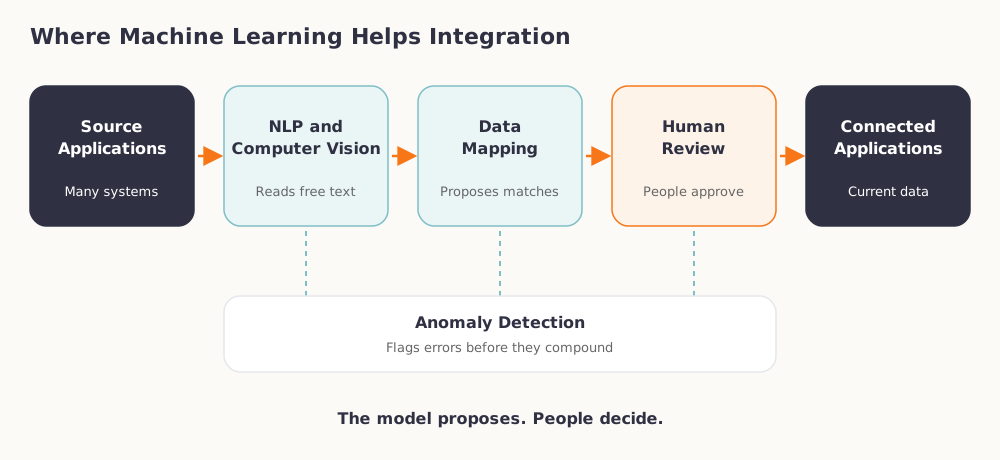
Two technologies do most of the work: natural language processing and computer vision. Both take input that used to need a human reader and turn it into something a system can act on.
NLP handles the unstructured side: free-text fields, support tickets, contract clauses, anything that was written for a person. Getting that into the same pipeline as structured records is the part that used to require either rigid templates or manual entry.
Computer vision does the equivalent for images and video, and its accuracy depends heavily on how the training data is curated, which is why computer vision data management tools exist as a category at all.
The same NLP techniques underpin machine translation and natural language processing in a language context, which is where these systems meet multilingual data.
Machine Learning Can Assist in Improving Data Modeling
Data modeling is a core element of application integration, creating a structured representation of the data to be integrated.
Machine learning algorithms can assist this process by automatically detecting patterns and relations within the data.
Models trained on an organization's own integration history produce better data models than a generic schema does, because they have seen how these particular systems actually store things.
Data mapping is where this pays off most directly. Matching fields across applications is slow, repetitive work, and a model that has seen a few hundred previous mappings proposes the obvious ones itself.
It proposes, rather than decides. A wrong field mapping is silent and expensive, so the human review step stays.
Improve Error Detection and Resolution
Integration errors are unavoidable. What changes is how long they run before anyone notices.
Anomaly detection is the useful application here: a model that knows what normal traffic between two systems looks like flags the run where a field starts arriving empty, or a record count drops by ninety percent overnight.
That is a monitoring gain rather than a correctness one. The error still happened; it just stopped compounding on day one instead of at month end.
Real-Time Data Integration Capability
Real-time data integration has quickly become an indispensable feature of modern business environments, empowering decision-makers with timely insights to respond more swiftly to changing circumstances and adapt more swiftly.
The shift is from batch to stream: processing records as they are created rather than in an overnight job.
Supply chain is the clearest example. Inventory levels that update continuously let production schedules move with them, instead of being planned against yesterday's numbers.
The same applies to anything customer-facing across several markets, which is where IT and technology translation becomes part of the integration problem rather than a step after it.
Enhancing Security and Compliance
Enterprises should prioritize security and compliance when sharing sensitive data across applications, using AI/ML tools to detect potential vulnerabilities while meeting regulatory standards for data exchanged.
AI-powered tools can analyze access patterns to detect any suspicious activities that could indicate a security breach, while machine learning algorithms ensure data is anonymized and encrypted where required.
This helps enterprises meet compliance regulations like GDPR or CCPA.
Implementing Positive User Experiences
From a user's side, good integration is invisible: the same data appears wherever they are working, without them re-entering it.
Assistants and chatbots sit on top of that, answering from whichever system holds the answer rather than the one the user happens to be in.
Personalization follows from the same plumbing, and it runs into a familiar limit at a border. An interface that adapts to a user's behavior but not to their language is only half-personalized, which is the argument behind software localization as a discipline in its own right.
Where the Competitive Advantage Actually Sits
The advantage is not the technology, which competitors can buy too. It is the speed at which an organization can connect a new system, or a new market, without a six-month integration project.
That flexibility is what lets a company act on a trend it spots in its own data rather than reading about it in a report a quarter later.
Future of Application Integration
Two developments are worth watching.
Federated learning trains models across multiple devices or servers without moving the underlying data, which matters in exactly the regulated contexts where integration is hardest.
Explainable AI addresses the other blocker: a model that flags a transaction but cannot say why is difficult to defend to an auditor, and impossible to improve deliberately.
Conclusion
AI and machine learning have made application integration faster to build and easier to monitor. They have not removed the need to understand what the data means, which is still where integrations go wrong.
The multilingual version of that problem is the one worth planning for early. Data crosses a language boundary the same way it crosses a system boundary, and the same discipline applies. That is the ground translation and localization services cover, and it is easier to design for at the start than to retrofit later.