Can Market Research Be Capitalized? Rules for Grammar and Accounting
Market research capitalization rules differ sharply between English grammar and financial accounting. Get the direct answer to both, plus how to run and translate market research internationally.

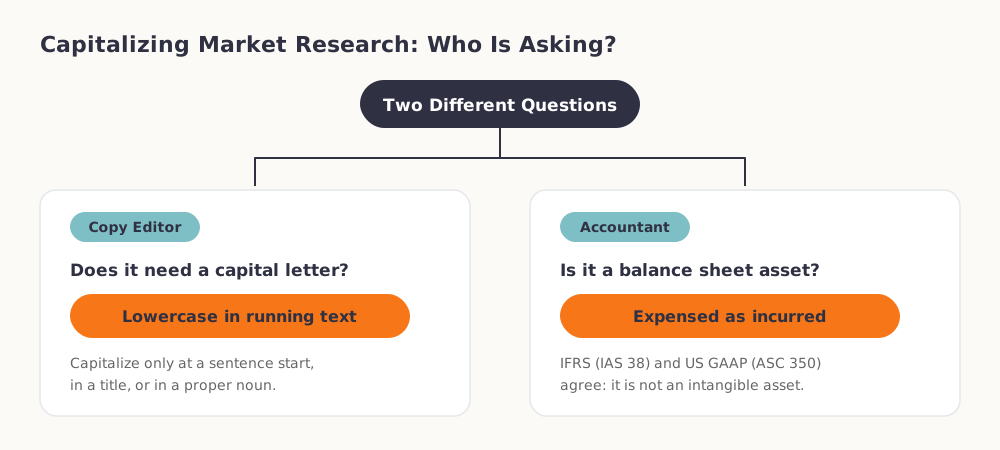
Market research capitalization means two entirely different things depending on who is asking. A copy editor wants to know if the phrase needs a capital letter. An accountant wants to know if the cost belongs on the balance sheet. Get the wrong one and you either fail a style guide or misstate a set of financial statements.
The short answer
- Grammar: No. "Market research" is a common noun phrase. Keep it lowercase in ordinary sentences, and capitalize it only at the start of a sentence, in a title, or when it is part of a specific proper noun.
- Accounting: No. Under both IFRS (IAS 38) and US GAAP (ASC 350), the costs of conducting market research are expensed as incurred. They are not recognized as an intangible asset on the balance sheet.
Whichever question brought you here, the detail matters, so here is both, plus what it means if you are actually trying to run and translate market research for an international launch.
1. Capitalization Rules in English Writing (Grammar)
"Market research" functions the same way as "customer service" or "product design": a common noun phrase describing an activity, not the name of a specific thing.
That means it stays lowercase in the middle of a sentence, the same as any other common noun.
It gets capitalized in exactly the situations any common noun would: at the start of a sentence, inside a headline written in title case, or when it is genuinely part of a proper noun, such as a specific named report ("the 2026 Global Market Research Report") or an official department name ("the Market Research Division reports directly to the CMO").
| Context | Example | Capitalized? |
|---|---|---|
| Mid-sentence, general reference | "We commissioned market research before launch." | No |
| Start of a sentence | "Market research showed strong demand in Brazil." | Yes (sentence case only) |
| Headline or title (Title Case) | "Why Market Research Matters for Global Expansion" | Yes (as part of title case) |
| Part of a proper noun | "The Global Market Research Report, 2026 edition" | Yes (proper noun) |
| Official department or team name | "She leads the Market Research Division." | Yes (proper noun) |
If you are not sure which case you are in, the test is simple: could you swap in a different generic activity, like "customer support" or "product testing," and have the sentence still make sense? If yes, it is a common noun, and it stays lowercase.
2. Financial Accounting: Expensing vs. Capitalizing Research Costs
The accounting version of this question is more consequential, since it decides how a real cost gets reported.
Under IAS 38, "no intangible asset arising from research (or from the research phase of an internal project) shall be recognised. Expenditure on research shall be recognised as an expense when it is incurred."
Market research sits squarely in that research phase: it is exploratory, its future benefit is not yet certain, and IAS 38 draws a hard line between research (always expensed) and development (capitalized, but only if a project clears six specific criteria: technical feasibility, intent to complete, ability to use or sell it, probable future benefit, resource availability, and reliable cost measurement). Market research does not clear that bar, so it is expensed.
US GAAP reaches the same practical outcome through a slightly different route. ASC 730 (Research and Development) explicitly excludes market research and market testing from its own scope, so it is not governed by ASC 730's rules directly. Instead, it falls under the broader principle in ASC 350, which prohibits capitalizing most internally generated intangibles, including market-related items, because their cost cannot be reliably separated from the ordinary cost of running the business.
The bottom line for both frameworks: money spent on market research shows up on the income statement as an expense in the period it was incurred, not as an asset on the balance sheet.
This is not just an academic distinction. A company preparing multi-jurisdiction financial statements, or translating an annual report for investors in a different market, needs a translator who understands this well enough not to invent a line item that does not exist under either accounting framework. If your team is localizing financial statements, annual reports, or investor disclosures, our financial translation services are built around exactly this kind of accounting-literate precision, not just linguistic accuracy.
3. How to Conduct and Translate Multilingual Market Research
Whichever question brought you here, if you are actually running market research ahead of an international launch, the accounting and the grammar both take a back seat to getting the research itself right in every market you enter.
A few things matter most once you take that international perspective:
- Customer segmentation per market, not just per product. A sporting goods company selling to recreational and professional athletes in one market may find the same segments split differently, or not at all, in another.
- Local industry and regulatory research, since market size, growth rate, and competitive landscape data rarely transfer cleanly across borders, and neither do local laws, tax rules, and compliance requirements.
- Market entry strategy, evaluated per market: a joint venture, a local partnership, or a licensing arrangement can each make sense in one country and not another, depending on the regulatory and competitive picture your research surfaces.
- Working with local research organizations where useful, since a partner already embedded in the target market brings context on customer behavior and regulation that a purely remote research effort will miss.
None of that research is worth much if the surveys, reports, and findings do not translate accurately for the teams and stakeholders who need to act on them.
Need your international market research surveys localized accurately across global audiences?
Our specialized market research translators handle survey instruments, findings reports, and stakeholder presentations with the same rigor your research itself required.
Whether you are conducting research in-house or through a local partner, treating market research as a genuinely international exercise, not a domestic study with the numbers swapped, is what actually drives growth and profitability in a new market.