The Ins and Outs of German and French UEFA Football Terminology
From Trikot and tricot to Freistoss in Switzerland and nonante in Belgium, here are the German and French football terms, false friends and regional variants that trip up translators.
The Ins and Outs of German and French UEFA Football Terminology
Few events stir up as much feeling as a European football championship. Countries compete against countries, yet good sportsmanship can also bring people together, and sports translation is part of how that happens.
Germany hosted the UEFA European Championship in 2024, Switzerland hosted the Women's Euro in 2025, and the next men's tournament heads to the United Kingdom and Ireland in 2028. Each one sends fans, broadcasters and sponsors hunting for the right word in another language, and German and French are full of traps.
This article started with Euro 2016, when the Goethe-Institut published learning materials on football vocabulary auf Deutsch and en français. The interview below dates from then, and the advice on false friends holds up as well as ever.
False Friends on the Pitch
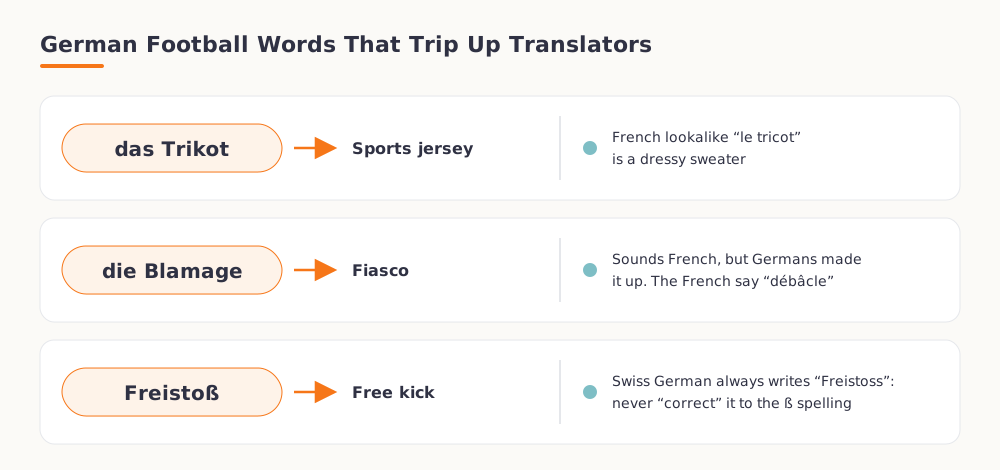
One of the funniest faux amis for a French speaker watching a German match is "das Trikot." In German, the noun means a sports jersey, while the French "le tricot" is a knitted sweater, and French football calls the shirt "le maillot."
"I always picture the players running across the field in a smart cardigan instead of a football jersey," said Eva Korb, then multimedia coordinator at the Goethe-Institut, in 2016. She had just produced a series of free German-French learning materials on Euro 2016, or Europameisterschaft, a word that is a mouthful, as many German nouns are.
Why Word-Lego Makes Translating German Difficult
I asked Ms. Korb how she handles long German nouns when doing sports translations.
"Obviously, German is a very creative language when it comes to playing word-lego! I often enough encountered problems while translating a German word into French or English.
Sometimes I had to add a proper subordinate clause or something similar to express what I actually wanted to say. As annoying as this circumstance can be at times, I count it as one of the beautiful sides of each language - something unique that can't be translated. There are so many aspects of language that cannot be translated mechanically," reported Ms. Korb.
What inspired the German-French learning materials? "We wanted to support the German teachers during the championship, since we know that it is often quite hard to motivate the kids just before the big holidays and with so many matches that consume all their attention," she said.
The materials were aimed at young adults and children, which made them fun for adults too. They introduced foreign words and phrases alongside fun facts, a section on false friends and a collection of absurd quotes.
A German-French Football Glossary
Here are the terms that come up in every match report, with the Swiss German variant where it differs from the German used in Germany.
| English | German (Germany) | Swiss German usage | French |
|---|---|---|---|
| Goal | das Tor | das Tor | le but |
| Free kick | der Freistoß | der Freistoss | le coup franc |
| Penalty | der Elfmeter | der Penalty | le penalty, le tir de réparation |
| Corner kick | der Eckball, die Ecke | der Corner | le corner, le coup de pied de coin |
| Offside | das Abseits | das Offside | le hors-jeu |
| Goalkeeper | der Torwart | der Goalie | le gardien de but |
| Header | der Kopfball | der Kopfball | la tête |
| Extra time | die Verlängerung | die Verlängerung | la prolongation |
| Penalty shootout | das Elfmeterschießen | das Penaltyschiessen | la séance de tirs au but |
| Jersey | das Trikot | das Trikot, das Leibchen | le maillot |
What Machine Translation Gets Right Now, and What It Still Misses
In 2016, Google Translate stumbled over several words in the Goethe-Institut materials, including Rechtsschuss, Kopfball, zweikampfstark and even Europameisterschaft itself. I asked Ms. Korb about her experience with online translators.
"While I was giving workshops in schools, I often encountered translations obviously done by semi-professional online-translators. I could always tell apart the results from the students who used online-translators and from the students who tried to write a text themselves. Personally, I don't count too much on online-translators…"
Machine translation has improved a great deal since then. Today Google Translate renders Europameisterschaft as "European Championship" and Freistoss as "free kick," but a word like Rechtsschuss still comes out as a flat "right shot" where a commentator would say "a right-footed shot."
The ß is a good example of why context still matters. Germany and Austria write "Freistoß," while Switzerland dropped the ß altogether and writes "Freistoss," so a translator working for a Swiss club or broadcaster should never "correct" the spelling.
Ms. Korb put the wider problem this way: "Especially when it comes to an area or field, you don't know a lot about. But that's the problem with the automatic translators, isn't it? They don't give you a lot of options, so you're stuck with one version, not knowing whether it's correct."
When One Word Says It All
One French article in the materials carried the German title "Tooooooooooooor!" (Goal!), a perfect sports translation in a single word. I asked Ms. Korb how she accounts for cultural translation, not just the mechanical kind, since that one word captured the German enthusiasm for football so well.
"There are certain things you can only fully express in their meaning in one language. Often enough, it's the setting and the context that count a lot. As for football in German: We have a lot of commentators - probably all - who would yell "Toooooooooooooor" when someone is scoring a goal. I never heard a French commentator yell "Buuuuuuuuuuuuuuut" - but maybe that's just me. Then again, this is an example for oral expression and not the written one.
For the translation of written language, I will put forward the classic example of "Gemütlichkeit". That word is basically untranslatable, and you will always have to describe or paraphrase it. Sometimes, languages simply adapt the German word, e.g. "Zeitgeist" in English and French. I think that tells you a lot about the culture of the people and that is one of the reasons why it is a great perk to know as many different languages as possible - language is culture and vice-versa," reported Ms. Korb.
Do German and French Have Dialects?
They do, and football makes the differences audible. German has not just dialects but also varieties, and some linguists treat them as separate languages, which is why Swiss commentators say "Penalty" and "Goalie" where German ones say "Elfmeter" and "Torwart."
French varies too. Belgian and Swiss commentators count with "septante" and "nonante," so a late goal falls "à la nonantième minute," while a commentator in France says "quatre-vingt-dixième." Translations for the different German and French markets need to follow the reader's variety, whether the audience sits in Zurich, Vienna, Brussels or Dakar.
My Favorite German Sports Word
My favorite false friend from the Goethe-Institut material is "die Blamage." It sounds French, but German speakers built it themselves from the French verb "blâmer," and they use it to mean a fiasco, which the French call a débâcle.
If you want your football or other specialized sports translations to avoid a débâcle, treat machine output as a first draft at most, and give the long "lego-block" nouns in German to a human who knows the game. And if anyone asks what "Europameisterschaft" means, you now know.