How Marketing Translation Makes Your Brand Stand Out
Literal translation can flatten a slogan and confuse a new market. See how marketing transcreation protects your brand voice across web, video, social media and AI search, and why it pays for itself.

How Marketing Translation Makes Your Brand Stand Out
Advertising and marketing are key in creating brand identity, and many companies spare no expense hiring top professionals to make sure their brand attracts its target market. The same attention is not always paid to the translation of marketing materials, which can misrepresent a company and even lead to some costly blunders.
Translating advertising copy requires a deep understanding of the target culture and the ability to recreate, in a new country, the impact a brand has at home. That is why it pays to work with a skilled translation service that specializes in the sector, and why professional marketing translation deserves a place in every launch budget.
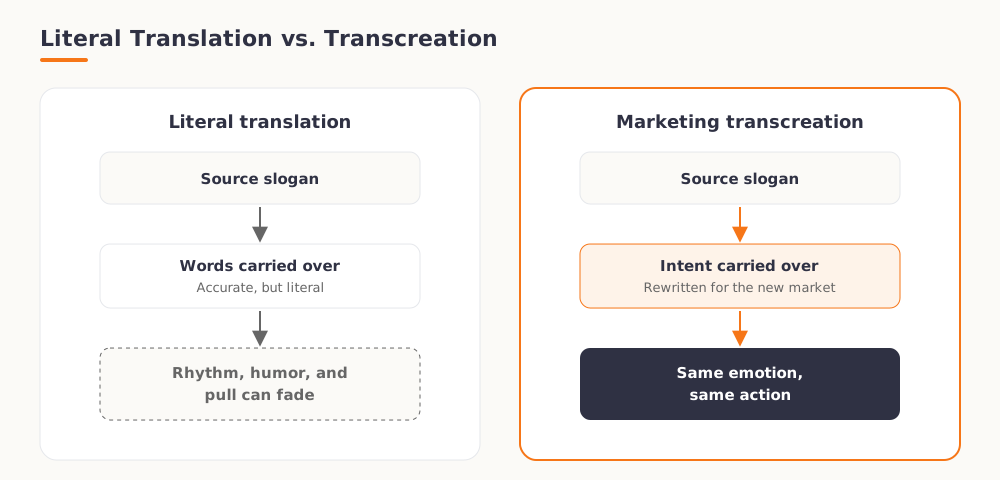
Literal translation vs. marketing transcreation
Literal translation carries over the words. It is accurate, but a slogan can lose its rhythm, its humor, and its persuasive pull.
Marketing transcreation carries over the intent. The copy is rewritten so it triggers the same emotion and the same action in the new market.
1. Translation vs. Transcreation: Protecting Your Brand Voice
Your brand voice is the sum of every word choice, joke, and turn of phrase your customers have learned to recognize. A literal translation can keep the meaning of each sentence and still lose that voice entirely, which is why marketing transcreation services exist as a discipline of their own.
Translating Humor Is No Laughing Matter
So much of marketing is based on humor, which varies greatly from language to language and culture to culture. Things get particularly tricky when the humor relies on wordplay, such as puns or idioms. Translated literally, this kind of copy is nonsensical at best and offensive at worst.
Take the classic example of KFC's first restaurant in Beijing in 1987, where the famous slogan "Finger-lickin' good" was reportedly rendered as "We'll eat your fingers off"! Stories like this spread for a reason: they show how quickly a brand can become a punchline when nobody checks the copy with a native speaker.
For this kind of copy, it's highly recommended that you consider transcreation rather than simple translation. It takes cultural differences and idioms on board, so the result works for the new audience the way the original works at home.
Repetition, Alliteration, and Rhyme
A lot of advertising language uses repetition, alliteration, or rhyme to create catchy taglines and slogans that are easy to remember. Think of KitKat's "Have a break, have a KitKat", Panasonic's "A better life, a better world", or Pringles' "Once you pop, you can't stop".
These devices are notoriously difficult to translate, because a literal version loses both meaning and sound. Transcreation solves this with a new line that works in the target language while keeping the brand promise intact.
A short brand voice guide makes this work far more consistent. Share your tone, the words you never use, and a glossary of taglines that must stay in English.
A Picture Speaks a Thousand Words
When it comes to advertising, words aren't everything. A brand's logo, color scheme, and taglines all come together to create a brand identity, and each one should be considered when you take that identity to an overseas market.
An image that is perfectly fine in one country can be confusing or insulting in another, a point every brand localization strategy has to address. Pampers is said to have confused Japanese parents with a stork delivering a baby, since local folklore has newborns arriving in a giant peach floating down a river.
Gerber is said to have sold baby food in parts of Africa with a baby on the label, where labels usually picture what is inside. Whether or not every detail is accurate, the lesson holds: test your visuals with the target market before launch.
Color matters just as much, because its meaning varies from culture to culture. In the US, orange is associated with fall, harvest, and Thanksgiving, while in parts of the Middle East it is linked to mourning and loss.
Knowledge of color symbolism can also strengthen a brand image. Red Bull sells its drink in China in a gold can with red bulls, colors widely considered lucky in Chinese culture. Working with a Chinese translation team that understands these codes helps you spot opportunities like this, not just risks.
2. Multi-Channel Marketing: Web, Video and Social Media
A campaign rarely lives on one channel anymore. The same message has to work on a product page, in a video, in a social caption, and in the answer an AI assistant gives about your company.
Websites and Landing Pages
Your website is usually the first place a new market meets your brand. Translated pages need localized headlines, calls to action, prices, and forms, plus keywords researched in the target language rather than translated from English. Pairing translation with multilingual SEO services makes sure those pages get found in the first place.
Video Dubbing, Subtitling, and AI Voice Cloning
Video carries a brand's tone of voice more directly than any other format. Subtitling is the fastest and most affordable way to take a video into new markets, and professional subtitling and captioning services handle timing, reading speed, and line breaks so viewers can keep up.
Dubbing goes further by replacing the soundtrack, and AI voice cloning has changed its economics: tools can now reproduce a speaker's voice in another language. YouTube, for example, lets creators add audio tracks in several languages to a single video.
The script still decides whether a dubbed video works. A cloned voice reading a literal translation sounds fluent but flat, so treat the script as transcreated copy and have a native reviewer check the final audio.
Social Media Transcreation
Social media is where brand voice is tested most often, in short bursts and in real time. Hashtags, memes, emoji, and slang rarely travel intact, and a caption that feels playful in English can read as rude or confusing elsewhere.
Social media transcreation adapts each post to the habits of the market as well as its language, including which platforms people actually use. A coordinated multilingual social media plan keeps your tone consistent while leaving room for local teams to react to trends.
How AI Search Engines Summarize Your Brand
Buyers increasingly ask AI assistants and AI-powered search features to compare products or recommend suppliers. Optimizing for these answers is often called generative engine optimization (GEO) or answer engine optimization (AEO), and language plays a bigger role in it than many brands realize.
If your brand only publishes in English, an AI engine answering a question in German or Italian has less of your own content to draw on. It may describe you through third-party sources or competitors instead.
Well-translated product pages and FAQs in each target language give these systems accurate material to summarize. Consistent brand names and taglines across languages make it more likely the summary matches your intended message.
3. The ROI of Professional Marketing Translation
Marketing translation is sometimes treated as a cost to trim at the end of a campaign. In practice, the translated version is the only version your new customers will ever see, so it carries the full weight of your media spend.
76% of online shoppers prefer to buy products with information in their native language, and 40% will never buy from websites in other languages. Source: CSA Research, "Can't Read, Won't Buy", 2020 survey of 8,709 consumers in 29 countries
In other words, an ad that sends shoppers to a page they cannot read comfortably wastes part of the budget before the campaign has a chance to perform. The same logic applies to paid media. Ad copy and landing pages adapted for each market speak to local search terms and local motivations, instead of echoing an English brief.
Specialized advertising translation services cover formats where every character counts, from search ad headlines to banner copy. They keep offers and calls to action consistent from ad to landing page, so the campaign ROI you measure reflects the market, not a clumsy translation.
Mistakes have a price too. Pulling a campaign or repairing a brand story after a translation blunder costs far more than getting the copy right first.
To see the return, track each market on its own: conversion rate by language, cost per acquisition, and engagement on localized posts. Testing a transcreated campaign against a literal version shows stakeholders what the extra care is worth.
Ready to Launch Your Brand in New Markets?
As you can see, there's a lot more to marketing translation than might be expected. Whether you need Cantonese marketing translation for Hong Kong or a full campaign in a dozen languages, investing in a qualified team could make or break your company in its new overseas markets.
Is your company planning to expand internationally? Get in touch with BeTranslated's specialized marketing translators for more information, or request a free quote today.