Why Print Marketing Still Drives Results (And How to Localize Print Campaigns)
Print still earns trust and brand recall that many screen ads struggle to match. Learn how to connect print with QR codes, AR and CRM-triggered mail, and how to localize print campaigns for new markets.
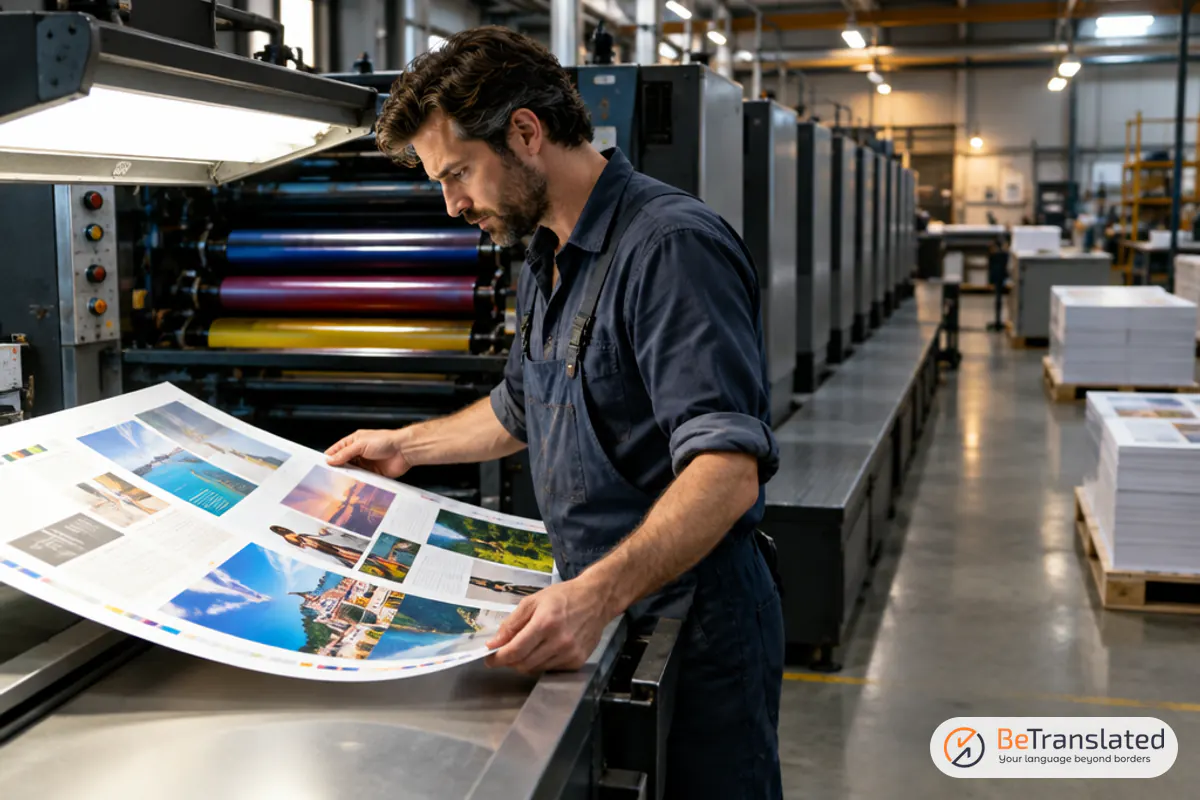
Why Print Marketing Still Drives Results (And How to Localize Print Campaigns)
Digital channels take most marketing budgets, but that does not make print obsolete. A well-designed flyer, catalog or postcard still reaches people in a way a banner ad rarely does.
Print also works harder when it stops competing with digital, and every piece you send abroad has to work in the local language. Getting your marketing materials translated is the first step, but layout, reading direction and print specs matter just as much.
Why print still outperforms screen ads
Trust: in a survey of 1,200 US consumers in October 2016, 82% placed print ads in newspapers and magazines among the ads they trust when making a purchase decision, compared with 61% for search engine ads and 25% for online pop-ups. Source: MarketingSherpa, "Which Advertising Channels Consumers Trust Most and Least When Making Purchases", 2017
Recall: in a 2015 neuroscience study of 270 participants, unaided brand recall was 70% higher after a direct mail piece (75%) than after a digital ad (44%), and direct mail took 21% less cognitive effort to process. Source: Canada Post and True Impact Marketing, "A Bias for Action", 2015
1. The Psychology of Print: Tangibility, Trust and Brand Recall
Print has a physical presence that a screen cannot copy. People hold it, keep it on a desk or a fridge, and come back to it, which gives your message time to sink in.
A study by the US Postal Service Office of Inspector General and Temple University found that participants processed digital ads faster but spent more time with physical ads, responded to them more emotionally and remembered them better. Trust grows from the same qualities: a printed piece costs money to produce, it does not pop up uninvited, and nobody can scroll past it in a split second.
Print Ads vs. Digital Ads
| Factor | Print Ads | Digital Ads |
|---|---|---|
| Trust Level | Higher: seen as more credible and less intrusive | Varies by format: pop-ups and banners rank lowest |
| Brand Recall | Stronger: physical pieces are easier to process and remember | Weaker for most formats: processed quickly, forgotten quickly |
| Lifespan | Days to months: brochures, catalogs and magazines are kept and shared | Seconds to hours: gone once the feed moves on or the campaign ends |
| Multilingual Layout Effort | Higher: each language needs DTP work, proofs and a fixed print file | Lower to moderate: responsive layouts reflow and text can be fixed after launch |
Sustainability as a Decision Factor
Environmental impact now shapes how customers and procurement teams judge printed materials. FSC certification shows that paper comes from responsibly managed forests, recycled stock reduces demand for virgin fiber, and carbon-neutral printing usually means measuring a job's emissions and offsetting what cannot be cut.
Ask suppliers for documentation rather than trusting a logo at face value. Printing only what you need helps too, since targeted runs and clean mailing lists cut waste as effectively as any paper choice.
Flyers and Door Hangers
Flyers announce events such as a grand opening or give a quick overview of your services, and they can go on public boards or into newspaper boxes. Door hangers do the same job for startups promoting their business in nearby neighborhoods before expanding further.
Both are inexpensive, but you should still factor printing and mailing costs into your budget. They also have to look professional, because the image your company portrays through its advertising and promotional campaigns shapes how people judge the quality of your services.
Inaccurate or awkward-sounding translation gives a poor impression of your business. Avoid it by hiring a professional translation service or ordering dedicated leaflet and flyer translation.
Brochures and Catalogs
Brochures and catalogs have room for in-depth information, such as before-and-after images, product specifications or customer testimonials. You can even repeat key information in several different languages, so one document serves a wide range of readers.
Longer formats are also where translation causes the most layout trouble, from overflowing text boxes to broken page flow. Planning to print catalog or brochure runs internationally? Explore our multilingual desktop publishing services to guarantee print-ready formatting.
Postcards, Magazines and Newsletters
Postcards rely on a strong visual rather than long text, but an error in a few lines stands out even more, so translate them professionally. Magazines offer glossy, full-color pages and niche audiences: a freelance translator specializing in food and wine, for example, could advertise in relevant titles and win direct clients, although the cost per contact can be high.
Newsletters usually cover a single topic and go to subscribers or are distributed freely. They give you an inexpensive, natural reason to reach potential clients regularly.
Business Cards
Although they are small, your business cards can go a long way. Hand them out after meetings or leave them at relevant business locations worldwide for others to pick up.
Striking design helps people remember you, whether that is an unusual shape or a digital business card with a QR code. Think about what the card communicates about your business and how it shows what makes your approach unique.
2. Combining Print with Digital (QR Codes, AR and Direct Mail Automation)
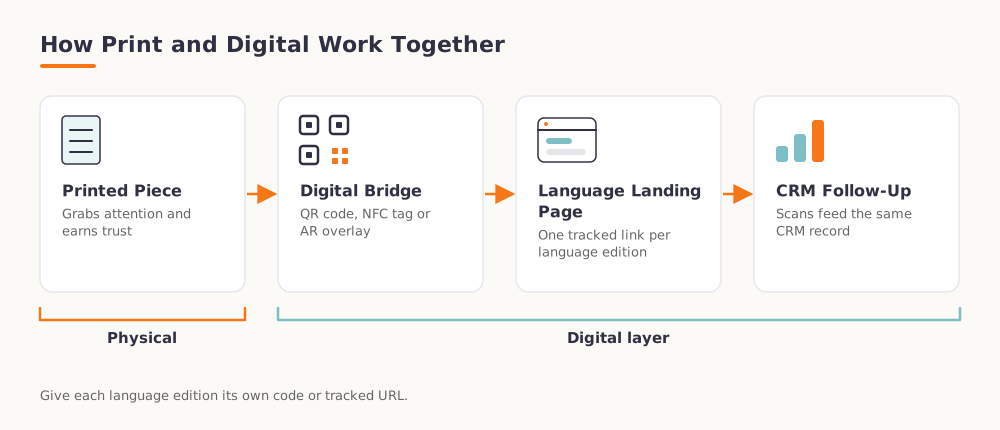
The strongest print campaigns today are "phygital." The physical piece grabs attention and earns trust, while a digital layer handles tracking, personalization and follow-up.
Editable, Trackable QR Codes
A static QR code points to one fixed URL forever. An editable QR code points to a short redirect you control, so you can change the destination after printing and see scans by region or language version.
For multilingual campaigns, give each language edition its own code or tracked URL. A German brochure then lands on your German page, and you can measure each market separately.
NFC Tags
NFC tags embedded in business cards, packaging or point-of-sale displays open a link when someone taps them with a phone. They suit premium materials where a visible code would spoil the design, but add a printed QR code too, since not everyone knows to tap.
Personalized Variable Data Printing (VDP)
Variable data printing changes names, images or offers from one printed piece to the next, pulling from your customer database. A single job can also output French, Dutch and German versions for a Belgian mailing list, as long as each text has been translated and fitted to the template in advance.
Augmented Reality (AR) Print Overlays
AR overlays let a phone camera recognize a printed page and add video, 3D product views or animations on top of it. Keep the experience browser-based rather than app-based, and localize any audio or on-screen text along with the print.
Direct-Mail-Triggered CRM Workflows
Direct mail apps available for CRMs such as HubSpot and Salesforce let an automated workflow send a postcard or letter when a contact reaches a trigger, such as an abandoned cart or a lapsed account. Add a personal QR code and every scan feeds back into the same CRM record, so the next email or sales call can pick up the conversation.
3. Multi-Market Execution: DTP Formatting and Translation Pitfalls
A layout designed for English rarely survives translation untouched. Text changes length, some scripts run in the opposite direction, and print conventions differ from one market to the next.
Text Expansion in German and Other Languages
German text commonly runs noticeably longer than the English source, partly because German builds long compound nouns. The W3C's guidance on text size in translation adds that the shorter the source text, the larger the relative expansion tends to be, so headlines, buttons and table cells suffer most.
Build slack into your templates, avoid fixed-size text boxes, and agree in advance whether copy can be edited to fit. Our German localization tips cover more language-specific details.
Right-to-Left Layouts for Arabic and Hebrew
Arabic and Hebrew read from right to left, so the whole layout needs right-to-left (RTL) DTP reformatting. Page order, binding side, image placement, arrows, timelines and charts all flip.
Your DTP team also needs fonts that support the script and correct handling of numbers and Latin brand names inside RTL text. Arabic letters connect to each other, so software without proper script support can break words apart, which is why a native reviewer should check the final proofs.
Other Pitfalls in Multilingual Print Runs
- Paper sizes: the US uses Letter while most other markets use A4, which shifts margins and page breaks.
- Fonts: check that your typeface covers accented characters, Cyrillic, Greek or Asian scripts.
- Local details: phone formats, currencies, dates, units and legal mentions must match each market.
- Final proofs: have a native linguist check the print-ready PDF, since hyphenation and line breaks can introduce new errors.
Plan Print and Translation Together
Print reaches potential customers in ways your digital channels cannot, and digital tools now make it measurable. The campaigns that travel well are the ones where design, translation and DTP are planned together from the first draft.
If you are looking to get your promotional material translated and formatted by reliable and skilled translators, look no further than BeTranslated. Get in touch today for a free, no-obligation quote.