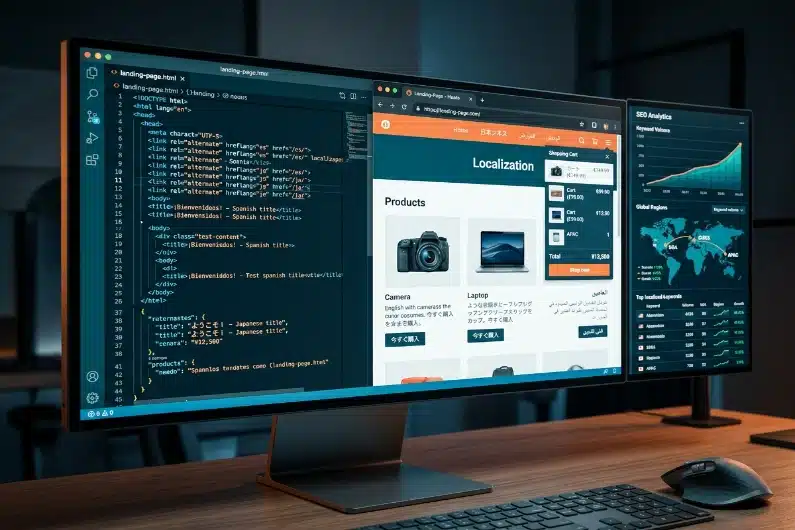
10 Common Localization Mistakes That Hurt Global Growth (And How to Fix Them)
From AI hallucinations to hard-coded strings to a hand gesture that means something else entirely, here are the localization mistakes that quietly cost businesses their international launch.

Hiring professionals for localization is the single best way to avoid mistakes that jeopardize an international launch. Experts are experts because they have already made these mistakes once and stopped making them.
But even professional work needs a second set of eyes, and some of the costliest mistakes happen before a translator ever touches the content, in how the project was scoped, built, or briefed in the first place.
Quick summary
- Legal, technical, and AI-generated content each carry their own failure modes, and a generic proofread will not catch all three.
- Most cultural and linguistic mistakes come from treating one market's assumptions as universal, whether that is a hand gesture, an idiom, or a page layout.
- The fix is rarely "translate more carefully." It is building review steps, technical flexibility, and native QA into the process from the start.
1. Not Hiring Legal Experts for Legal Document Translation
Localizing a business is not only about product instructions and marketing materials.
Expanding abroad means dealing with legal documents, contracts, incorporation paperwork, compliance filings, often as PDF documents, and many of these require notarized translations.
Legal translation is complex and unforgiving. The agency you hire needs demonstrated experience in translating legal documents specifically, not just general localization.
Ask for examples of past legal work, and have a qualified legal expert in the target jurisdiction review the translated document before you rely on it. A mistranslated clause is not a style issue, it is a liability.
2. Trusting Unvetted AI and LLM Output
Machine translation mistakes used to be obvious: garbled grammar, an odd word choice, something a native speaker would catch instantly.
Modern LLM-generated localization has the opposite problem. It reads fluently, confidently, and is sometimes still wrong, which makes the error much harder to catch before it ships.
Bad example (unreviewed AI output): An LLM asked to localize a US employment contract clause into German invents a plausible-sounding but nonexistent German legal term for "at-will employment," a concept that does not actually exist under German labor law. The sentence reads fluently and confidently. It is also legally meaningless in the target jurisdiction.
Localized solution: The same clause, drafted by a bilingual legal translator familiar with German employment law, replaces the concept entirely with the closest functional equivalent (a fixed-term or notice-period clause), rather than translating a US legal concept that has no German counterpart.
The same risk shows up in brand voice. An LLM prompted inconsistently, or without a maintained style guide, will quietly drift toward generic, flattened phrasing over a long project, the kind of writing that reads as competent but not like your brand.
The fix is not avoiding AI-assisted localization, which is now a normal part of the workflow. It is never publishing AI output without a native-speaking human reviewer who knows the subject matter checking it line by line, the same discipline a good translation team already applies to machine-translated drafts.
3. Aiming for Slang and Missing Badly
Translating slang directly, or reaching for a similar-sounding word in the target language, rarely goes well.
Bad example: KFC's "finger lickin' good" slogan, translated into Chinese in the 1980s, reportedly came out closer to "eat your fingers off," a case still cited in marketing and translation training decades later.
Localized solution: A slogan built around taste and enjoyment, rewritten for the target market's own idiom and food culture, rather than translated word for word from the English original.
In marketing translation, tone is everything. If your brand voice leans on slang, that content needs to be recreated by a native copywriter in the target market, not translated from the source language. Specify this requirement explicitly when you brief local content writers.
4. Ignoring Cultural Assumptions in Educational and How-To Content
Product instructions and how-to content assume a baseline of shared knowledge, and that baseline is rarely universal.
An American writer will not think to specify that their country drives on the right, because to them that is not a variable, it is just how roads work.
A reader in a left-hand-traffic country hits that same set of driving directions and gets confused or makes a mistake, because the assumption baked into the content was never stated.
Many of these gaps are far more subtle than traffic direction, which is exactly why they are easy to miss. Rewrite the educational content itself with a market-neutral base, then layer in location-specific detail for each target market rather than assuming one version travels everywhere.
5. Cross-Cultural Miscommunication in Visuals and Gestures
A lack of understanding of cultural differences shows up in the small, easy-to-miss details: a model's hand gesture in an ad, or the tone of a marketing tagline.
Take a V-sign facing inward. In the US, it can mean "two" when ordering another round, or "peace."
In the UK, the same gesture is an insult, roughly equivalent to giving someone the finger.
A mistake like this in a launch campaign does real damage to a brand's first impression in a new market. Hiring a local marketing team to vet visuals and gestures before launch is worth the cost precisely because a mistake here is public and hard to walk back.
6. Hard-Coding Text and Breaking Modern i18n Pipelines
Hard-coded strings and manual string concatenation are the classic technical localization mistakes, and they still happen. A hard-coded string cannot be translated without a code change, and concatenated strings ("You have " + count + " items") break the moment a language reorders the sentence or needs a different plural form.
The modern version of this mistake is subtler. Teams building on a software or app localization pipeline still trip over:
- Naive pluralization, instead of proper ICU MessageFormat rules, which matters enormously outside English: Polish and Arabic both have plural categories English does not, and a naive
count === 1 ? singular : pluralcheck silently produces wrong grammar in those languages. - Micro-frontend architectures, where each independently deployed frontend owns its own translation strings, causing the same UI term to drift into three different translations across one product.
- Headless CMS content that was modeled without localization in mind, so translated fields do not map cleanly onto the same structured content the source language uses, forcing manual patchwork per locale at publish time.
Building the string, plural, and content-model rules in from the start is far cheaper than retrofitting them once a product is already live in six languages.
7. Not Accounting for Text Expansion
Translated text rarely takes up the same space as the source. German commonly runs 20 to 35 percent longer than English; other languages run shorter.
Marketing materials and interfaces designed to look good in one language can look cramped, overflowing, or broken once translated, if the layout was never built to flex.
The old fix was manually reformatting every template per language. The current fix is building layouts that do not need manual reformatting in the first place: CSS logical properties (margin-inline, padding-inline, inset-inline-start) instead of hard left/right values, and flexbox or CSS Grid with auto-fit/auto-fill, so a button or menu label that is 40 percent longer in Finnish simply reflows instead of clipping.
This matters even more for software, where menu labels have hard space constraints, and for brand names and logos, which often need their own localized treatment per market rather than a stretched or shrunk version of the original.
8. Ignoring Right-to-Left (RTL) Layout Requirements
Arabic, Hebrew, and a handful of other major languages read right to left, and a layout built with hardcoded left/right values does not just look wrong in these markets, it can genuinely break: navigation ends up on the wrong side, icons face the wrong direction, and form fields read in the wrong order.
This is the other reason CSS logical properties matter, since a layout written with margin-inline-start instead of margin-left flips correctly for RTL locales without a separate stylesheet or a manual mirroring pass.
Testing an RTL locale properly, not just running the site through an automatic mirroring tool and calling it done, catches the icons, illustrations, and directional cues (like "next" arrows) that automatic mirroring alone gets wrong.
9. Overlooking Region-Specific Legal and Privacy Compliance in Product UI
Beyond translating legal documents, the product itself often needs region-specific compliance content: cookie consent wording that satisfies GDPR in the EU but is legally unnecessary elsewhere, currency and tax display that matches local expectations, and disclaimers required in some markets but not others.
Shipping one compliance banner globally, translated but not adapted to what each jurisdiction actually requires, either over-asks users in markets where it is not required or under-delivers in markets where it is a legal minimum, not a nice-to-have.
10. Skipping Native Linguistic QA Before Launch
Even a well-managed localization project needs a final check by a native speaker who was not the original translator, looking at the content in context, not as an isolated string list.
This step catches the things that survive every earlier review: a tone that is technically correct but off-brand, a term that is accurate but not what people in that market actually say, a layout that looks fine in the CMS but breaks on a real device.
Skipping this step to save time or budget is one of the most common ways an otherwise well-executed localization project ships with a mistake nobody caught until customers did.
The Most Reliable Fix: Work With a Professional Team
For any localization project, the most important decision is which language service provider you bring in.
BeTranslated's team of native language professionals specializes in website and software localization, legal translation, marketing and transcreation, and business translation, with the native QA step built into every project rather than treated as optional.
Request a free, no-commitment quote today and get your next market launch right the first time.