Multilingual Web Copywriting: How to Scale Global Conversions
Multilingual web copywriting blends AI-assisted drafting, human transcreation, and SEO and GEO structure so every market reads, ranks, and converts. Here is how to get it right.

Multilingual Web Copywriting: How to Scale Global Conversions
The volume of content online, from news sites and social networks to company blogs, keeps climbing at a dizzying rate. Every page competes for the same reader attention, and good copywriting is what grabs a reader and, just as importantly, keeps them.
When you translate your site into another language, that challenge multiplies. Each market has its own search habits, cultural cues, and expectations of how a brand should sound, so copy that converts in English rarely converts word for word anywhere else.
Quick Takeaways
- Translation carries your existing copy into another language faithfully. It suits legal, technical, and support pages where accuracy matters more than persuasion.
- SEO copywriting builds each page around what local audiences actually search for. Today it also structures content so AI search tools can extract, cite, and summarize your brand correctly.
- Transcreation recreates the message, tone, and emotional impact for each culture. It is the right choice for headlines, calls to action, and campaign copy that has to persuade.
BeTranslated pairs expert copywriters with translation specialists to drive more qualified traffic to your sales pages. Here is how to choose the right approach, write for search and AI, and keep your voice intact.
1. Translation vs. Transcreation vs. Native Copywriting
These three approaches are often lumped together, but they solve different problems. Picking the right one for each page type is the fastest way to control cost without sacrificing conversions.
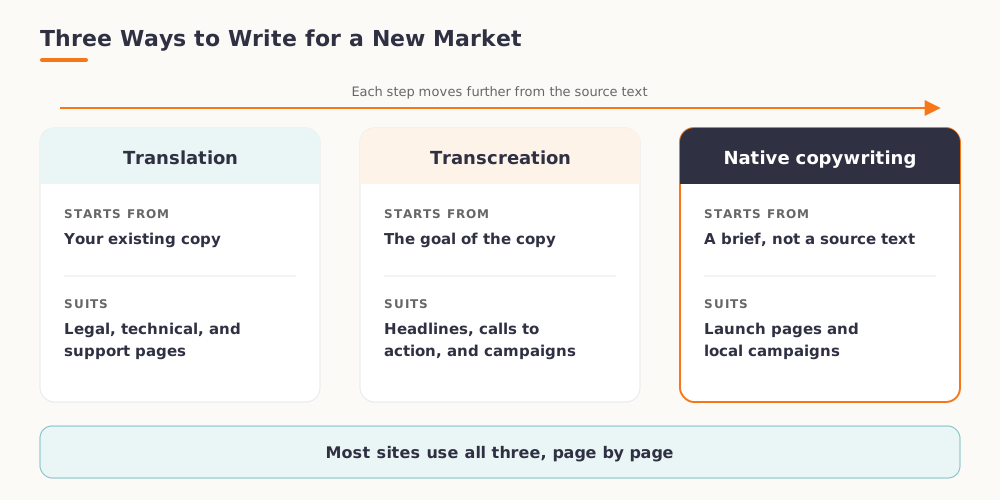
Translation: Accurate but Literal
Translation keeps the meaning of the source text and renders it faithfully in the target language. It is the right tool for product specifications, terms and conditions, and help content, where the reader needs precision more than persuasion.
The weakness shows up on sales pages. A literal version misses local idiom, tone, and search habits, so the copy reads correctly but lands flat.
Transcreation: Same Intent, New Words
Transcreation starts from the goal of the copy rather than its wording. A transcreator rewrites headlines, taglines, and calls to action so they trigger the same response in the new market, even when the sentences look nothing like the original.
Native Copywriting: Written for the Market
Native copywriting goes one step further, with a writer in the target market drafting the page from a brief rather than from a source text. It suits launch pages, local campaigns, and any content where the English version would only get in the way.
The case for writing in your customer’s own language is hard to argue with:
76% of online shoppers prefer to buy products with information in their native language, and 40% will never buy from websites in other languages. Source: CSA Research, “Can’t Read, Won’t Buy”, 2020 survey of 8,709 consumers across 29 countries
Where AI Drafting Fits
AI tools now produce a usable first draft in seconds, which makes multilingual content far faster to scale. That draft is a starting point, not a finished page, because it can miss cultural nuance or drift from your brand voice.
The model that works is AI-assisted drafting paired with expert human transcreation and brand-voice oversight. Machines handle volume and consistency, while native linguists decide what actually persuades a reader in Madrid, Munich, or Montreal.
Comparing the Three Approaches
| Literal Translation | SEO Translation | Full Multilingual Copywriting | |
|---|---|---|---|
| Cost | Low | Medium | High |
| Speed | Fast | Moderate | Slower |
| SEO Impact | Low | High | High |
| Brand Relevance | Low | Medium | High |
Most sites end up using all three. Legal and support pages get translation, category and service pages get SEO translation, and home pages, landing pages, and ads get persuasive landing page copy written natively for each market.
Web Copy Goes Beyond Static Pages
Modern web copywriting covers far more than static pages and blog posts. Personalized landing pages swap headlines and offers by visitor segment, and every variant needs to read naturally in every language.
UX microcopy, such as button labels, form hints, and error messages, shapes whether a visitor completes a purchase. Localized video scripts and short ad copy bring their own limits on timing, character count, and platform tone, so they need writers who know the format as well as the language.
We deliver content creation and SEO-friendly translation across many sectors, including:
- Tourism and travel
- E-commerce translation services
- Marketing translation services
- Audiovisual and video translation
- Technical translation services
- Business translation services
Each field has its own vocabulary, so we assign writers who already know the terrain. An e-commerce store needs persuasive product copy, while a technical manual needs precision above all, and the right writer makes that difference.
For full campaigns, our multilingual content marketing team takes the work from brief to published.
2. Optimizing Web Copy for Search Engines and AI Models (GEO and SEO)
A company can own the best-looking website in the world, yet none of it matters if nobody finds the page. Search engine optimization (SEO) closes that gap, and today it has a second front: the AI assistants that answer questions directly.
Keyword Integration That Matches Local Search
Translating keywords word for word rarely works, since people in each market phrase their searches differently. Our guide to keyword research in unfamiliar languages walks through how to find the terms your audience really uses.
Those terms then have to sit naturally in titles, headings, and body copy, which is where copywriting and multilingual SEO services meet. A translated keyword forced into a sentence no native speaker would write hurts both rankings and trust. Professional content creators and SEO experts track the constant shifts in search algorithms and turn that knowledge into content that keeps earning traffic.
Search Engines Differ by Market
Search behavior shifts from one country to the next, and so do the search engines people reach for. Google leads in much of the world, while Baidu dominates in China, and Yandex and Naver hold strong positions in Russia and South Korea.
A French SEO strategy needs native keyword research to match how French speakers search, and the same holds for German SEO, Spanish SEO, and Dutch SEO. A native writer also catches the tone, idiom, and cultural cues that a direct translation flattens out.
For the bigger picture, our overview of international SEO shows how content, hreflang, and structure fit together. Our multilingual international SEO guide walks through the full strategy step by step.
Generative Engine Optimization: Writing for AI Search
Generative Engine Optimization (GEO) means structuring copy so AI search tools such as ChatGPT, Perplexity, and Google AI Overviews can extract, cite, and summarize your brand accurately. These tools pull short passages from pages, so copy that states facts clearly and answers questions directly is easier to quote.
In practice, GEO-ready web copy:
- Opens each section with a direct answer before adding detail.
- Uses descriptive headings that mirror the questions buyers actually ask.
- Describes who you are, what you offer, and where you operate in plain, consistent terms on every page.
- Puts comparisons in tables and processes in lists, which are easy for a model to parse.
This has to happen in each language, not only in English. An AI assistant answering a question in Italian or Japanese often draws on content in that language, so a thin or machine-flattened local page can leave your brand summarized inaccurately or not mentioned at all.
3. Maintaining Brand Voice Across Global Web Pages
Brand voice is the part of your copy that is hardest to translate and easiest to lose. A playful tone can read as charming in one market and unprofessional in another, so voice needs clear rules rather than guesswork.
Build a Multilingual Style Guide
Start with a style guide for each language that sets tone, level of formality (such as tu versus vous in French), and words to use or avoid. Add a glossary of product names and key terms so every writer, and every AI tool, uses the same vocabulary.
Keep Humans in the Review Loop
AI drafting speeds up volume, but a native editor should sign off on anything customer-facing. That review catches tone drift, awkward phrasing, and claims that do not hold up in a local context.
It also keeps personalized variants, microcopy, and ad copy aligned with the core pages. A visitor who clicks a localized ad should land on a page that sounds like the same brand.
Publish Consistently Across Your CMS
If your site runs on WordPress, our WordPress website translation service keeps the workflow simple. BeTranslated is an exclusive WPML translation partner, the leading WordPress translation plugin, so we translate your content and slot it back into your site with no rebuild.
That partnership makes translating your website straightforward. We handle content whatever the format, whether Word, Excel, or plain text, and we also work across Joomla, Magento, and PrestaShop or translate straight from your site’s HTML when needed.
Pair the copy with full website translation services and a clear multilingual website structure, and your global rollout holds together.
Multilingual Copywriting FAQs
What Is Multilingual Web Copywriting?
It is the craft of writing and adapting website copy for each target market so the content reads naturally, ranks in local search, and persuades readers in their own language. The result reads like it was written for that market, not translated into it.
Why Not Just Translate My Existing Content Word for Word?
Direct translation misses local idiom, tone, and search habits. Native copywriting backed by local keyword research consistently converts better than a literal version.
Does Multilingual Content Really Affect Sales?
Yes. CSA Research's 2020 survey of 8,709 consumers found that most online shoppers prefer product information in their own language, so language shapes both conversion and trust.
How Do I Optimize Web Copy for AI Search?
Answer the questions your buyers actually ask, state facts about your brand clearly and consistently, and structure pages with descriptive headings. Do this in every language, because AI assistants summarize the version of your page written for each market.
Can You Translate Content Inside My WordPress Site?
Yes. As an exclusive WPML partner, we translate your content and place it back into your WordPress site without a redesign.
Do You Combine Copywriting With SEO?
We do, pairing native copywriting with our international SEO services so each page is written to rank and to read well in its target market.
Ready to reach readers in every market that matters to you? BeTranslated writes, translates, and optimizes multilingual content that gets found and gets results.
Want a baseline first? Start with a free SEO audit.
Get in touch today for a free translation quote, or call our Valencia team at +34 962 02 22 22.