Blog Translation Services: How to Localize Articles for Search & Conversion
Blog translation and B2B content localization are not the same service. See how transcreation, native keyword research, and CMS workflow decide whether a localized article ranks and converts, or just exists in another language.

"Blog translation" and strategic B2B content localization get talked about as the same thing.
They are not.
Swapping the words of an English post into French keeps the sentences intact.
It loses almost everything that made the post rank or convert in the first place: the keywords a French buyer actually searches, the cultural references that land, the tone a French B2B reader expects.
That distinction matters more now than it did a few years ago.
Search results increasingly surface an AI Overview before they surface a blue link, and those overviews cite pages - they do not cite word-for-word machine translations of someone else's English article.
Native human localization - not post-edited machine output - is what gives a page the originality and topical authority that gets cited rather than filtered out as low-quality, mass-produced content under Google's own scaled-content-abuse policy.
At BeTranslated, this is the distinction our blog translation service is built around: native writers and transcreation specialists, not a plugin running your post through machine translation.
1. Translation vs. Transcreation for Blogs
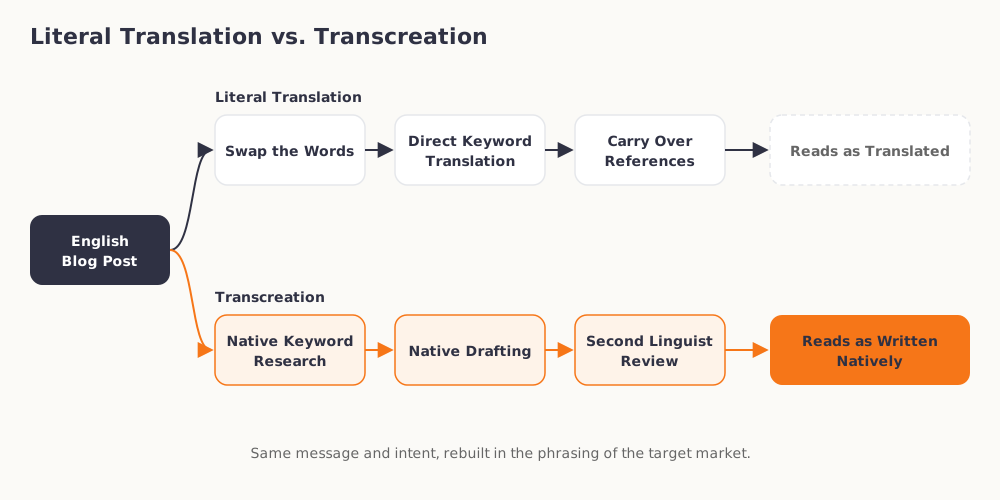
A literal translation keeps the source sentence structure and swaps the words.
It is fast, and it is the right choice for a small share of content: product specs, legal boilerplate, anything where precision matters more than persuasion.
Blog content is rarely that.
A headline built on an English pun, a stat framed for a US reader, a call to action that assumes US buying norms - none of that survives literal translation intact.
Transcreation rebuilds the argument in the target language: same message, same intent, native phrasing and references.
| Literal Translation | Localized Transcreation | |
|---|---|---|
| Goal | Preserve the exact source wording | Preserve the message and intent |
| Best for | Legal text, product specs, technical documentation | Blog posts, landing pages, campaigns, headlines |
| Keyword basis | Direct translation of the English keyword | Native-language keyword research in the target market |
| Cultural references | Carried over as-is, even when they do not land | Replaced with a reference the local reader recognizes |
| Typical outcome | Grammatically correct, reads as translated | Reads as though it was written natively for that market |
2. Local Keyword Research Before Drafting
The keyword a French reader types to find information about a topic is often not a direct translation of the English term.
Legal, financial, and technical vocabulary in particular is shaped by the local system, not by the English source: a French reader searching for information on sworn translation searches "traduction assermentée," a French legal term with no literal English equivalent.
A blog post translated without that research step reads correctly and ranks nowhere, because it was optimized for a query nobody in that market actually types.
Our multilingual SEO services run that keyword research in the target language before a single sentence is drafted. BeTranslated builds the localized post around what your audience actually searches, so it is built to rank in its own market rather than just exist in the right language.
Need blog content that ranks in every market, not just translates into it?
Our content marketing team pairs native writers with local keyword research and CMS delivery, so localized articles are built for search from the first draft.
Explore Our Content Marketing Services3. CMS and Automated Publishing Workflows
Where your content lives changes how translation gets delivered, and the answer is no longer just "WordPress."
For WordPress, BeTranslated works directly with WPML and Polylang translation management workflows.
We export your content into a format our translation software handles, then publish the localized version back into the plugin's language structure.
For headless setups, delivery runs through the CMS's own API rather than a plugin.
That means direct integration with Contentful and Strapi, plus REST or GraphQL delivery for a custom headless build. The same applies to HubSpot-hosted blogs and other marketing CMS platforms.
Whatever the platform, file format support covers MS Word and HTML for simpler exports, and .po/.pot, XLIFF, CSV, and JSON for structured CMS exports and more complex file formats your content team already works in.
In practice, a blog translation engagement runs the same four steps regardless of platform:
- Native keyword research. Target-language search terms are identified before drafting begins, so the brief is built around what your audience actually searches, not a translated version of your English brief.
- Native drafting or transcreation. A native-speaking writer builds the post from the brief, adapting tone, examples, and cultural references rather than translating the English post line by line.
- Second-linguist review. A second native reviewer checks the draft for accuracy, tone, and search-intent match before it leaves our hands.
- CMS delivery. The finished post is delivered in the format your platform needs - populated directly in WordPress, Contentful, or Strapi when access is provided, or handed off as a ready-to-import file.
4. Measuring ROI Across Markets
A localized content program earns its budget back the same way the English original did: organic traffic, keyword rankings, and conversions.
Track it per market rather than blended into one global number, since a strong result in one language can hide a weak one in another.
Increasingly, AI Overview and chatbot citations are worth tracking alongside classic rankings, for the same reason covered above.
An AI Overview answering a French query needs a real French source to cite, and a page built around native keyword research and original phrasing is the one that gets picked.
Ready to turn one blog into a multilingual content program?
Tell us which markets you are targeting and we will show you how translation, transcreation, and native SEO work together to get your content found.
Explore Our Content Marketing ServicesBlog content is only one piece of the picture.
BeTranslated also handles newsletter translation, e-commerce content, and full website translation into French, Spanish, German, and 50+ other languages.
That means your blog, your site, and your campaigns stay consistent across every market you operate in.
Request a quote for a structured blog translation and localization program, and we will help you prioritize which markets and which posts to start with.