Localization: What’s All the Fuss About?
Most businesses branching out into international markets realize that professional translation will be a part of the process. Fewer have considered the need for a professional localization service.

Localization: What’s All the Fuss About?
When businesses decide to expand into international markets, they quickly realize that professional translation will be important for success. This includes translating legal contracts, marketing campaigns, and company websites.
Many companies overlook the worth and value of professional localization services.
So what exactly is localization? And why is it important for your business?
Understanding Localization
While translation and localization share some similarities, many language service providers offer both services for good reason.
The Globalization and Localization Association (GALA) frames localization as adapting a product or content to a specific locale or market. The goal is to make target readers feel as though the content was created specifically for them.
Machine translation and AI tools can now produce a fast first draft, but they do not decide which names, colors, formats, or references suit a given market. That judgment still comes from people who know the locale.
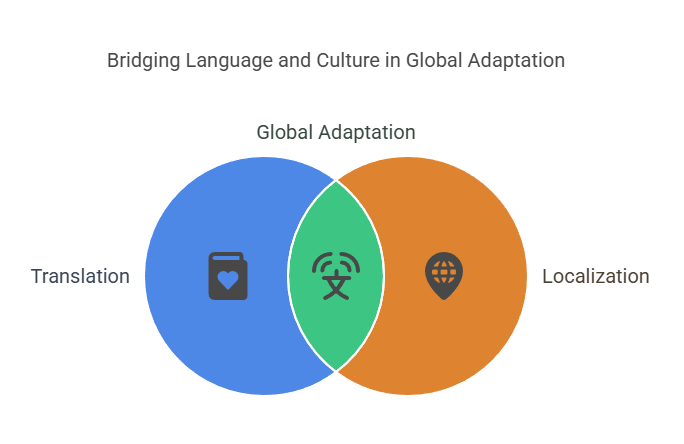
While translation focuses primarily on language, localization goes much further by considering graphics, layout, and cultural nuances.
Interestingly, localization is often necessary even when targeting countries or regions that share the same language, such as adapting content from the US market for British audiences.
Real-World Success Stories
Let’s examine some compelling examples of effective localization strategies.
Coca-Cola’s ‘Share a Coke’ campaign, which began in Australia in 2011, brilliantly demonstrated localization in action. The company printed popular names on its packs to create a more personal customer experience.
Rather than using generic names, it selected names that were popular in each specific market. In Ireland, for instance, 500ml bottles carried 150 of the most popular names in the country.
The campaign’s cultural sensitivity truly shone in China, where first names could not work at that scale. Coca-Cola launched there in 2013 with 60 nicknames, such as ‘Buddy’ and ‘Sweetie Pie’, instead of first names.
ASOS, the online fashion retailer, serves as an excellent example of eCommerce localization.
Their website shows the appropriate language, shopping experience, and currency for each visitor’s country. The payment methods on offer also vary by regional site, to match customer preferences across various countries.
This thoughtful approach has paid off: just over half of ASOS’s revenue now comes from outside the UK.
ASOS reported total revenue of £2,477.8m for the 52 weeks to 31 August 2025: UK £1,211.8m, EU £819.3m, US £257.7m, and Rest of World £189.0m. Source: ASOS plc, “Final results for the 52 weeks to 31 August 2025”, 2025
The Business Case for Localization
There are compelling reasons why investing in localization benefits your business:
- Customers are more likely to buy from companies whose content feels familiar and accessible to them.
- Clients who purchase your products or services will enjoy a smoother, more satisfying experience, leading to increased customer loyalty and repeat business.
- Working with localization experts helps you avoid costly mistakes that could damage both your profits and reputation.
- High-quality localization gives you a significant competitive advantage over companies that take shortcuts in this area.
The research points the same way.
76% of online shoppers prefer to buy products with information in their native language, and 40% will never buy from websites in other languages. Source: CSA Research, “Can’t Read, Won’t Buy (B2C)”, 2020 survey of 8,709 consumers in 29 countries
Common Pitfalls That Localization Prevents
Professional localization helps you avoid three critical mistakes:
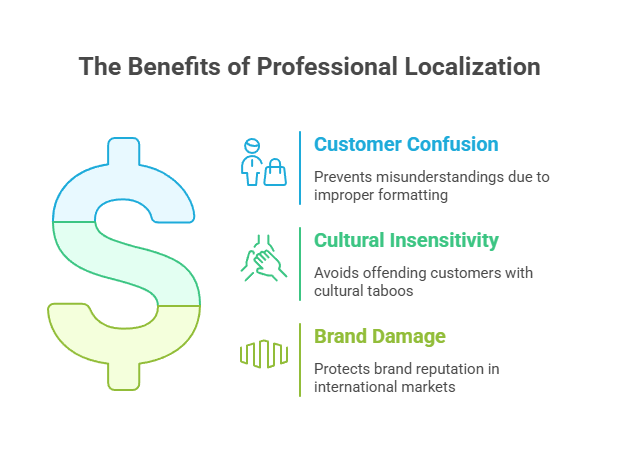
Customer Confusion
When content isn’t properly localized, especially regarding measurements, currencies, or formatting, customers become confused and frustrated.
Shoppers rarely tolerate friction. If they need to manually convert clothing sizes or currency amounts, they’ll often simply shop elsewhere.
Cultural Insensitivity
Without deep cultural knowledge, it’s surprisingly easy to accidentally offend potential customers.
Professional localization services identify potential cultural taboos in your content and suggest appropriate alternatives that preserve your original message while respecting local sensitivities.
Brand Damage
Your marketing campaigns or website could inadvertently alienate international customers, creating lasting negative impressions of your brand.
Elements that seem perfectly innocent to you might carry negative associations in other cultures.
For example, if you’re entering the Japanese market, you should avoid using the numbers 4 or 9 in your imagery, as these numbers are considered unlucky because they sound like the Japanese words for death and suffering.
Key Elements That Require Localization
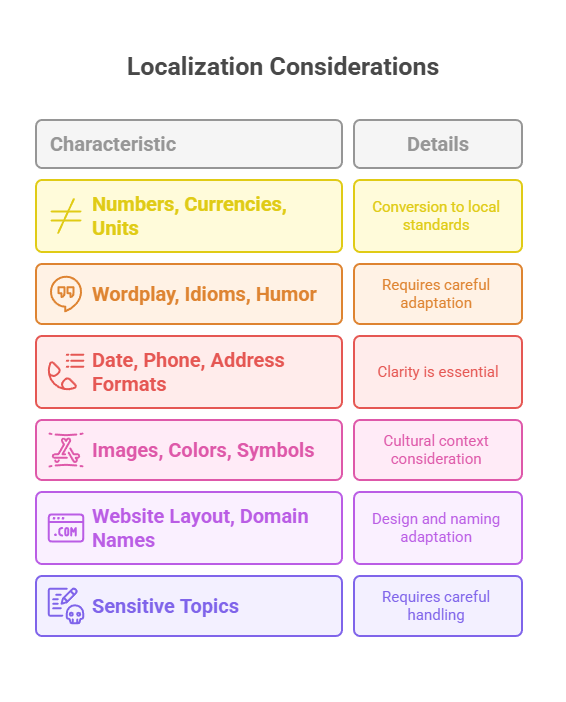
Several important elements typically need localization attention:
- Numbers, currencies, and measurement units
- Wordplay, idioms, and humor
- Date formats, phone numbers, and address structures
- Images, colors, and symbolic elements
- Website layouts and domain names
- References to potentially sensitive topics like alcohol and religion
Let’s explore some of these elements in greater detail.
Measurement Systems
Measurements appear in countless types of content, from instruction manuals to product packaging.
Consider a recipe that includes measurements for weight, volume, temperature, and cooking times.
Failing to convert these to local standards creates unnecessary friction and confusion for users.
No one wants to interrupt their cooking to search for conversion charts online!
Date Formatting
Incorrect date formatting can lead to serious misunderstandings.
Whether it’s scheduling an important business meeting, reading expiration dates, or processing payment deadlines on a banking app, absolute clarity is important.
Imagine a German supplier promising their American client delivery by 3/4.
The American client expects delivery on March 4th, while the German supplier means April 3rd.
This kind of misunderstanding can have serious business consequences!
It’s worth noting that a reputable language service provider will consider these details during translation, but it’s always wise to double-check.
Many businesses prefer written date formats (like “March 4”) to eliminate any potential confusion.
Visual Elements
Compelling visuals can significantly boost customer engagement, but attracting international customers requires careful consideration of cultural context.
Consider a travel website featuring a happy family giving thumbs up gestures.
While this gesture conveys positivity in many Western countries, it can read as rude or offensive in some other cultures.
Legal Requirements and Compliance
Sometimes localization becomes a legal necessity rather than just a business choice.
Experienced localization professionals stay informed about legal requirements, including censorship laws and content regulations, that could affect what your business can publish in different markets.
The gaming industry provides a clear example of this challenge.
In April 2019, China’s game regulator announced publication guidelines that ended new approvals for poker and mahjong titles, rejected games showing corpses or blood in any color, and stopped approving games inspired by imperial-court intrigue, including the “harem scheming” and “palace official competition” genres.
Analysts linked the rules to concerns about illegal gambling, obscene content, and political metaphors.
The regulatory environment has kept evolving, with a growing focus on protecting minors and curbing in-game spending.
In December 2023, China’s National Press and Publication Administration (NPPA) published draft Measures for the Administration of Online Games for public comment. The draft proposed spending caps for players of every age, pop-up warnings against irrational spending, and limits on reward systems that encourage overspending.
Separately, the Regulations on the Protection of Minors Online took effect on January 1, 2024, setting obligations for online platforms and stronger data privacy protections for children.
These build upon earlier anti-addiction measures, including the 2021 limit of one hour of play on Fridays, Saturdays, and Sundays for young gamers. Tencent and NetEase also use facial recognition to stop children playing on adult accounts, and both set specific gaming hour caps during the 2025 winter school break.
Tencent allowed children a maximum of 15 hours of play between January 13 and February 15, 2025, while NetEase set a limit of 16 hours from January 15 to February 14. Source: The Star, “China restricts children to 15 hours of gaming hours over school holidays”, January 14, 2025
Rules like these change often, so confirm the current text with a local specialist before you publish in a regulated market.
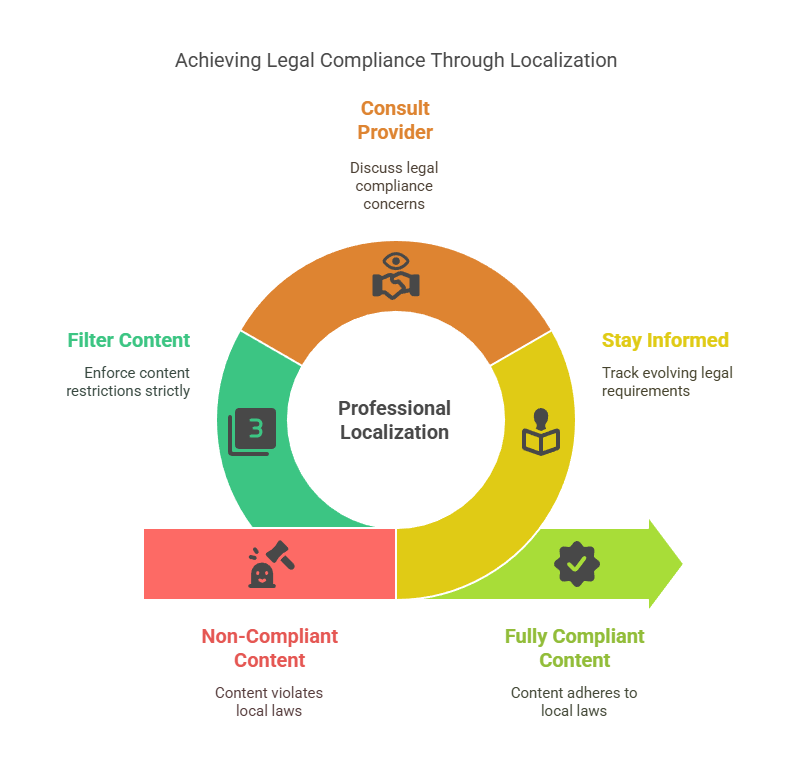
If you have concerns about legal compliance in your target markets, discuss them with your language service provider.
Now that you understand the role of localization, you might be ready to find a professional language service provider to help localize your content.
BeTranslated offers exactly what you need. With our team of skilled linguists and extensive industry experience, we provide reliable, trustworthy service.
Contact us today for more information or to receive a free, no-obligation quote.