58 Acronyms and Common Translation Industry Terms That May Puzzle You
58 acronyms and terms that come up constantly in translation and interpreting projects, from TEP and fuzzy matches to XLIFF, RSI and ISO 17100, explained without the jargon.
58 Acronyms and Common Translation Industry Terms That May Puzzle You
You would probably think that the translation world is the best place for simple and effective communication, with no slang and no abbreviations.
In practice the industry runs on abbreviations, and a quote or a project brief can be close to unreadable if you do not know them.
Here are 58 of the acronyms and terms that come up most in translation and interpreting projects, grouped by where you will meet them: the project itself, the price, the technology, the files, localization, interpreting, and the standards behind it all.
Project and Quality Basics
Document
In the translation world, the document is the foundation for everything. It is not necessarily an official document, but whatever is being translated, in any format: Word, Excel, PDF, plain text, audio, video, subtitles or web pages.
The document is analyzed first, before deciding how to tackle the translation and what it will cost.
Source Language and Target Language (SL and TL)
Sometimes the terms that look the most obvious are the ones nobody explains. The source language is the language of the original text, and the target language is the language of the translation.
For a translation from French to English, the source language is French and the target language is English. You will often see the two shortened to SL and TL.
DNT
DNT simply means "Do not translate". It marks words or expressions the client wants kept in the source language, such as business names, trademarks or product names.
A good DNT list is short, specific and agreed before the project starts, so nobody has to guess.
Glossary
A glossary is a bilingual list of the terms that matter in a client's field, with the approved translation of each. Important terms are then translated the same way no matter which translator works on the text.
Building one takes a little effort, but it quickly becomes the most valuable asset in a long-running account.
Style Guide
A style guide sets the rules a translation has to follow for a particular client or publication: tone, grammar, punctuation, spelling and number formats.
Before starting any translation, it is always worth asking whether one exists. It saves time and prevents a round of corrections later.
PM
The project manager (PM) assigns and manages the translation projects for a client and the translation company. The PM chooses the most suitable translators, keeps the client informed, and makes sure the work is delivered on time and to standard.
LSP
LSP stands for language service provider: a company that supplies translation, interpreting and related language services. A translation agency is an LSP, and so is a firm that only does interpreting or subtitling.
You will see the term in procurement documents and tenders, where buyers compare LSPs rather than individual translators.
TEP
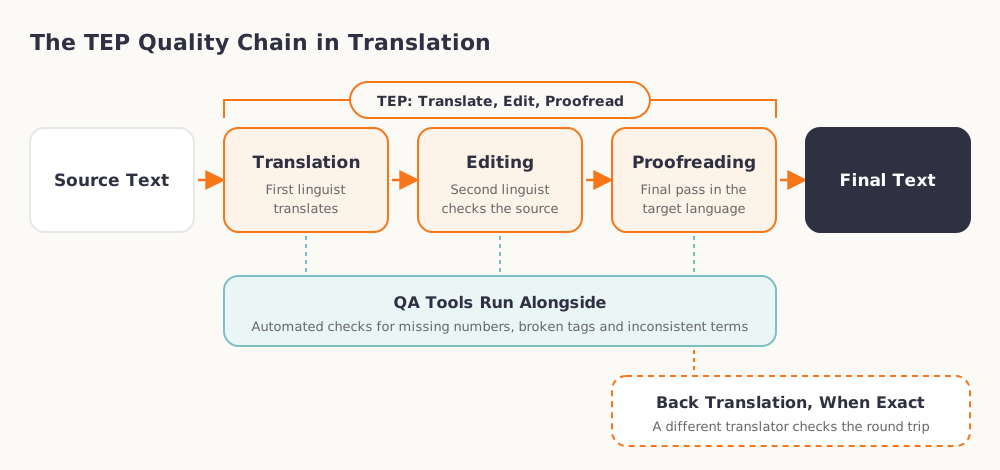
TEP stands for translation, editing, proofreading, the three steps behind a quality translation. A first linguist translates, a second edits the translation against the source, and a final proofread catches what is left.
These steps are the standard way a translation company works. If one is skipped, the result rarely meets the required standard.
QA
QA means quality assurance. In translation it covers the checks that run alongside the human steps: automated scans for missing numbers, broken tags, inconsistent terminology and untranslated segments.
QA tools catch mechanical errors quickly. They do not judge meaning, which is still the editor's job.
Proofreading
Proofreading is the final pass through the almost finished text in the target language. It checks spelling, grammar, punctuation, terminology, register and style, and sometimes adjusts the layout to fit the available space.
The aim is to read the translation with a fresh pair of eyes, so the final piece of work is of the highest quality.
Back Translation
Back translation means translating the finished target text back into the source language, as a quality check. Comparing the round trip with the original surfaces inaccuracies that reading the target text alone would miss.
It is always done by a different translator, and it is reserved for texts that must be exact, such as clinical, legal or technical documents.
NDA
An NDA, or non-disclosure agreement, is the contract that binds translators and agencies to keep a client's documents confidential.
Contracts, patents, financial results and medical records are all routinely translated under an NDA signed before the files are shared.
SLA
An SLA, or service level agreement, sets out what a client can expect from a language service provider: turnaround times, quality thresholds, availability and how problems are handled.
It is common in ongoing contracts, where the same type of content arrives every week.
Pricing Terms
Price per Word (PPW)
The price per word, or PPW, is the most common basis for pricing a translation. A quote should state whether it is counted on the source text or the target text.
The rate varies with the language pair, the subject and the size of the job. Very short texts are often charged a minimum fee instead.
New Words
New words are the words, phrases or segments a translation tool has not seen before, because nothing similar is stored in the translation memory.
Most of a project is usually new words, and they are what the price is mainly calculated on.
Repetitions
Repetitions are segments that appear more than once in the same text. Once translated, they do not need translating again, so they are usually charged at a lower rate.
The translator still checks each repeated segment in context, because the same sentence can need a different translation in a different place.
Fuzzy Matching
Fuzzy matches, or "fuzzies", are segments that partially match something already stored in the translation memory. Any segment with a match of 70% to 99% is generally considered a fuzzy match.
The tool shows the translator the earlier translation to adapt, which speeds up the work and can reduce the fee.
Translation Technology
CAT Tools
CAT stands for computer-assisted translation, nothing to do with your pet cat. CAT tools split the source text into segments and show the translator earlier translations of similar segments alongside each one.
That is where the speed comes from, and it is also what keeps terminology consistent across a long document.
Do not confuse CAT tools with machine translation. A CAT tool is a workbench for a human translator; machine translation writes a draft.
TM (Translation Memory)
The translation memory (TM) is the database where translated segments are stored, so they can be reused. It is a bilingual record of everything translated for a client.
The TM keeps repeated content consistent and is what the fuzzy matches and repetitions in a quote are calculated against.
TMS
A TMS, or translation management system, handles the workflow around the translation: receiving files, assigning linguists, tracking deadlines and returning finished work.
Many TMS platforms include a CAT tool, a translation memory and a terminology database in one place.
MT (Machine Translation)
Machine translation, usually written MT, produces a draft translation without a human translator. It is not the same as a CAT tool, which organizes a human translator's work.
Early MT worked phrase by phrase and mangled anything idiomatic. Modern systems handle idiom and register far better, but they still miss the context nobody wrote down, which is why MT output goes to a professional translator before publication.
NMT
NMT stands for neural machine translation, the approach behind most current MT engines. Instead of translating phrase by phrase, a neural network reads the whole sentence before producing a translation.
The result is far more fluent than older systems. Fluency is also the risk: an NMT error reads as smoothly as a correct sentence.
LLM
An LLM, or large language model, is the kind of AI model behind chat assistants, now also used to translate and rewrite text.
LLMs can follow instructions about tone and terminology, but they can also add, drop or invent content. Their output needs the same human review as any other machine translation.
Post-editing (MTPE)
Post-editing is the review and correction of a machine translation by a human translator. You will most often see it as MTPE, machine translation post-editing, which is now a standard line item on quotes.
Light post-editing fixes what is wrong and leaves the rest; full post-editing brings the text to the standard of a human translation. They are priced differently, so it is worth checking which one a quote covers.
Pre-editing
Pre-editing is preparing a source text before a machine translates it, so that less correction is needed afterwards. Ambiguous sentences are rewritten, terminology is standardized, and the format is checked.
An hour of pre-editing usually saves more than an hour of post-editing.
HITL
HITL stands for human in the loop: a workflow where AI produces a draft and a qualified person reviews, corrects and approves it before it is used.
In translation, it is the difference between publishing machine output as it is and publishing something a professional has signed off.
OCR
OCR, or optical character recognition, turns a scanned page or a photo of text into editable text that a translation tool can work with.
Scanned contracts and certificates usually need OCR first, and the result has to be checked, because OCR misreads stamps, handwriting and low-quality scans.
File Formats
XLIFF
XLIFF (XML Localization Interchange File Format) is the standard file format for moving translatable text between tools. A website or app exports its text as XLIFF translation files, the translator works on it in a CAT tool, and the translated file is imported back.
It keeps the text separate from the code, so nothing breaks on the way back in.
TMX
TMX (Translation Memory eXchange) is the format for moving a translation memory from one tool or provider to another.
If you change agencies, ask for your TM as a TMX file. It is your translation history, and it should go with you.
TBX
TBX (TermBase eXchange) does for terminology what TMX does for translation memories: it moves a glossary or termbase between tools without losing its structure.
IDML and INDD
INDD is Adobe InDesign's native file format, and IDML (InDesign Markup Language) is the exchange version that CAT tools can open. Sending InDesign IDML files lets the translation go straight back into the original layout.
DITA
DITA (Darwin Information Typing Architecture) is an XML standard for writing technical documentation in reusable topics. Manuals written in DITA translate efficiently, because each topic is translated once and reused wherever it appears.
SRT and VTT
SRT (SubRip Text) and VTT (WebVTT) are the two most common subtitle formats: plain text files that pair each line of dialogue with its start and end time.
Translating SRT subtitle files means respecting reading speed and line length, not just the words.
Localization and Multilingual Content
Localization
Localization goes further than translation. Translation converts a text from one language to another; localization adapts the whole product to a specific market, including its culture, formats, colors, images and layout.
An advert translated into Spanish for US audiences, for example, may still need different words, references and imagery for viewers in Mexico, Spain or Argentina.
Transcreation
Where localization adapts content, transcreation recreates it for the target market, keeping the intent rather than the words. It is used for slogans, taglines, campaigns and anything that relies on wordplay or emotion.
For the full comparison, see localization versus transcreation.
DTP
DTP stands for desktop publishing: using software such as Adobe InDesign, FrameMaker or Microsoft Publisher to lay out text and images.
Multilingual DTP services rebuild brochures, manuals and packaging after translation, because the translated text is rarely the same length as the original.
RTL
RTL means right-to-left. Arabic, Hebrew, Farsi and Urdu are written right to left, so a translated layout has to be mirrored: text alignment, columns, icons and even the order of images.
A layout built only for left-to-right languages often breaks when RTL text goes into it.
CJK
CJK groups Chinese, Japanese and Korean, which share demands that alphabetic languages do not: large character sets, specific fonts and text without spaces between words.
They are usually counted by characters rather than words, which changes how a quote is calculated.
Transcription
Transcription converts speech from an audio or video file into written text. That text may then be translated, subtitled or used for a voice-over.
Professional transcription services are often the first step of a video translation project.
SDH
SDH stands for subtitles for the deaf and hard of hearing. Besides the dialogue, they describe the sounds that matter, such as music, laughter or a door slamming, and identify who is speaking.
They are a requirement on many broadcast and streaming platforms, alongside standard subtitling and captioning services.
CMS and WPML
A CMS, or content management system, is the platform a website runs on, such as WordPress. WPML (WordPress Multilingual) is the most widely used plugin for running a WordPress site in several languages.
Working inside the CMS lets translated pages go live without copying text back and forth. BeTranslated is a WPML translation partner.
SEO
SEO, search engine optimization, is the work of making a page rank in search results. In translation, it means researching what people actually search for in each language rather than translating the original keywords.
A literal keyword translation is often a term nobody searches for, which is why multilingual SEO services start with local keyword research.
GEO
GEO, generative engine optimization, is the newer cousin of SEO: structuring content so AI assistants and AI search features can understand, cite and summarize it accurately.
It matters in every language, because an assistant summarizes the version of your page written for each market.
Interpreting
RSI
RSI stands for remote simultaneous interpreting: interpreters work from a remote hub or their own studio while participants listen through a meeting platform. Remote simultaneous interpreting is now standard for hybrid conferences and online events.
OPI
OPI means over-the-phone interpreting. An interpreter joins a phone call, usually consecutively, so two people without a shared language can speak.
Over-the-phone interpreting is used for urgent calls in healthcare, public services and customer support.
VRI
VRI stands for video remote interpreting, where the interpreter joins by video instead of by phone. Seeing the speakers helps with tone, and sign language interpreting cannot work without it.
Video remote interpreting is common in hospitals, courts and client meetings.
AIIC
AIIC is the International Association of Conference Interpreters, the professional body for conference interpreting. Its standards cover working conditions, team sizes and booth requirements.
"AIIC-level" on an event brief means the client expects interpreters of that standard for simultaneous interpreting.
Standards, Certification and Compliance
ISO 17100
ISO 17100 is the international standard for translation services. It sets requirements for translator qualifications, the translation process and revision by a second linguist.
When you see "ISO 17100-aligned", it means the workflow follows those requirements, including a separate revision step on every job.
ISO 18587
ISO 18587 is the standard for post-editing machine translation output. It defines what full post-editing must deliver and the competences a post-editor needs.
ISO 18841
ISO 18841 sets general requirements for interpreting services: interpreter qualifications, preparation, and the responsibilities of the provider and the client.
ISO 4043
ISO 4043 specifies mobile booths for simultaneous interpreting: size, sound insulation, ventilation and visibility. When an event venue has no built-in booths, this is the standard the hired ones should meet.
ATA
The ATA, or American Translators Association, is the largest professional association of translators and interpreters in the United States. It also runs a certification exam for specific language pairs.
NAATI
NAATI, the National Accreditation Authority for Translators and Interpreters, certifies translators and interpreters in Australia. Many Australian authorities only accept translations by NAATI-certified translators.
CIOL
CIOL, the Chartered Institute of Linguists, is a UK professional body for linguists. Its Diploma in Translation is a widely recognized professional qualification.
NRPSI
The NRPSI, or National Register of Public Service Interpreters, is the UK register of qualified interpreters for courts, police, health and other public services.
USCIS
USCIS (U.S. Citizenship and Immigration Services) requires every foreign-language document submitted with an application to come with a full English translation and a translator's certification of accuracy.
Those USCIS certified translations are some of the most common certified translation services requested in the United States.
GDPR
GDPR, the EU's General Data Protection Regulation, governs how personal data is handled. Translation projects are full of it: names, addresses, medical histories and employee records.
Under GDPR, a translation provider has to handle that data securely, limit who sees it and delete it when the job is done.
IFU and MDR
IFU means instructions for use, the documentation that comes with a medical device. The EU Medical Device Regulation, or MDR (Regulation (EU) 2017/745), requires device information to be provided in the official language or languages set by each member state where the device is sold.
That makes medical device translation a regulatory requirement, not an optional extra.
We hope this guide has helped you make sense of the vocabulary of the translation world. Is there another term you are still struggling with? Let us know!
Looking for quality translation services? Contact us for more information, or request a free, no-obligation quote today.