4 Reasons to Hire a Translation Agency in 2026
Top four reasons to hire a translation agency - take the next step in globalizing your business today!


Why Hire a Translation Agency in 2026?
With instant AI tools like DeepL, Google Translate, and ChatGPT now deeply embedded in everyday business operations, you might expect the professional translation industry to be shrinking. It is actually expanding.
The global language services market was valued at roughly USD 30.85 billion in 2025 and is projected to reach USD 36.10 billion by 2031, growing at a 2.65% CAGR.
Source: Slator, 2026 Slator Market Report: Language Solutions & AI
Why is demand for human expertise still accelerating in 2026? Across our multilingual projects in Spain, Belgium, France, the Netherlands, and North America, the pattern is clear: businesses that rely solely on raw machine output inevitably return to professional agencies after a costly mishap. They come back after a rejected sworn translation, a marketing campaign that flopped culturally, or a contract clause that carried unintended legal liabilities in a foreign jurisdiction.
AI is now a standard, non-negotiable part of agency workflows. The issue is not whether to use AI, but whether your team has the linguistic and subject-matter expertise to know when to trust it, when to override it, and when to scrap it entirely.
Here are four reasons why choosing to hire a professional language service provider remains a critical business strategy in 2026.
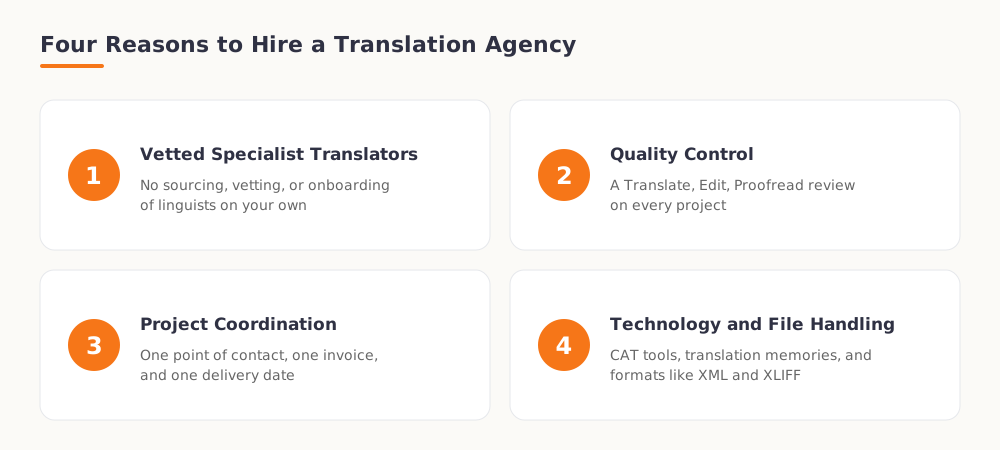
1. Access to Vetted, Specialist Translators Without the Hiring Headache
Every reputable professional translation agency maintains a curated roster of specialist linguists. These are not bilingual generalists; they are professionals with verified domain expertise in legal, technical, medical, marketing, and audiovisual fields.
Sourcing, vetting, testing, and onboarding these experts internally takes months and drains internal resources. A specialized agency eliminates that burden.
For example, a sworn translator certified in Spain cannot automatically step in for a sworn translation required by a Belgian notary, even if the language pair is identical. Jurisdictional nuances matter. When you partner with an agency, you draw on years of established relationships with in-country professionals who stay ahead of regulatory and linguistic shifts.
Need on-site interpreting in multiple cities on short notice? A single call to your project manager handles the logistics.
2. Quality Control That a Single Freelancer Cannot Replicate
Fluency in two languages does not qualify someone to translate complex commercial content. Specialized translation requires deep subject-matter knowledge, years of craft, and a rigorous, systematic review process.
Professional agencies mandate a Translate-Edit-Proofread (TEP) workflow for every project. A second qualified linguist reviews the initial draft, a project manager enforces consistency against a tailored glossary, and the final file is verified against the source before delivery.
ISO 17100:2015 mandates a Translate-Edit-Proofread (TEP) cycle for professional translation services.
Source: ISO 17100 Official Standard
The stakes are simply too high for anything less. In legal translation, a single misplaced term can void a contract or delay court proceedings. In marketing translation, a culturally tone-deaf idiom does more than just fail to generate Instagram likes, it can permanently damage a brand’s reputation in a new market. In audiovisual localization, a half-second lip-sync error shatters the viewer’s immersion.
Agencies exist to prevent these failures. The hidden costs of cheap translation compound rapidly when professional quality control is absent from the workflow.
3. Project Coordination You Should Not Be Doing Yourself
Consider the logistics of managing five freelance translators across three time zones, each with different availability, currency preferences, and invoicing terms, all while racing toward a product launch deadline. This is a common scenario that drives clients to seek agency support.
An agency absorbs that administrative friction. A dedicated project manager tracks version history, confirms turnaround times, reconciles terminology across all languages, and flags scope changes before they trigger budget overruns. You get one point of contact, one consolidated invoice, and one guaranteed delivery date.
For any business translation project spanning multiple languages, the administrative overhead of the DIY approach usually wipes out any perceived cost savings. For a deeper dive, our guide on hiring a translator the right way outlines how to brief and manage complex multilingual rollouts.
4. Advanced Technology and File Handling You May Not Have In-House
Modern translation projects rarely arrive as clean, ready-to-use Word documents. They come as XML exports from a headless CMS, XLIFF packages from a WordPress WPML workflow, complex InDesign files requiring multilingual desktop publishing, or frame-accurate subtitle tracks.
Agencies use Computer-Assisted Translation (CAT) tools and secure translation memories that store approved terminology, ensuring long-term consistency while driving down costs on repeat projects. Crucially, they also know exactly how to implement AI post-editing without compromising quality.
In SEO translation, this technical capability is paired with cultural intelligence. Ranking in a new market requires understanding regional search intent, not just swapping words. A single tag error in a localized web file can break a page layout or corrupt an app build. Professional agencies carry that technical accountability so your development team does not have to.
Work With a Translation Agency Built for Global Markets
When you decide to hire a translation agency, the partner you choose dictates the success of your global expansion.
We are a boutique multilingual agency with offices in Valencia, Brussels, Paris, Amsterdam, and North America. Our project managers understand the regulatory, cultural, and linguistic specifics of the regions we serve. We provide complete document translation, sworn translation, interpreting services, audiovisual localization including dubbing, multilingual SEO, and more, across dozens of language pairs and specialized industries.
Ready to find the right solution for your project? Request a free, no-obligation quote from BeTranslated, or reach out directly to speak with a project manager today.
Frequently Asked Questions About Hiring a Translation Agency
What is the difference between hiring a freelance translator and a translation agency?
A freelance translator handles the linguistic work in isolation. A translation agency provides a full-service workflow: specialist linguist selection, multi-step quality review, project coordination, terminology management, and multi-format file handling. For multi-language projects, tight deadlines, or regulated content, an agency’s structured process significantly reduces operational risk.
Can AI tools like DeepL or ChatGPT replace a translation agency?
No. While AI tools are integrated into modern agency workflows for speed and drafting, raw AI output is frequently fluent but factually or culturally wrong. It struggles with legal terms carrying jurisdiction-specific weight, marketing copy that requires cultural transcreation, and technical instructions where inverted logic can create safety hazards. Knowing when to trust AI and when to override it is the core value an agency provides in 2026.
How do translation agencies handle confidential documents?
Reputable agencies mandate strict data security protocols. This includes non-disclosure agreements for all linguists, encrypted file transfer systems, and role-based access controls ensuring only assigned personnel view sensitive content.
Agencies adhere to ISO/IEC 27001 standards for information security management, covering NDAs, access controls, and secure data transfer.
For highly regulated sectors like healthcare or finance, always request details on their specific data processing protocols before sharing files.
What types of content does a translation agency typically handle?
Agencies manage a broad spectrum of content: contracts and legal briefs; product pages and marketing collateral; software UI and technical manuals; voiceovers, subtitles, and dubbing scripts; as well as multilingual SEO content tailored for regional search engines.
How much does it cost to hire a translation agency?
Pricing depends on the language pair, subject matter complexity, volume, and turnaround time. We provide transparent translation rates and offer a free, detailed quote. Ultimately, investing in professional translation is significantly cheaper than correcting operational errors, reprinting materials, or repairing brand reputation after a localization failure.